8.05e–8.05g - Chords and tangents
How can the centre of a circular design help you split a chord exactly or predict the angle where a straight line touches it? In 8.05e you will prove the chord-bisector relationship, in 8.05f connect a tangent to its radius, and in 8.05g link a tangent–chord angle to an angle across the circle.
Bisecting a chord
A straight cut long crosses a circular disc of radius . How far is the cut from the centre? Drawing the perpendicular from the centre splits the cut into two equal lengths and makes a right-angled triangle.
Perpendicular bisector
The perpendicular bisector of a segment passes through its midpoint at . For a chord that is not a diameter, let be where a line through centre meets the chord. Then if and only if .
“If and only if” means both directions need reasons. The diagram shows the two triangles to compare.
[DIAGRAM: asset_name: A chord and its perpendicular bisector; asset_slug: chord-bisector-proof; caption: Equal radii make the two triangles congruent in either direction.; description: A circle with centre O above a horizontal non-diameter chord AB and midpoint M. Radii OA and OB and segment OM are drawn. AM and MB have matching ticks and a right-angle square marks the perpendicular at M. A second panel shows radius 10 cm, half-chord 6 cm and perpendicular distance 8 cm.]
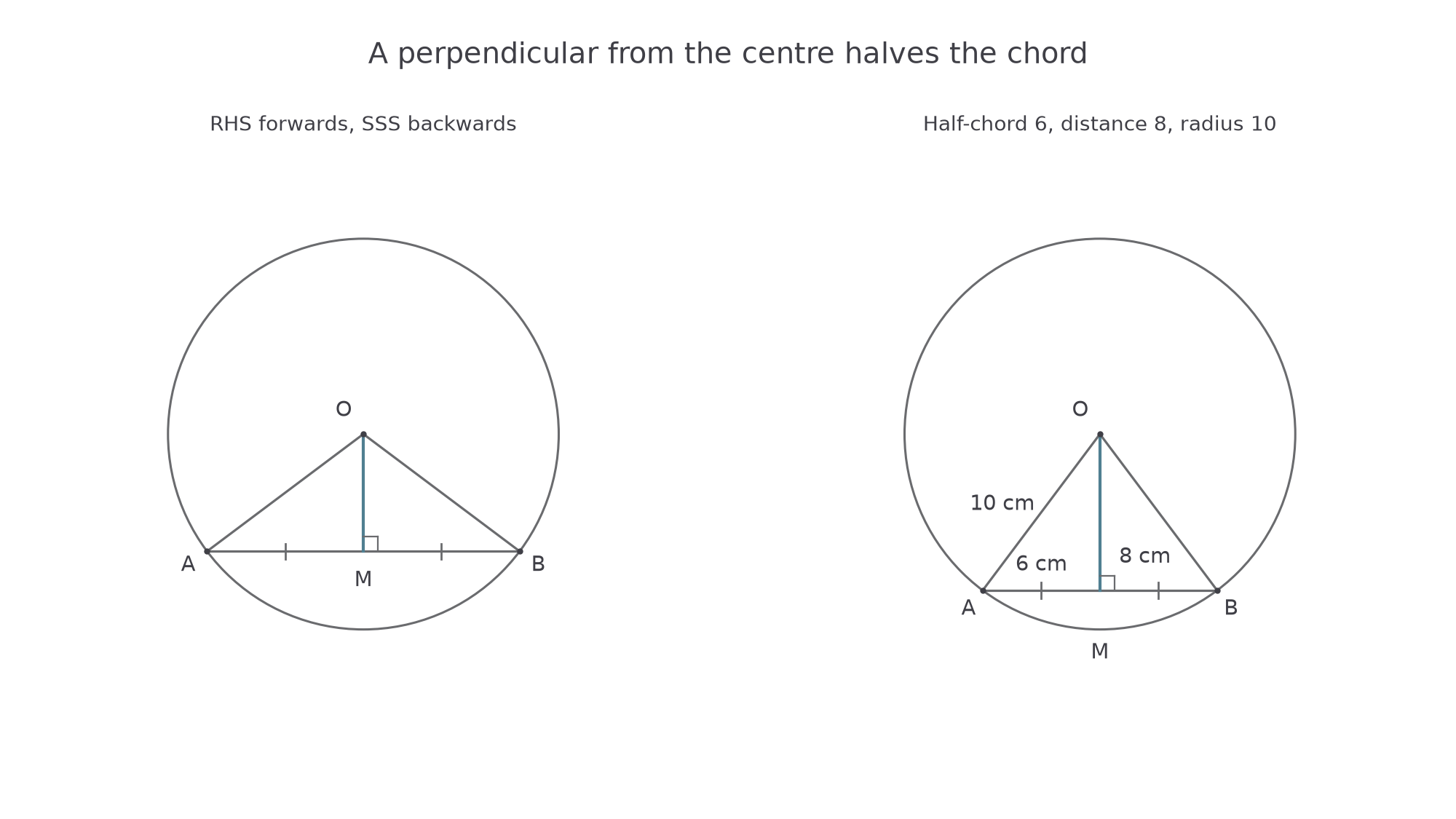
Perpendicular implies bisected. If , triangles and are right-angled, have equal hypotenuses and share side . They are congruent by RHS, so .
Bisected implies perpendicular. If , then , is shared and . The triangles are congruent by SSS. Thus ; they lie on a straight line, so each is .
The non-diameter condition avoids a collapsed triangle. If is itself a diameter, its midpoint is . Every line through then passes through its midpoint, so passage through the midpoint alone does not force a right angle. Its perpendicular bisector is still the particular line through perpendicular to .
Worked example 1: distance from the centre
Question. A circle has radius and chord has length . Find the perpendicular distance from the centre to the chord.
Plan. Halve the chord, then use Pythagoras with a radius as hypotenuse.
Answer. .
Check. . Two halves restore the full chord.
Change only the chord length. A longer chord of the same circle sits closer to the centre.
Worked example 2: a longer chord
Question. The radius is still , but the chord is long. Find its perpendicular distance from the centre.
Plan. Use half the new chord in the same right-angled triangle.
Answer. .
Check. . The distance has fallen from to , consistent with the longer cut approaching a diameter.
Pythagoras is on the 2027 formula sheet; the chord-bisector theorem is not. The key decision is to halve the chord before substituting.
The radius and tangent
A tangent has one point in common with a circle, and the radius to that contact point meets it at a right angle.
Tangent
A tangent to a circle is a straight line meeting its circumference at exactly one point. If that point is and the centre is , then is perpendicular to the tangent at .
Why must it be perpendicular? Drop a perpendicular from to the tangent line at . Suppose . Reflect in to get a second point on the line. If , reflection in gives directly. Otherwise the two right-angled triangles and have the same two perpendicular side lengths, so again . Thus is also on the circle, contradicting the single contact point. Therefore .
[DIAGRAM: asset_name: Why a tangent must be perpendicular to the radius; asset_slug: radius-tangent-proof; caption: A non-perpendicular line through P would also contain another circle point P prime.; description: Left panel shows a true tangent at P with radius OP and right-angle square. Right panel shows a crossing line with perpendicular foot H, distinct equal-distance intersections P and P prime, and the two radii. The crossing line is explicitly labelled not a tangent.]
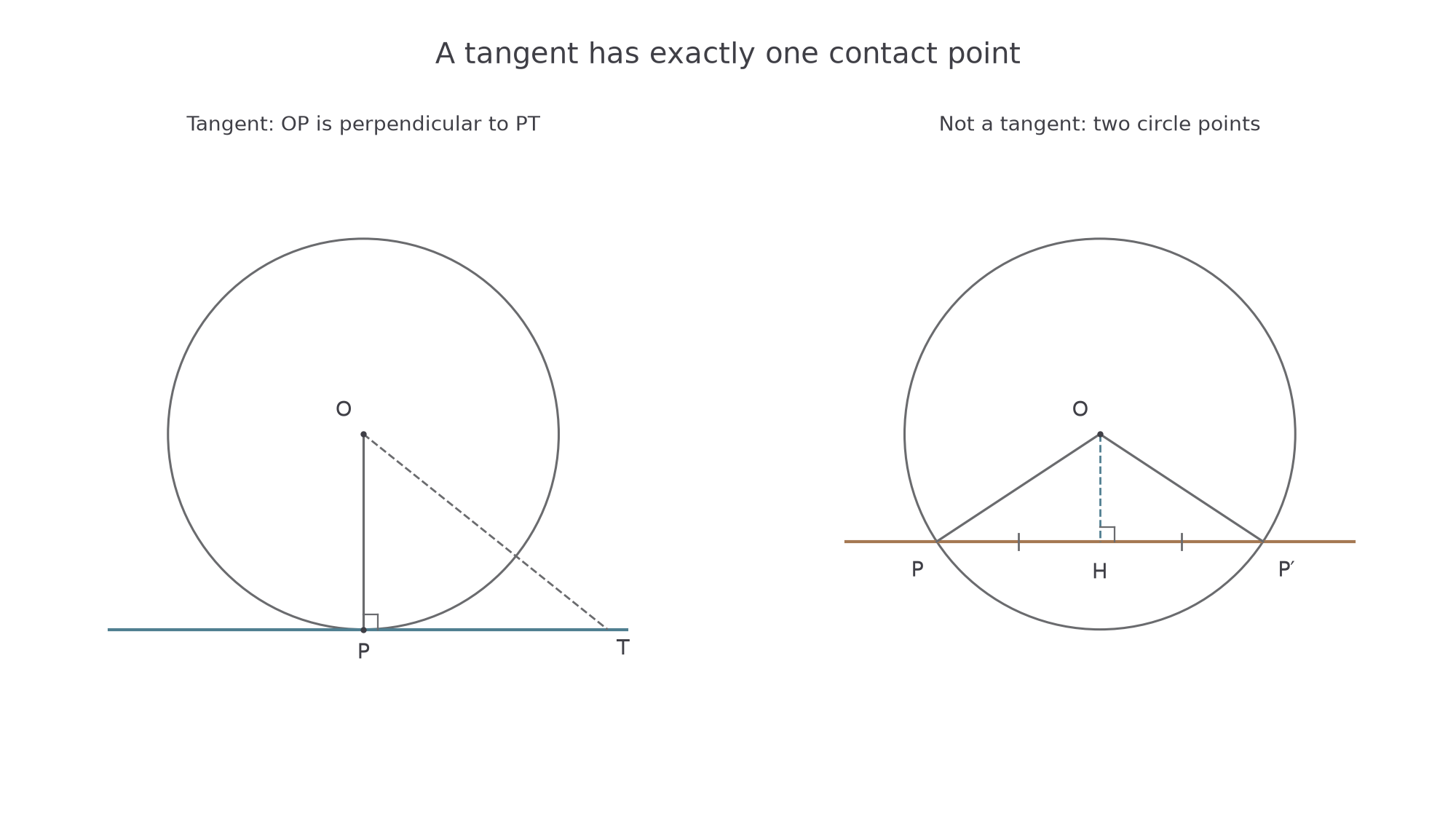
Conversely, if a line through is perpendicular to radius , every other point on it satisfies . Every such is outside the circle, so the line is a tangent. These arguments use distance and Pythagoras, rather than assuming the tangent theorem to prove itself.
Continue this lesson.
You’re previewing NovaLearn without an account. Create a free account to read the rest.
Create free account