6.02d, 10.03a - Triangle area using sine
Find a triangle's area without being given its perpendicular height. Derive the 6.02d formula from base and height, then apply 10.03a to included angles, missing lengths and angles, and problems that first need a sine or cosine rule.
Area from a perpendicular height
Two triangular panels each have sides and . In one panel these sides meet at ; in the other they meet at . Can the two panels have the same area even though they have different shapes?
Area depends on a perpendicular height, not on a sloping side. If the side is the base, the first panel's height is . Its area is therefore . The sine turns a sloping side into the height we need.
Perpendicular height
The perpendicular height of a triangle is the perpendicular distance from a vertex to the line containing the opposite side. Its foot can lie on the side or on an extension of that side.
Use the standard labels: , , . The included angle between and is . Taking as the base, the height from is .
[DIAGRAM: asset_name: Sine supplies the perpendicular height; asset_slug: area-sine-height; caption: The height is b sin C whether the included angle is acute or obtuse.; description: Two accurate triangles have base BC horizontal, of length a, and AC of length b. The first has acute angle C and the perpendicular foot D on BC. The second has obtuse C and D on the extension beyond C. Both show height AD equal to b sin C, right-angle markers and the angle at C.]
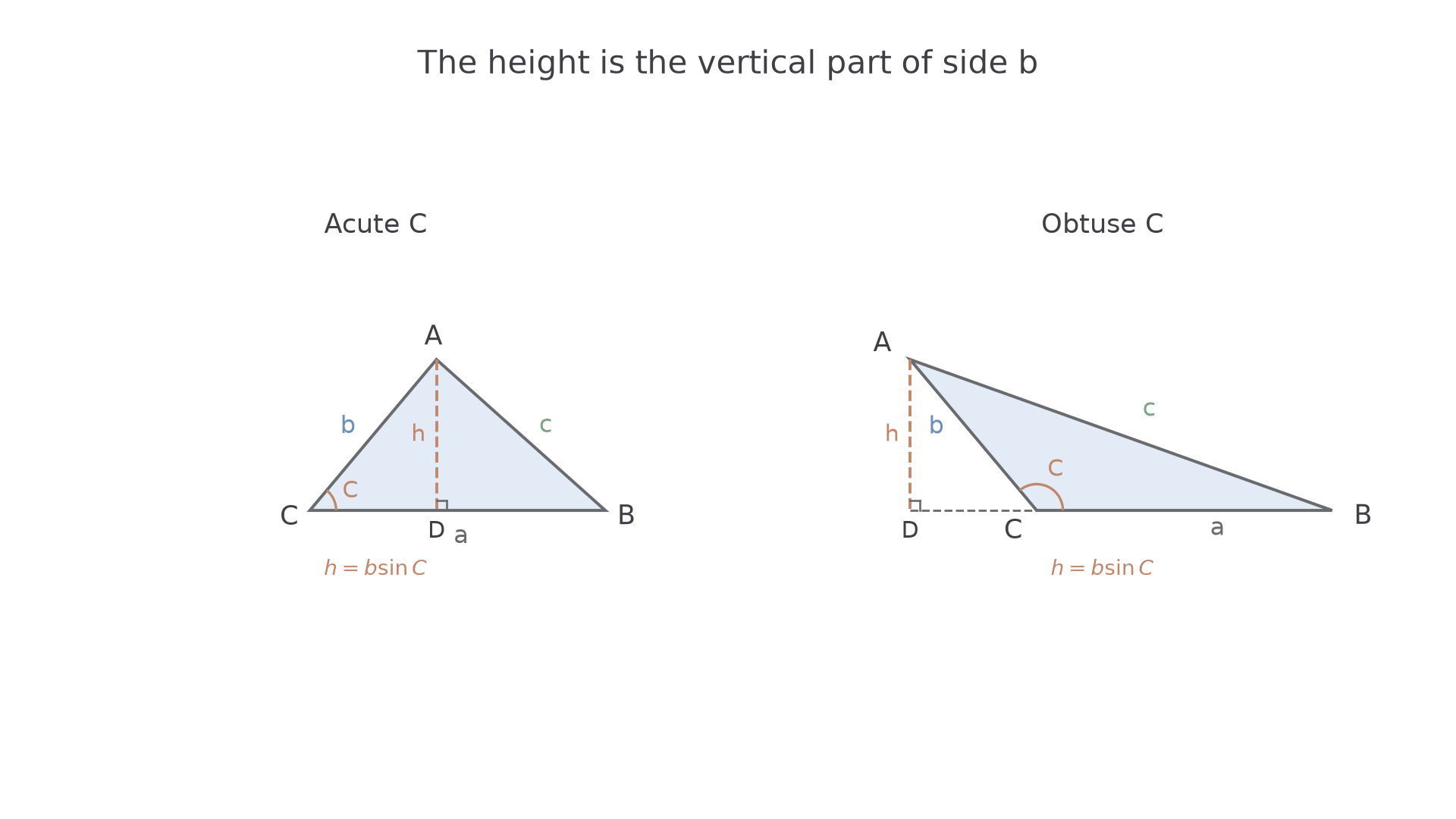
For an obtuse , the small right-triangle angle is . Its sine equals , so the same expression gives the positive height.
We use for area here so that can continue to mean angle .
Triangle area using sine
The angle must be between the two chosen sides and . Equally, . Use the same length unit for both sides, giving the corresponding square unit for area.
In the June and November 2027 Higher Tier Formulae Sheet.
Check the height explicitly in the first panel.
Worked example 1: an acute angle gives a height
Question. Sides and meet at . Find the triangle's area.
Plan. Find the perpendicular height, then use half base times height.
Answer. .
Check. The triangle is half of a parallelogram of base and height . That parallelogram has area , so half is .
Change only the included angle to its supplement, . The height's foot moves outside the base, but the perpendicular height stays the same.
Worked example 2: an obtuse angle gives the same height
Question. Sides and meet at . Find the triangle's area.
Plan. Use the acute angle in the right triangle outside the base, or use .
Answer. .
Check. The vertex is still above the base line. Sliding a vertex along a line parallel to a fixed base leaves the perpendicular height and area unchanged.
So the two opening panels really can have equal areas despite their different shapes. The sine of supplementary angles explains the connection.
Watch out
The sloping side is not the height. The calculation would require those two sides to be perpendicular.
Use the right-angle case to connect the formula to a familiar area.
Using the included angle
Choose two sides and the angle where they meet before calculating area.
For example, and meet at , so their area formula is . Using angle with those same sides would be a mismatch. You can rotate the drawing without changing this relationship.
The angle must be known or found first. If it is an interior angle of a triangle, use a value between and ; the sine is positive throughout that interval.
Worked example 3: a small included angle
Question. , and . Calculate the area to significant figures.
Plan. The two known sides meet at , so use .
Answer. .
Check. The height above is , giving half of , about . This is below the maximum possible area .
Keep the same sides and change only their included angle to . Opening towards a right angle increases the height.
Worked example 4: a larger included angle
Question. , and . Calculate the area to significant figures.
Plan. Use the same two sides and update their included angle.
Answer. .
Check. is close to , so the height is close to and the area is close to, but below, .
Sometimes a needed side or included angle is missing. The next two examples have the same goal, area, but change the type of information supplied. Use the cosine rule for three sides, or the sine rule for an opposite pair, before applying the area formula.
Worked example 5: find the included angle first
Question. A triangle has , and . Calculate its area to significant figures.
Plan. Find angle , between and , using cosine. Then use those same sides with .
Answer. .
Check. Put the side on a horizontal base. The other known side has horizontal component . Pythagoras gives height , and half base times this height is again .
Continue this lesson.
You’re previewing NovaLearn without an account. Create a free account to read the rest.
Create free account