2.01c, 3.03a - Fractions of quantities
Can taking a fraction of an amount give more than you started with? Use 2.01c to calculate fractional amounts and compare two quantities, then use 3.03a to keep fraction calculations exact without a calculator.
A fraction of an amount
What would of £24 mean, and could it exceed £24? Start with a smaller request: three quarters of £24. Split the £24 into four equal shares of £6, then take three shares. The result is £18.
In a calculation, “of” tells you to multiply: of is . Dividing by the denominator finds one part; multiplying by the numerator counts how many of those parts you need. These two steps may be done in either order, but dividing first often keeps whole-number arithmetic smaller.
A fraction of a quantity
Here . Keep the units of in the answer. For an ordinary shared amount, use a positive denominator.
Not on the 2027 formula sheets: learn it.
A unit fraction, such as , has numerator . It names one equal part. Three quarters means three of those quarter-sized parts, rather than three successive divisions by four.
Worked example 1: three quarters of an amount
Question. Work out of £24.
Plan. Find one quarter, then take three quarters.
Answer. £18.
Check. The unused quarter is £6; , so the four quarters rebuild the full amount.
Change only the denominator to eight. The number of shares selected stays three, but each share is smaller.
Worked example 2: three eighths of the same amount
Question. Work out of £24.
Plan. Divide into eight equal shares and take three.
Answer. £9.
Check. Eighths are half the size of quarters, so three eighths of £24 must be half of £18. Half of £18 is £9.
For a positive amount, a positive proper fraction gives a smaller amount. A fraction of zero is zero.
Watch out
For of £24, dividing by and multiplying by gives £64, which reverses the fraction. The denominator chooses the size of one share; the numerator counts shares.
Use smaller shares with a new total.
More than one whole
A numerator larger than the denominator asks for more shares than one whole contains. Five quarters of £24 means five shares of £6, even though the original £24 contains only four such shares.
[DIAGRAM: asset_name: Seven quarters of twenty-four pounds; asset_slug: seven-quarters-amount; caption: Each quarter of £24 is £6, so seven quarters total £42.; description: Two equal-length bars each divided into four equal cells. The first four cells are shaded blue and labelled one whole £24. Three cells in the second bar are shaded blue and the remaining cell is neutral. Each selected cell is labelled £6, and a caption states seven selected quarters total £42.]
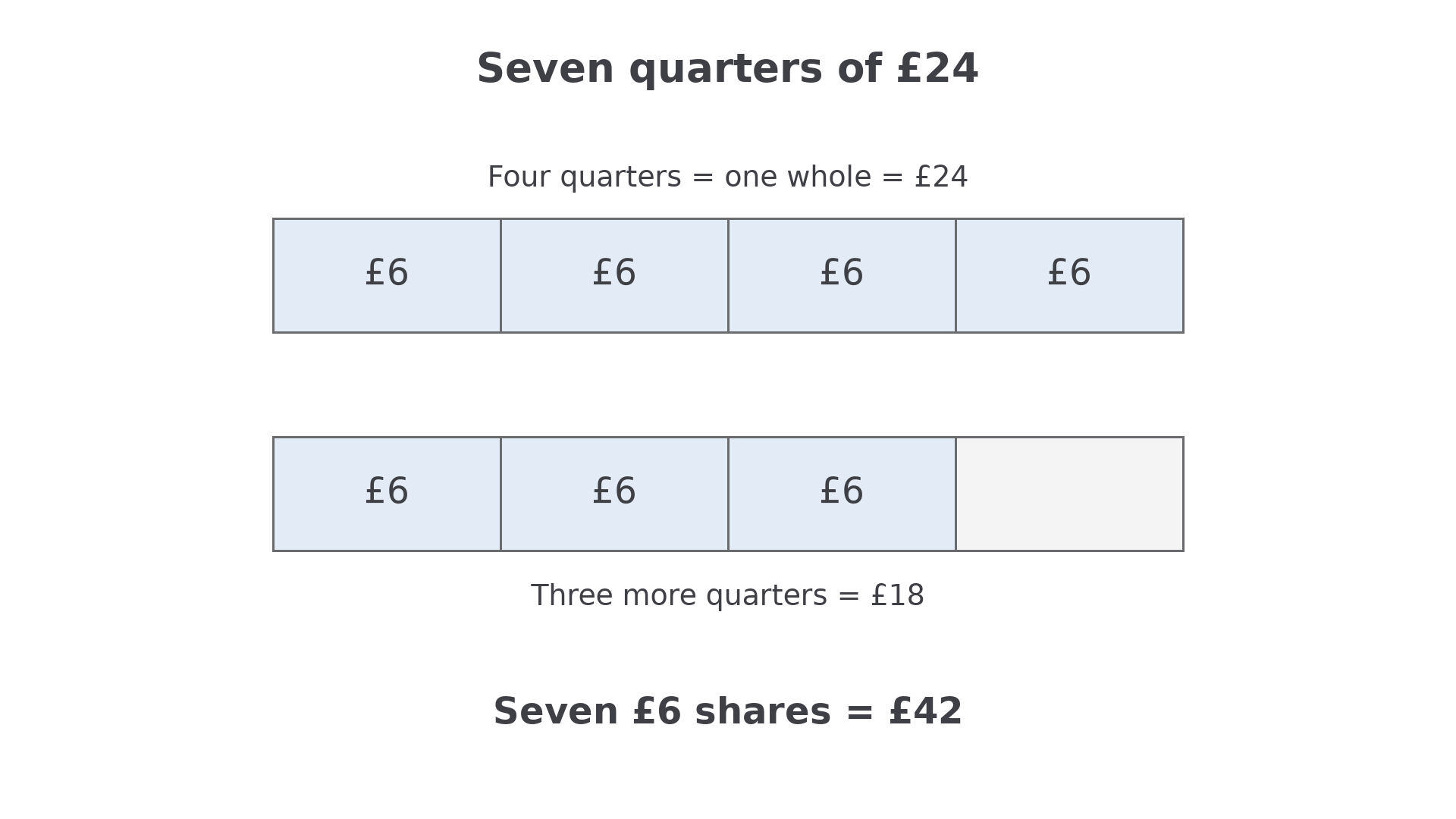
This is multiplication by a scale factor above one. You may imagine extra copies of the original whole; there is no rule that a fraction must mean a piece smaller than one.
Worked example 3: five quarters
Question. Work out of £24.
Plan. Find the value of one quarter, then count five quarters.
Answer. £30.
Check. , so take one whole £24 and another quarter £6: .
Increase only the numerator from five to seven. The quarter-sized share remains £6.
Worked example 4: seven quarters
Question. Work out of £24.
Plan. Use seven of the same quarter-sized shares.
Answer. £42.
Check. . One whole is £24 and three quarters are £18, so .
The opening question is answered: taking a fraction can increase an amount when that fraction exceeds one. The method has not changed; only the number of shares has.
Watch out
Do not automatically reject an answer larger than the original quantity. For a positive quantity, must produce a larger result because . Multiplication by leaves it unchanged.
Keep counting equal shares beyond the first whole.
One quantity as a fraction of another
“What fraction of 50 is 30?” reverses the comparison: instead of finding an amount, you know both amounts and want their relationship. Put the amount being described above the comparison amount: .
One quantity as a fraction of another
Use the same units for both quantities, and the comparison quantity must be nonzero. The units then cancel, leaving a fraction with no unit.
Not on the 2027 formula sheets: learn it.
Order matters. Thirty as a fraction of fifty is ; fifty as a fraction of thirty is . A comparison fraction can exceed one if the quantity being described is larger.
Worked example 5: quantities in the same units
Question. Express as a fraction of .
Plan. Put thirty over fifty, then simplify.
Answer. .
Check. of is , the described amount.
Change only the unit of the comparison quantity from centimetres to metres. The written number remains fifty, but the actual comparison length is much greater.
Worked example 6: quantities in different units
Question. Express as a fraction of .
Plan. Use , then compare in centimetres.
Answer. .
Check. , so of the comparison length gives .
Writing the units on the conversion line helps you avoid comparing a count of centimetres with a count of metres.
Watch out
does not compare with : its numbers use different units. Convert first, then form and simplify the fraction.
Use centimetres for both quantities.
Keeping exact fractional answers
Not every quantity divides into a whole number of units. Sharing equally among three people gives each , or . This is an exact value: it has not been rounded.
Fractions keep division exact throughout a calculation. A finite decimal may also be exact when it represents the fraction precisely, but rounding an ongoing decimal changes the value. Three lengths each rounded to total ; three exact lengths of total exactly . Retaining the fraction prevents that rounding drift.
Worked example 7: an exact share
Question. Find exactly of .
Plan. Multiply by the fraction and keep the division as a fraction.
Answer. , or .
Check. , so three exact shares reconstruct the original length.
Change only the numerator from one to two. The unit share is unchanged, and two of those shares are needed.
Worked example 8: two exact shares
Question. Find exactly of .
Plan. Find one third, retain it as a fraction, then double it.
Answer. , or .
Check. The remaining third is ; , so the pieces sum to the whole.
Exact fractional arithmetic also applies to fractional starting quantities. For example, of is . Cancel factors and simplify before considering a decimal; if an exact answer is requested, an approximation does not replace it.
Watch out
Do not replace by in an exact calculation. They are close, but unequal. A simplified fraction or an equivalent mixed number preserves the full value.
Keep both the starting amount and the result fractional.
Quick Recap
- Divide by the denominator and multiply by the numerator to find a fraction of an amount.
- Fractions greater than one scale a positive amount upwards.
- To express one quantity as a fraction of another, use consistent units and the requested order.
- Keep fractions through exact calculations, simplifying without rounding.
Seven quarters of £24 is £42: seven £6 shares, or one whole plus another three quarters.