6.04a - Linear inequalities
An inequality describes a range of possible values rather than one answer. Learn to solve linear inequalities, keep their direction correct and show exactly which values are included on a number line.
What an inequality describes
How can one statement describe every number of tickets you can afford? Suppose tickets cost £5 each, there is one £2 booking fee and you can spend at most £22. If you buy tickets, the condition is . The symbol matters: spending exactly £22 is allowed.
Start with a simpler condition, . It accepts , , and , among infinitely many others, but rejects . Changing it to includes the boundary value as well.
Inequality
An inequality compares values. means is less than ; means it is greater. means less than or equal to, and means greater than or equal to. The pointed end faces the smaller value.
The solutions are all values that make the statement true. A strict inequality, using or , excludes equality. A non-strict inequality, using or , includes it. You can reverse the order of the written values if you also turn the symbol: says the same thing as .
[DIAGRAM: asset_name: Strict and inclusive boundaries; asset_slug: inequality-endpoints; caption: An open circle excludes three; a filled circle includes it.; description: Two aligned number lines show x less than three and x less than or equal to three. Both solution arrows extend left from three. The first has an open circle at three and the second a filled circle.]
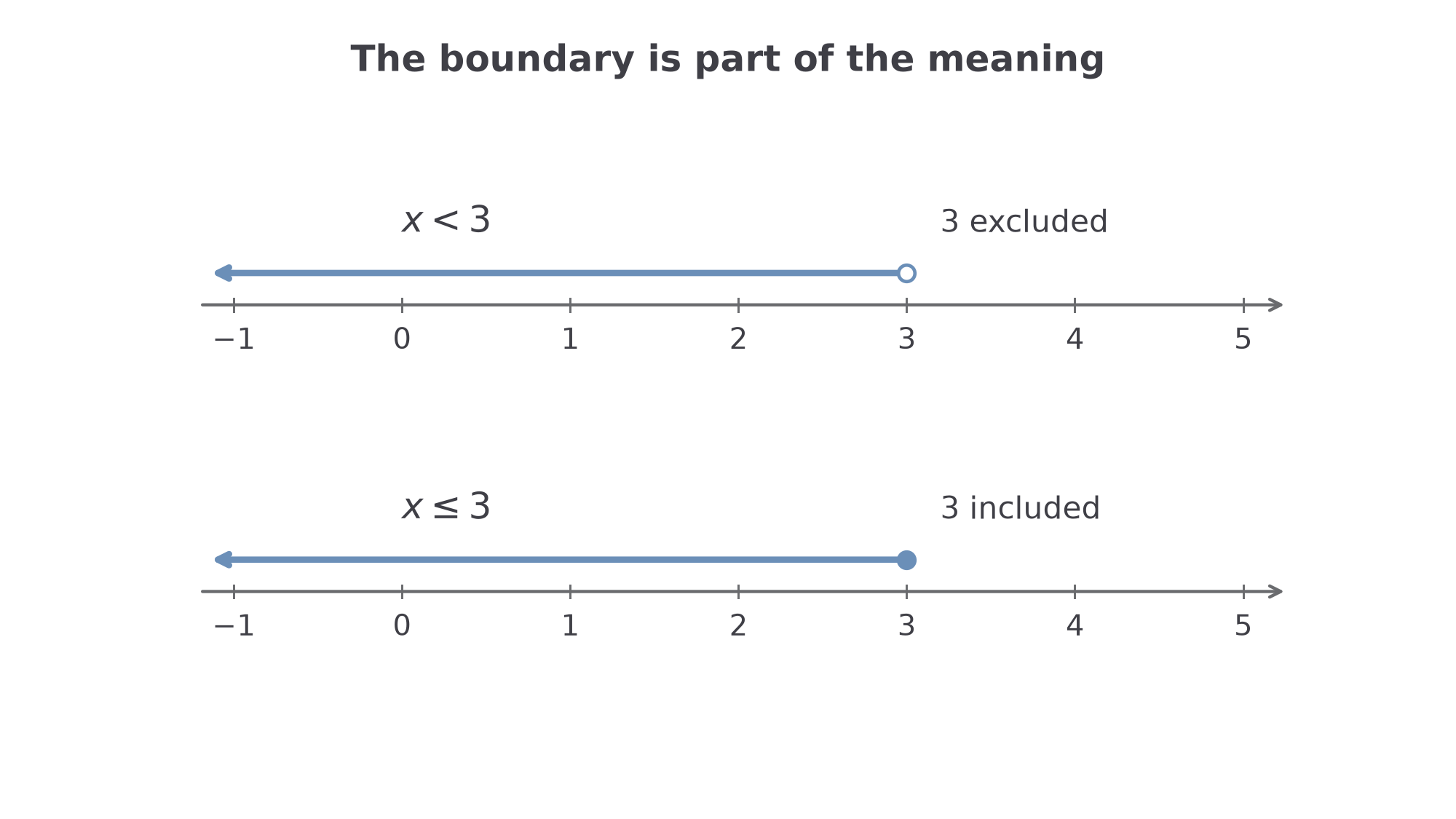
Unless a question limits to integers, decimals and fractions between the marked numbers are included too. A ticket count is different: it must be a whole number, and buying tickets requires a positive count.
Key idea
An inequality gives a condition to satisfy. Its boundary and its direction are both part of the answer.
Check a value by reading the whole condition, including equality.
Solving while preserving order
Use the balancing moves you know from equations, but keep an inequality symbol throughout the solution.
Adding or subtracting the same number on both sides preserves order: if one runner is ahead by 4 metres, moving both runners 2 metres forwards leaves the same gap. Multiplying or dividing both sides by the same positive number also preserves order. These reversible moves keep exactly the original solutions.
Worked example 1: a strict boundary
Question. Solve .
Plan. Undo the addition, then divide both sides by positive three.
Answer. .
Check. gives , which is true. At the boundary, gives , which is false: five must be excluded. The reversible steps justify the whole range, not just these two checks.
Change only the final comparison to include equality. The calculation stays the same; the boundary decision changes.
Worked example 2: an inclusive boundary
Question. Solve .
Plan. Use the same inverse operations while preserving the inclusive symbol.
Answer. .
Check. Five now gives , true. Six gives , false. Smaller inputs reduce the left side because its coefficient is positive.
Brackets and an unknown on both sides work in the same way. For example, expanding gives . Subtract , then subtract 2, to get . A fraction with a fixed positive denominator can be cleared by positive multiplication: becomes , hence .
Watch out
The answer loses almost all the solutions of . Write : five is the boundary, not the only answer.
Now keep track of an inclusive boundary through two moves.
Multiplying or dividing by a negative
Negative multiplication changes the order, so it needs a different rule.
You know . Multiplying both numbers by gives and , and . Reflection in zero swaps left and right on a number line. Multiplying by any negative number combines this reflection with a positive scaling, so it reverses order. Negative division does the same.
Key idea
Reverse and , or and , whenever you multiply or divide both sides by a negative number. Adding or subtracting a negative number does not reverse the sign.
Read the coefficient's sign before dividing.
Worked example 3: a positive coefficient
Question. Solve .
Plan. Subtract seven, then divide by the positive coefficient.
Answer. .
Check. Three gives equality; four gives , true, and two gives , false.
Continue this lesson.
You’re previewing NovaLearn without an account. Create a free account to read the rest.
Create free account