6.01d, 6.01e - Expanding and factorising a bracket
Why must a number outside brackets multiply every term inside? Use distribution to expand brackets, combine expanded expressions, and reverse the process by taking out the greatest common factor.
Expanding a single bracket
Three bags each contain blue counters and two white counters. There are counters altogether. Why is this , rather than ? Each bag contains its own pair of white counters, so the multiplier reaches both parts.
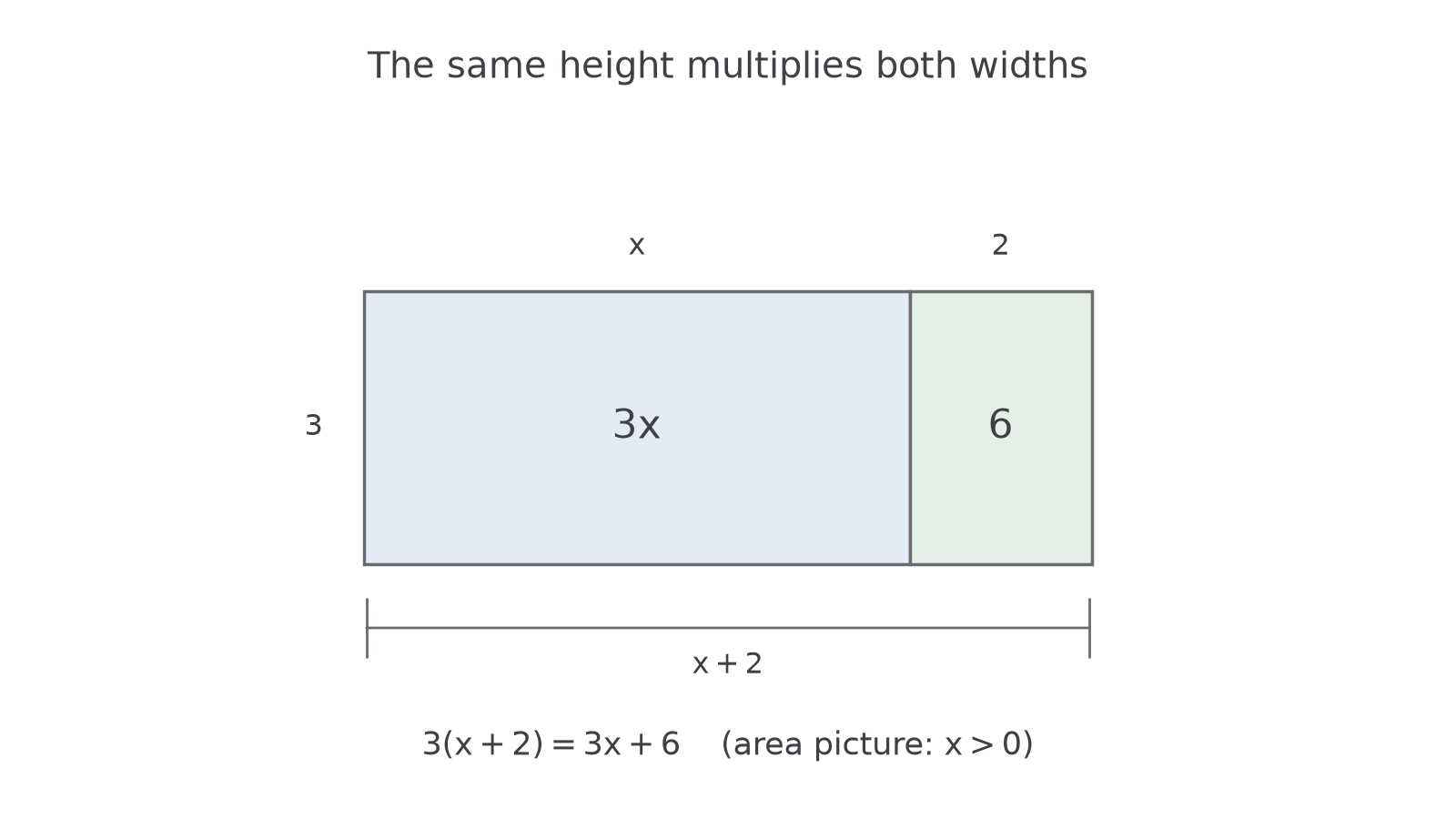
A rectangle gives the same idea. Split a rectangle of height three and width into widths and two. Its whole area is the sum of the two smaller areas.
[DIAGRAM: asset_name: A bracket as a split rectangle; asset_slug: single-bracket-area; caption: The common height multiplies both widths, so three times x plus two is three x plus six.; description: A rectangle of height three split vertically into widths x and two. The left region is labelled three x, the right region six, and the full width x plus two. Lengths are positive in the area picture.]
Distributing a multiplier
These rules hold for all real values of the letters. The area picture uses positive lengths, but the algebra also works with negative numbers and zero. The rules are not on the 2027 formula sheets: learn them.
To expand a bracket, multiply every term inside by the outside term. The multiplier may contain a letter: . Use the product rules you already know, keeping signs with their terms.
Worked example 1: an algebraic multiplier
Question. Expand .
Plan. Multiply both terms inside the bracket by .
Answer. .
Check. At , the bracket form gives . The expanded form gives .
Change only the sign of the outside multiplier. Both products must change sign.
Worked example 2: a negative multiplier
Question. Expand .
Plan. Include the minus sign in the multiplier sent to each term.
Answer. .
Check. At , the original gives ; the expansion gives .
A subtraction inside the bracket still follows the same rule. For example, , since the second product is . If the multiplier is zero, every product is zero.
Watch out
is wrong: the negative multiplier also reaches the three. The correct second term is .
Use a new negative multiplier, reaching both terms.
Combining expanded expressions
When an expression contains several brackets, expand each one before collecting like terms. A subtraction before a bracket is a negative multiplier for the entire bracket, not just its first term.
For example, . You can think of it as . That is why subtracting a whole expression reverses the sign of every one of its terms.
Problem-solving
Keep an intermediate line showing every expanded term. It separates the distribution step from collecting like terms and makes a lost minus sign easier to spot.
Start with a sum of two expanded brackets, then compare a difference with exactly the same brackets.
Worked example 3: adding two brackets
Question. Expand and simplify .
Plan. Expand both brackets, then group like terms.
Answer. .
Check. At , the original is , matching .
Change only the operation between the two brackets. The second multiplier is now negative two.
Worked example 4: subtracting a bracket
Question. Expand and simplify .
Plan. Distribute and separately, then collect like terms.
Answer. .
Check. At , the original gives , matching .
Sometimes terms cancel completely. In , the expansion is . The variable can disappear because the two opposite contributions balance for every value of . That is a useful surprise: an expression containing a letter can represent a fixed number.
Watch out
loses a sign. The correct expansion is . Check a simple value such as : the original is , so cannot be right.
Show the expanded line before your simplified answer.
Taking out a common factor
Expanding turns a product into a sum. Factorising reverses that direction: it writes a sum as a product. Since , the expression factorises to .
Common factor
A common factor multiplies into every term of an expression. To factorise fully using a common factor, take the highest common factor of the numerical coefficients and every letter factor shared by all terms. Inside the bracket, write each original term divided by that common factor.
For , the greatest numerical common factor is four. Both terms contain at least two factors of , so the full common factor is . Choose the lowest shared power, not the highest power you can see.
Worked example 5: numerical and letter factors
Question. Factorise fully .
Plan. Take out , the greatest common factor, and find both remaining terms.
Answer. .
Check. Expanding gives , exactly the original expression.
Change only the sign of the second term. The same common factor remains, and the sign inside the bracket changes.
Worked example 6: a negative remaining term
Question. Factorise fully .
Plan. Take out , preserving the subtraction.
Answer. .
Check. Expanding gives . At , both forms are zero as well: factorisation has not excluded that value.
Although dividing terms is a useful way to find the bracket, the final factorisation is an equality of products and sums. It holds even when the common factor is zero. We have not divided an equation by or claimed .
If the common factor equals one whole term, the remaining bracket entry is one. Thus , not . If no common factor greater than one is available, this method may leave the expression unchanged.
Watch out
is a factorisation, but it is not fully factorised: the bracket still shares an . The full common factor gives .
Reverse your answer by expansion to check the next factorisation.
Quick Recap
- Expanding distributes an outside term to every term inside the bracket.
- Keep a negative multiplier with every product.
- Expand separate brackets before collecting like terms.
- Factorising reverses expansion; take out the greatest common numerical and letter factors.
- Check a factorisation by expanding it.
Each of the three bags contains two white counters, so there are six white counters altogether: .