9.04a, 9.04c - Similar triangles and lengths
Two triangular signs have the same shape but different sizes. Can one measured side tell you every other length? In 9.04a you will recognise and prove triangle similarity; in 9.04c you will match corresponding sides, calculate unknown lengths and compare supplied measurements using the appropriate ratios.
Recognising similar figures
A sign has sides , and units. A second has sides , and . Doubling every side makes a larger version of the same triangle, even if the second sign has been turned around.
Similar figures
Similar figures have equal corresponding angles and proportional corresponding lengths: one common positive length scale factor relates all matching sides. They may be rotated, translated or reflected. Congruent figures are similar with length scale factor .
Match vertices by their angles and positions in the shape, rather than by “top” or “left” on the page. Writing similar to in matching order means corresponds to , to , and to . Consequently matches , not whichever side happens to be horizontal.
[DIAGRAM: asset_name: Common and inconsistent length factors; asset_slug: recognising-similar-triangles; caption: All three matching side ratios must agree, so changing just one side can destroy similarity.; description: Two panels compare a three-four-five triangle with a six-eight-ten triangle and then with a six-eight-eleven triangle. Every side is labelled with its exact length and vertices are in matching order. The triangles are drawn from exact side lengths, with no similarity claimed for the second pair.]
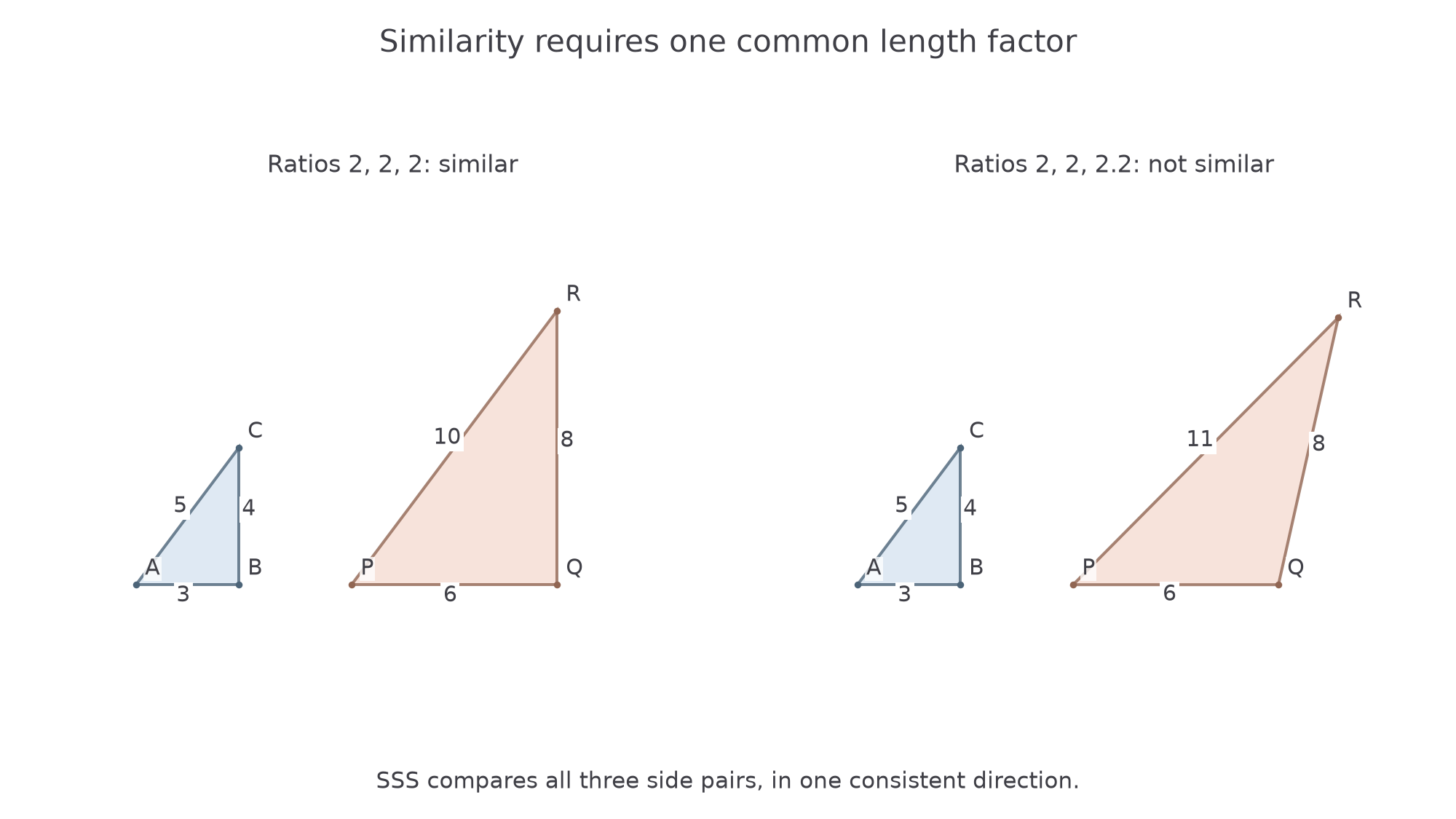
For triangles, three proportional side pairs are enough to guarantee equal corresponding angles. You can imagine enlarging the first triangle by the common factor: the enlarged triangle then has the same three sides as the second and is congruent to it by SSS. This explains the SSS similarity test.
Worked example 1: three ratios agree
Question. Triangles and have , , and , , . Are they similar?
Plan. Compare all three matching side ratios in the same direction.
Answer. Yes. All corresponding sides have the same factor , so the triangles are similar by SSS.
Check. A scale-two enlargement of has sides , exactly the side lengths of . There is no inconsistent side left over.
Change only the longest side of the second triangle. Two matching ratios will no longer be enough.
Worked example 2: one ratio disagrees
Question. Keep unchanged, but let have sides , , . Are the triangles similar?
Plan. Test the same three corresponding ratios, pairing shortest with shortest and longest with longest.
Answer. No. There is no common length factor for all three corresponding sides.
Check. Doubling would force the third side to be , rather than . Reordering the sides cannot repair this: corresponding longest sides must match.
For general polygons, equal angles alone are insufficient: a -by- rectangle and a -by- rectangle each have four right angles but are not similar. Conversely, matching side ratios alone do not fix a general polygon's angles. Triangles have special tests because their three sides determine their shape.
Watch out
A shared angle or a similar-looking outline does not establish similarity. Use sufficient equal-angle information or a complete proportional-side test.
Check a new three-side comparison.
Proving triangles are similar
Two equal angle pairs are enough for triangles, because their third angles must also agree: both angle totals are .
AA similarity
If two angles of one triangle equal two corresponding angles of another, the triangles are similar. This is AA similarity. State the equal angle pairs and the reasons that establish them.
Parallel lines often create equal corresponding or alternate angles. Intersecting straight lines create equal vertically opposite angles. Use the geometry actually given; do not assume lines are parallel because they look that way.
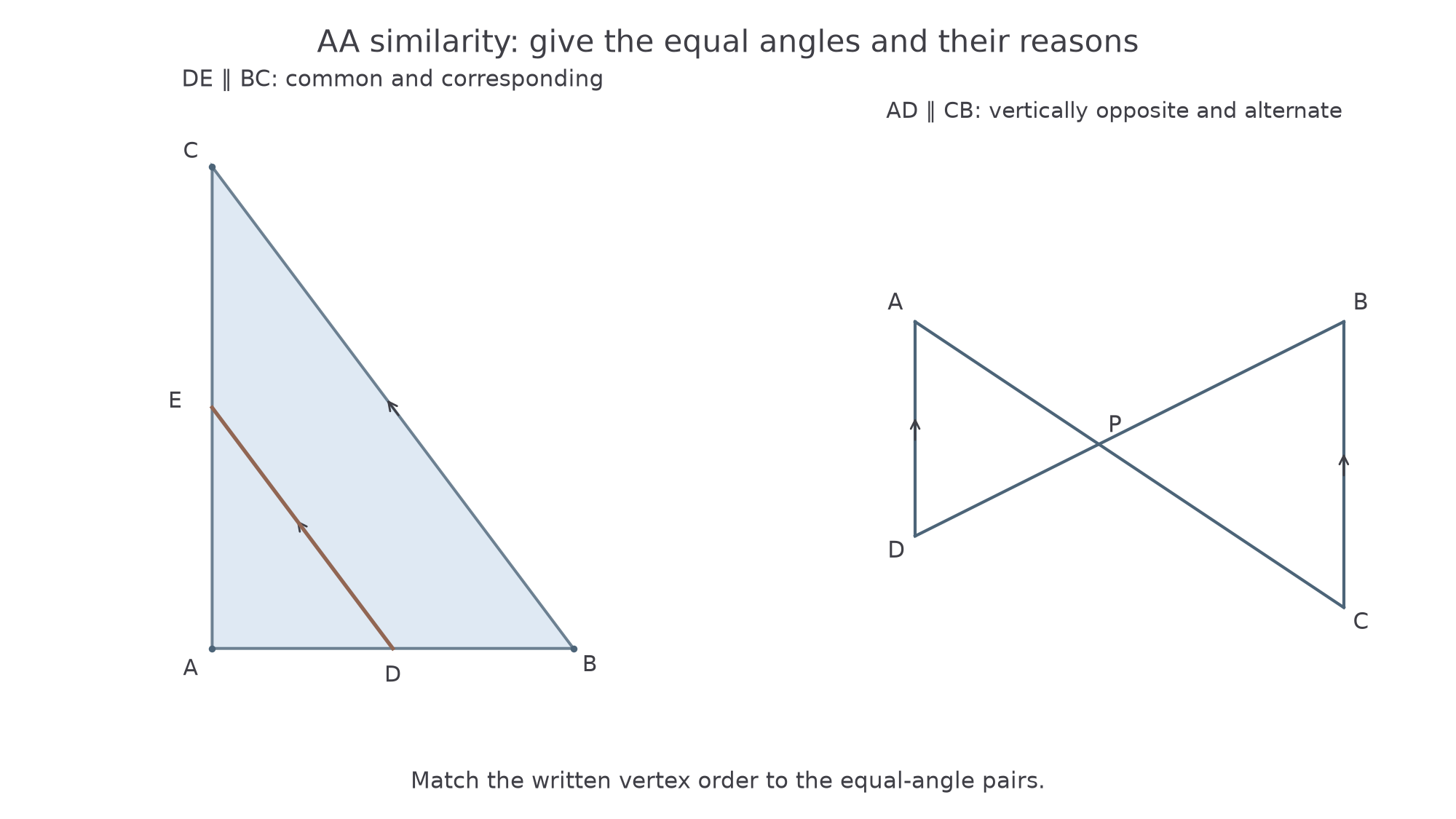
[DIAGRAM: asset_name: Angle reasons for triangle similarity; asset_slug: aa-similarity-proofs; caption: Parallel sides and a common angle or vertically opposite angles supply the AA proof.; description: The first panel shows D on AB and E on AC of triangle ABC, with DE parallel to BC. The second panel shows crossed lines A-P-C and D-P-B with AD parallel to CB. All vertices and the parallel-side marks needed for the AA arguments are visible.]
Worked example 3: a triangle inside a triangle
Question. lies on , lies on , and is parallel to . Prove that and are similar.
Plan. Find two angle pairs, naming the parallel-line reason and the common angle.
Answer. Triangles and are similar by AA, with , , .
Check. Their remaining angles also agree because subtracting the same two equal angles from gives equal results. The written vertex order matches the angle pairs used.
Keep the parallel-side idea, but change the arrangement to two triangles meeting at crossed lines. The shared central angle is now a vertically opposite pair.
Worked example 4: crossed triangles
Question. lie on one straight line, lie on another, and . The order on the lines is and . Prove that and are similar.
Plan. Pair the central vertically opposite angles and one alternate-angle pair.
Answer. Triangles and are similar by AA, with , , .
Check. The remaining pair is , another alternate-angle pair. It confirms the correspondence rather than reversing and .
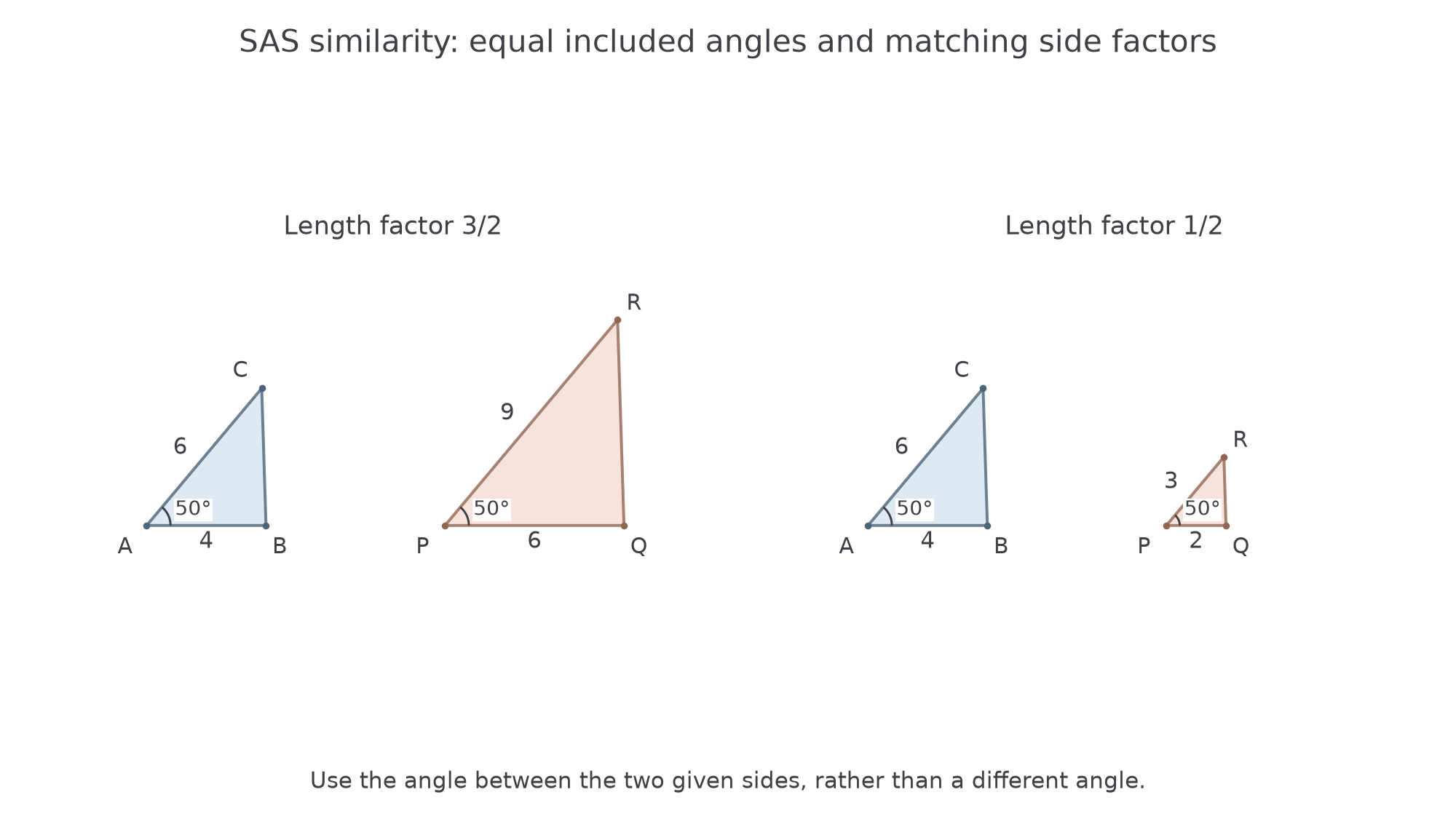
There is also a side-and-angle route. If two corresponding side ratios agree and the included angles between those sides are equal, the triangles are similar by SAS similarity. Enlarge the first triangle by the common factor: its two sides and included angle then match the second, so SAS congruence establishes the result. Moving the equal angle away from the included position removes that guarantee. SSS similarity from the previous part is the corresponding three-side route.
[DIAGRAM: asset_name: SAS similarity and included angles; asset_slug: sas-similarity-pairs; caption: The same included angle and one common side multiplier establish similarity, including when the image is smaller.; description: Two panels show a triangle with sides four and six enclosing fifty degrees beside similar triangles with corresponding sides six and nine, then two and three. Every included fifty-degree angle is marked at the matching vertex, with length factors three halves and one half respectively.]
Worked example 5: proportional sides and an included angle
Question. , , , , and . Prove that and are similar.
Plan. Compare the sides enclosing the equal angles, then apply SAS similarity.
Answer. Triangles and are similar by SAS, with , , .
Check. Reversing the scale by takes the two sides back to , while retaining the included angle. SAS congruence then fixes the whole triangle, rather than only those two sides.
Continue this lesson.
You’re previewing NovaLearn without an account. Create a free account to read the rest.
Create free account