8.03d, 8.04a–8.04c - Angles and properties of polygons
Why can a regular octagon have equal angles without any of them being right angles? Build the angle rules for triangles and larger polygons, use quadrilateral properties with reasons, and identify reflection and rotational symmetry.
Triangle properties and angles
A regular octagon has eight equal sides and eight equal angles. How large is each angle? Rather than measuring a particular drawing, start with a triangle: it is the building block for the calculation.
[DIAGRAM: asset_name: Deriving the triangle angle sum; asset_slug: triangle-angle-sum; caption: A parallel line through A puts all three triangle angles into one straight angle.; description: Triangle ABC has A above the horizontal base BC. A line through A is marked parallel to BC. The triangle's interior angles are a at A, b at B and c at C. The angles on either side of a beneath the upper line are labelled b and c by alternate-angle equality. A second panel has isosceles triangle PQR with PQ equal to PR, vertex angle v at P and equal base angles u. A third panel shows triangle XYZ right-angled at Y, with angle X 32 degrees and angle Z 58 degrees.]
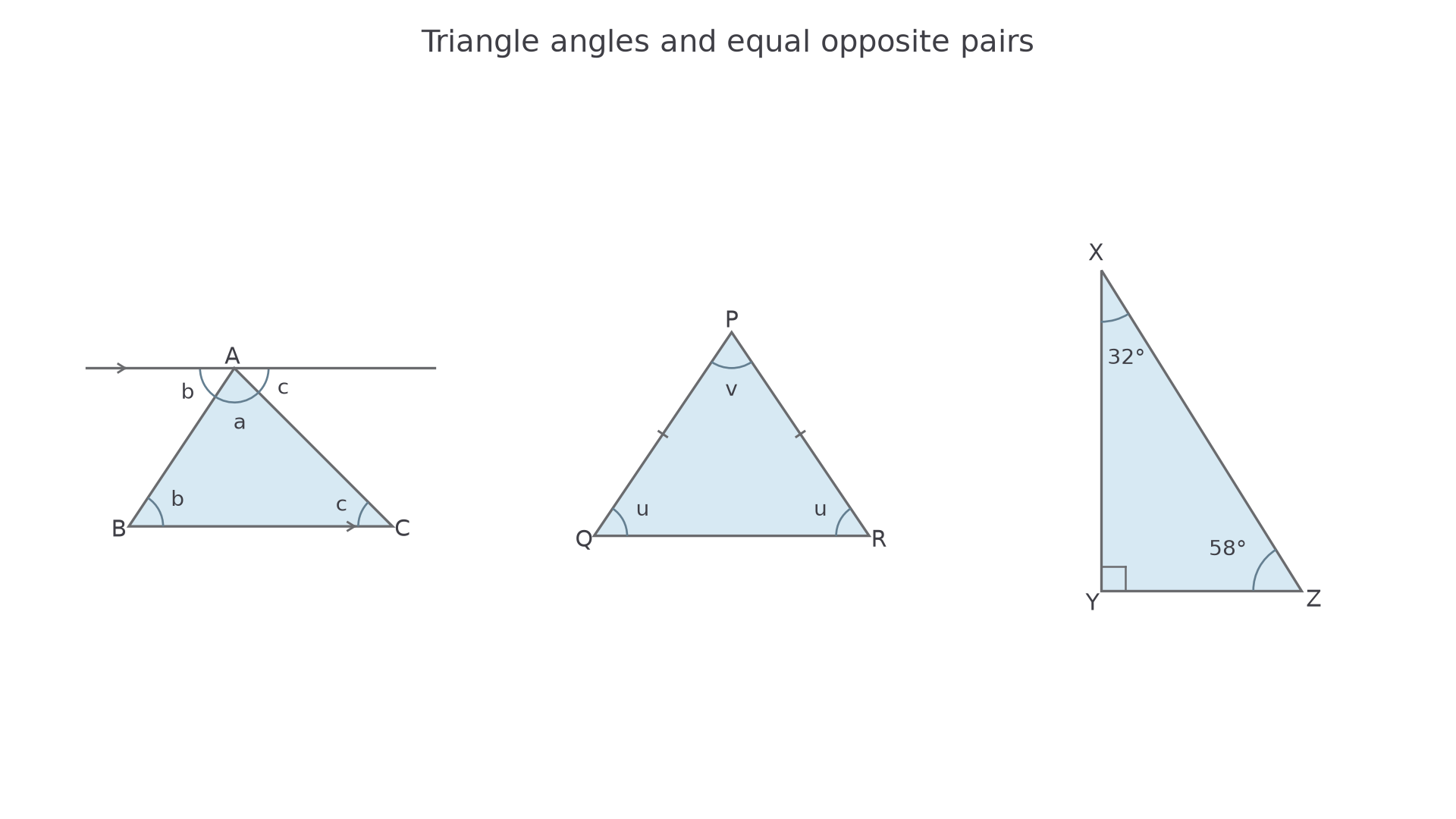
Through A draw a line parallel to BC. The angle next to AB on that line equals angle B, and the angle next to AC equals angle C, by alternate angles. Along the straight line at A, those two angles and angle A sum to . Therefore the three interior angles of a triangle sum to .
Triangle angles
For a non-degenerate triangle,
A non-degenerate triangle has three distinct vertices which do not lie on one line. This angle-sum rule is not on the 2027 formula sheet: learn it.
An isosceles triangle has at least two equal sides. The angles opposite those sides are equal: in PQR, gives . One way to see the reason is to fold along the line from P to the midpoint of QR: the two halves match, so the base angles match. We will justify this precisely using congruent triangles in a later lesson. Conversely, two equal angles have equal opposite sides.
Worked example 1: two equal unknown angles
Question. In isosceles triangle PQR, and the angle at P is . Find the angle at Q, giving reasons.
Plan. Remove the vertex angle, then share the remaining angle total equally between the base angles.
Answer. .
Check. The three angles are , and their total is . The equal angles are opposite PQ and PR as required.
Change only the vertex angle. A larger angle at the top leaves a smaller total for the base pair.
Worked example 2: changing the vertex angle
Question. In the same isosceles arrangement, the angle at P is . Find the angle at Q, giving reasons.
Plan. Keep the equal-base-angle relationship and use the new triangle total equation.
Answer. .
Check. . Raising the vertex angle by has reduced each base angle by .
In an equilateral triangle, all three sides are equal, so all three opposite angles are equal. Their total is , giving each. A right-angled triangle has one angle of , so its other two angles total . In the right-angled triangle XYZ shown, angle X is , so angle Z is . A right-angled isosceles triangle therefore has two angles.
You can also identify an isosceles triangle from two equal angles, even if equal sides are not marked. State that the sides opposite equal angles are equal; do not say “it looks symmetrical”.
Watch out
If , the equal angles are at Q and R, not at P and Q. Match each angle to its opposite side before forming the equation.
Use fresh data in the same labelled isosceles arrangement.
Interior and exterior angle sums
A diagonal divides a polygon into triangles. That lets a rule for three sides explain the angle total for many sides.
[DIAGRAM: asset_name: Triangles and turns in a pentagon; asset_slug: polygon-triangles-and-turns; caption: The pentagon contains three triangles. Walking its boundary makes one complete turn.; description: The left panel shows convex pentagon ABCDE with diagonals AC and AD, dividing it into three lightly shaded triangles. The right shows the same pentagon with each side extended in the direction of travel and a marked exterior turn at each vertex. One interior angle i and its adjacent exterior angle e are labelled.]
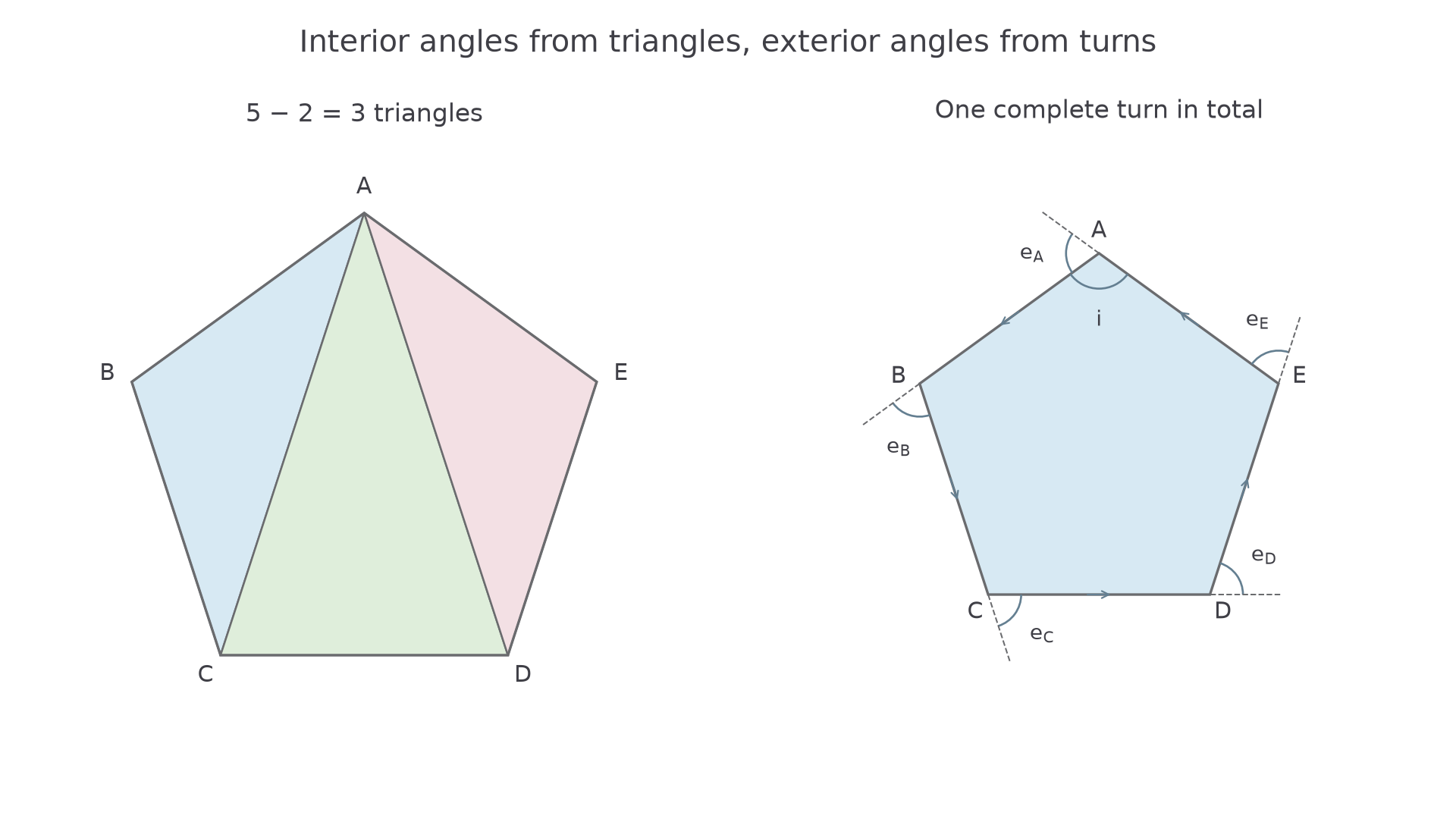
For a convex polygon, each interior angle is less than , and diagonals from one vertex lie inside the shape. A pentagon splits into three triangles, a hexagon into four, and an -sided polygon into . The triangle angles together make exactly the polygon's interior angles.
Interior-angle sum
For a simple polygon with sides,
Here is an integer at least 3, and “simple” excludes crossing sides. The formula also holds for concave simple polygons, which can be divided into triangles, though not always by drawing every diagonal from one chosen vertex. It is not on the 2027 formula sheet: learn it.
An exterior angle here is the turn from the straight continuation of the incoming side to the outgoing side as you travel around a convex polygon. It is adjacent to the interior angle, so
Do not use the reflex angle outside the shape instead. Walking once around the boundary returns you to your original direction after one complete turn. Hence the exterior angles total , even if the side lengths and angles differ. Algebra confirms it: . For a concave boundary, turns must be treated with signs; adding only positive smaller angles is not the same rule.
Worked example 3: a general hexagon
Question. Find the sum of the interior angles of a hexagon. Must it be regular?
Plan. Count the sides, then count the triangles in a triangulation.
Answer. . Regularity is unnecessary: the sum depends on the number of sides.
Check. The six straight-angle totals give ; subtract the exterior turn to get .
Change only the number of sides from six to seven. One extra side adds one triangle to the triangulation.
Worked example 4: one more side
Question. Find the sum of the interior angles of a heptagon, a seven-sided polygon. Must it be regular?
Plan. Use the same triangulation count with .
Answer. , whether regular or irregular.
Check. . The total rose by exactly , one triangle's angle sum.
The exterior total stays fixed while the interior total grows. That difference will be useful when a question gives you angles but asks for the number of sides.
Watch out
counts a straight angle at every vertex. It includes the exterior turns as well as the interior angles. Subtract , or count triangles instead.
Apply the relationship between the two totals.
Angles of regular polygons
In a regular polygon all the angles are equal, so divide the total by the number of angles. In an irregular polygon that division gives a mean, not necessarily any actual angle.
Regular-polygon angles
For a regular polygon with sides,
The exterior turn is adjacent to interior angle . These formulas are not on the 2027 formula sheet: learn the angle totals which explain them.
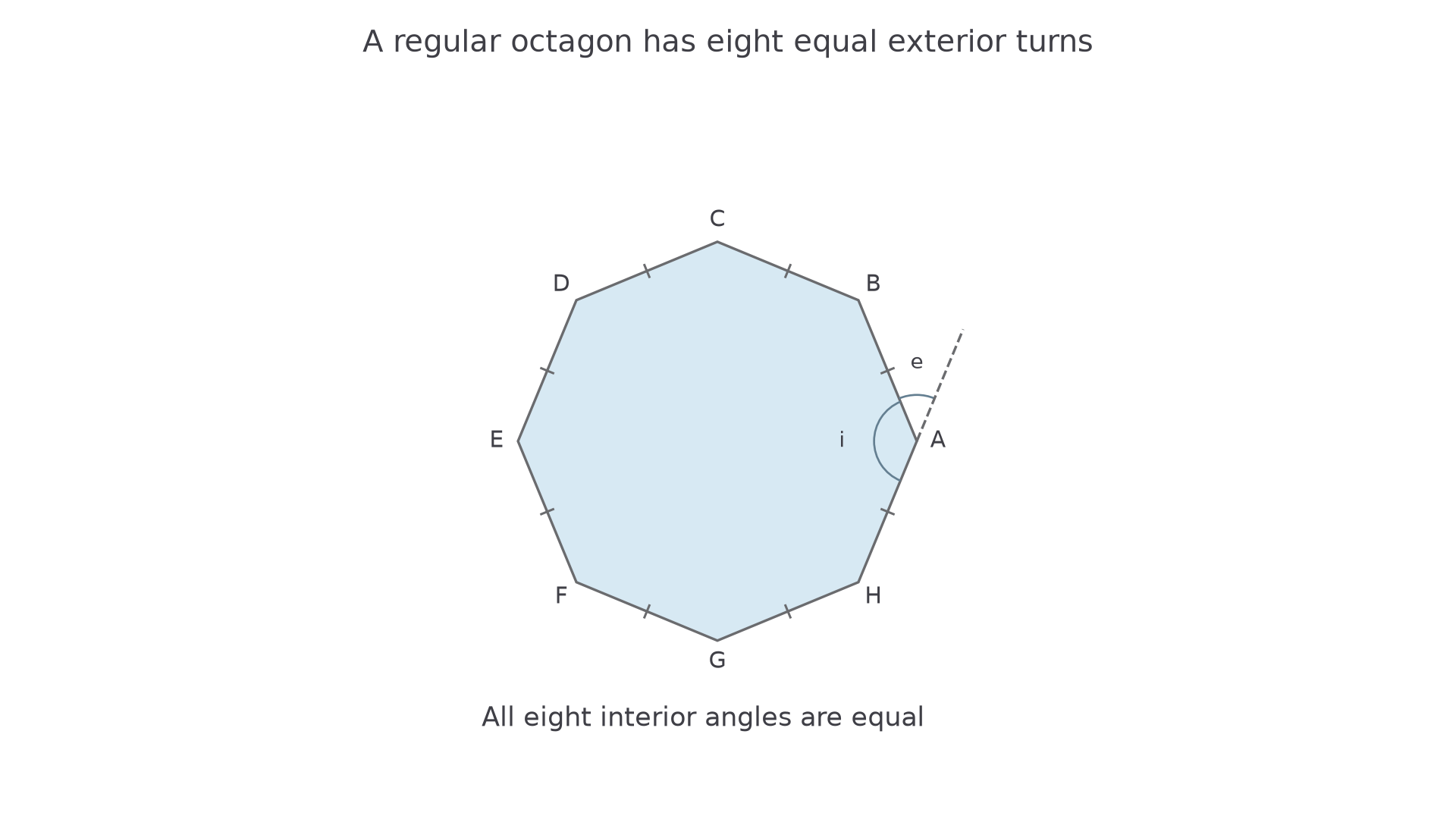
[DIAGRAM: asset_name: Regular octagon angles; asset_slug: regular-octagon-angles; caption: Eight equal turns divide 360 degrees equally. Each interior angle completes a straight angle with its turn.; description: A regular octagon has one side extended at vertex A. The interior angle i is shown inside, and its adjacent exterior turn e outside. Matching side ticks identify equal lengths, and the caption states that all eight interior angles are equal.]
Worked example 5: answering the octagon question
Question. Find one exterior angle and one interior angle of a regular octagon.
Plan. Divide one full turn into eight equal exterior turns, then subtract one turn from .
Answer. Exterior angle ; interior angle .
Check. The interior sum is , and .
Change only the number of sides to twelve. More sides mean smaller equal turns and larger interior angles.
Worked example 6: more sides, less turning
Question. Find one exterior angle and one interior angle of a regular twelve-sided polygon.
Plan. Share between twelve turns, then use the straight angle.
Answer. Exterior angle ; interior angle .
Check. . Both methods agree.
You can reverse the process when the angle is given instead of the number of sides. First recover the exterior turn; then count how many such turns fit one full turn.
Worked example 7: finding the number of sides
Question. Each interior angle of a regular polygon is . Find its number of sides.
Plan. Subtract from a straight angle, then divide the full turn by that exterior angle.
Answer. 20 sides.
Check. The interior total is , equal to .
Continue this lesson.
You’re previewing NovaLearn without an account. Create a free account to read the rest.
Create free account