6.3.2(e) - Combined spectroscopic structure deduction
Structure deduction is the point where the analytical techniques start working as a team. Elemental analysis and mass spectrometry restrict the formula, IR identifies key bonds, and NMR shows how the atoms are arranged into environments and fragments. The skill is not to spot one dramatic peak and guess; it is to build a structure that fits every piece of evidence.
Use each technique for a different constraint
A single spectrum rarely proves a structure on its own. A molecular ion can give a relative molecular mass, but not the atom arrangement. IR can show a carbonyl bond, but not whether the carbon skeleton is straight-chain or branched. Proton NMR can show neighbouring proton groups, but it must still be checked against the molecular formula and any functional-group evidence.
[DIAGRAM: asset_name: Lesson 6.3.2e: Combined spectroscopic structure deduction - diagram 01; asset_slug: 06_03_02d_combined_spectroscopic_structure_deduction__diagram_01; recommended_method: drawn_chem; description: 16:9 grey-on-white workflow showing elemental analysis plus molecular ion leading to molecular formula, then IR functional-group evidence, then carbon-13/proton NMR fragments, then candidate structure, with a loop labelled check every item of data.]
At A level, the evidence set may include:
| Evidence | Main question it answers | What it cannot do alone |
|---|---|---|
| Elemental analysis | What empirical formula fits the percentage composition? | It does not give the molecular formula unless a relative molecular mass is also known. |
| Mass spectrum | What is the molecular ion, and are there useful fragment ions? | It does not give a full structure by itself. Do not interpret organic halogen mass spectra in this lesson. |
| IR spectrum | Which diagnostic bonds or functional groups are present or absent? | Several functional groups can share similar regions, so IR needs cross-checking. |
| NMR spectra | How many environments are present, what type they are, and how proton groups neighbour each other? | A plausible NMR assignment must still obey the formula and functional-group evidence. |
Good structure deduction is a constraint problem: every proposed structure must fit the formula, key spectral peaks, absent evidence, NMR environments, integrations and splitting patterns.
The spectral reference data are provided on the Data Sheet. You need to know how to use the supplied values, not memorise a complete table. The scope is restricted to functional groups studied in OCR A Level Chemistry A, and mass spectra of organic halogen compounds are not required.
Start with formula evidence
Elemental analysis is usually handled before detailed spectra because it tells you the atom ratio. Convert each percentage into an amount in moles by dividing by the relative atomic mass, then divide by the smallest value to get the simplest whole-number ratio.
Elemental analysis method
If a mass spectrum gives the molecular ion peak, use it as the relative molecular mass of the molecule, then compare it with the empirical formula mass.
Worked example: formula from composition and molecular ion
An unknown compound contains 54.5% C, 9.1% H and 36.4% O by mass. Its mass spectrum has a molecular ion peak at m/z = 88.
| Element | Calculation | Ratio |
|---|---|---|
| C | 54.5 / 12.0 = 4.54 | 4.54 / 2.28 = 1.99 |
| H | 9.1 / 1.0 = 9.10 | 9.10 / 2.28 = 3.99 |
| O | 36.4 / 16.0 = 2.28 | 2.28 / 2.28 = 1.00 |
The empirical formula is C₂H₄O. Its empirical formula mass is:
The molecular ion gives Mr = 88, so:
The molecular formula is therefore C₄H₈O₂.
At this stage, do not guess a name. C₄H₈O₂ could fit several compounds studied in the course, such as a carboxylic acid or an ester. The formula has narrowed the problem; it has not finished it.
Use IR and mass spectra as filters
After the formula, use IR to identify functional groups and to rule out alternatives. A broad O-H absorption in the carboxylic acid region supports a carboxylic acid; an O-H absorption in the alcohol or phenol region supports an alcohol or phenol; a strong C=O absorption supports a carbonyl-containing compound. Absence matters as much as presence: a molecule with only one oxygen atom cannot be both a carbonyl and a separate O-H group.
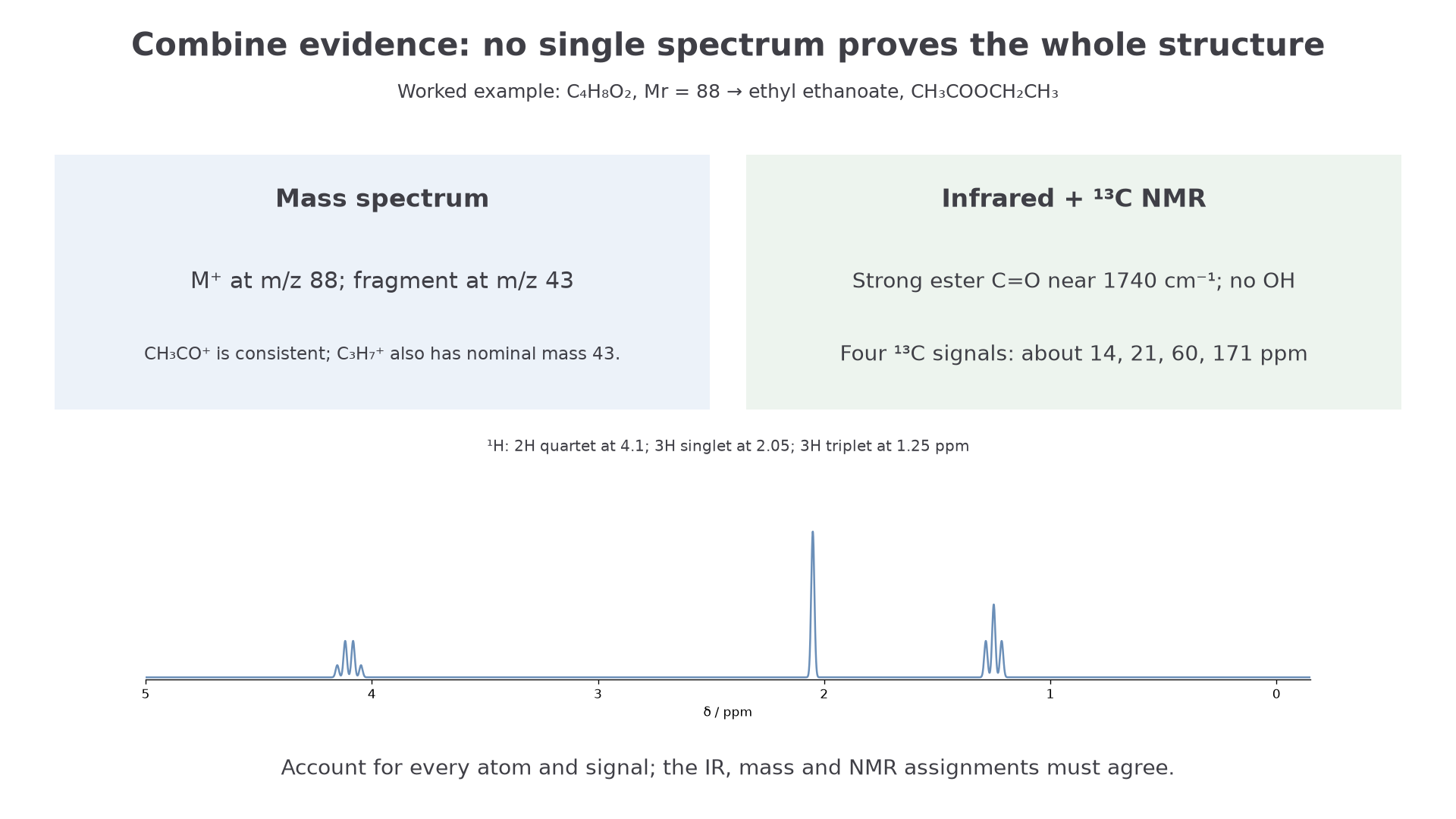
Mass spectra can also provide useful fragments, but keep the interpretation simple. Use the molecular ion to support Mr. A mass spectrum records positive ions, so write a fragment formula with its positive charge. For example, an ethanoate ester can give at m/z 43: . An ethyl fragment would instead have m/z 29. The m/z 43 peak can support a fragment, but also has nominal mass 43; use IR/NMR to distinguish them. The tallest (base) peak is not necessarily the molecular ion. Use fragments only when they are chemically plausible and clearly help the structure. Do not build this lesson around detailed fragmentation mechanisms.
Worked reasoning: applying filters to C₄H₈O₂
From the previous worked example, the molecular formula was C₄H₈O₂.
Evidence A:
- IR absorption: broad 2500-3300 cm⁻¹
- IR absorption: strong near 1710 cm⁻¹
- molecular ion: m/z = 88
The broad 2500-3300 cm⁻¹ absorption suggests an O-H bond in a carboxylic acid. The strong absorption near 1710 cm⁻¹ suggests C=O. Together, with two oxygen atoms in the molecular formula, this supports a carboxylic acid rather than an ester or a simple alcohol.
Evidence B:
- IR absorption: strong near 1740 cm⁻¹
- no broad O-H absorption
- molecular ion: m/z = 88
The C=O absorption still fits a carbonyl compound, but the absence of broad O-H evidence argues against a carboxylic acid. With formula C₄H₈O₂, an ester becomes a stronger candidate.
Use IR first to sort broad functional-group families, then use NMR to decide the exact arrangement within the formula.
Continue this lesson.
You’re previewing NovaLearn without an account. Create a free account to read the rest.
Create free account