3.2.2(f)-(g) - Boltzmann distributions
Boltzmann distributions help you explain why changing temperature or adding a catalyst can change the rate of reaction. The graph is a model: it shows how molecular kinetic energies are spread out in a sample, and it lets you compare the proportion of molecules with enough energy to react. The key is to read the area beyond the activation energy threshold, not just describe the curve shape.
What the Curve Shows
In a reacting sample, molecules do not all have the same kinetic energy. Some have relatively low kinetic energy, many have a middle range of kinetic energies, and a small proportion have very high kinetic energy. A Boltzmann distribution represents this spread at a particular temperature.
[DIAGRAM: asset_name: Lesson 3.2.2f-g: Boltzmann distributions - diagram 01; asset_slug: 03_02_02c_boltzmann_distributions__diagram_01; recommended_method: drawn_chem; description: A clean 16:9 Boltzmann distribution graph with y-axis labelled (number of) molecules, x-axis labelled kinetic energy, a curve starting at the origin, rising to a most probable energy, then falling into a long high-energy tail, with activation energy Ea marked and the area beyond Ea shaded.]
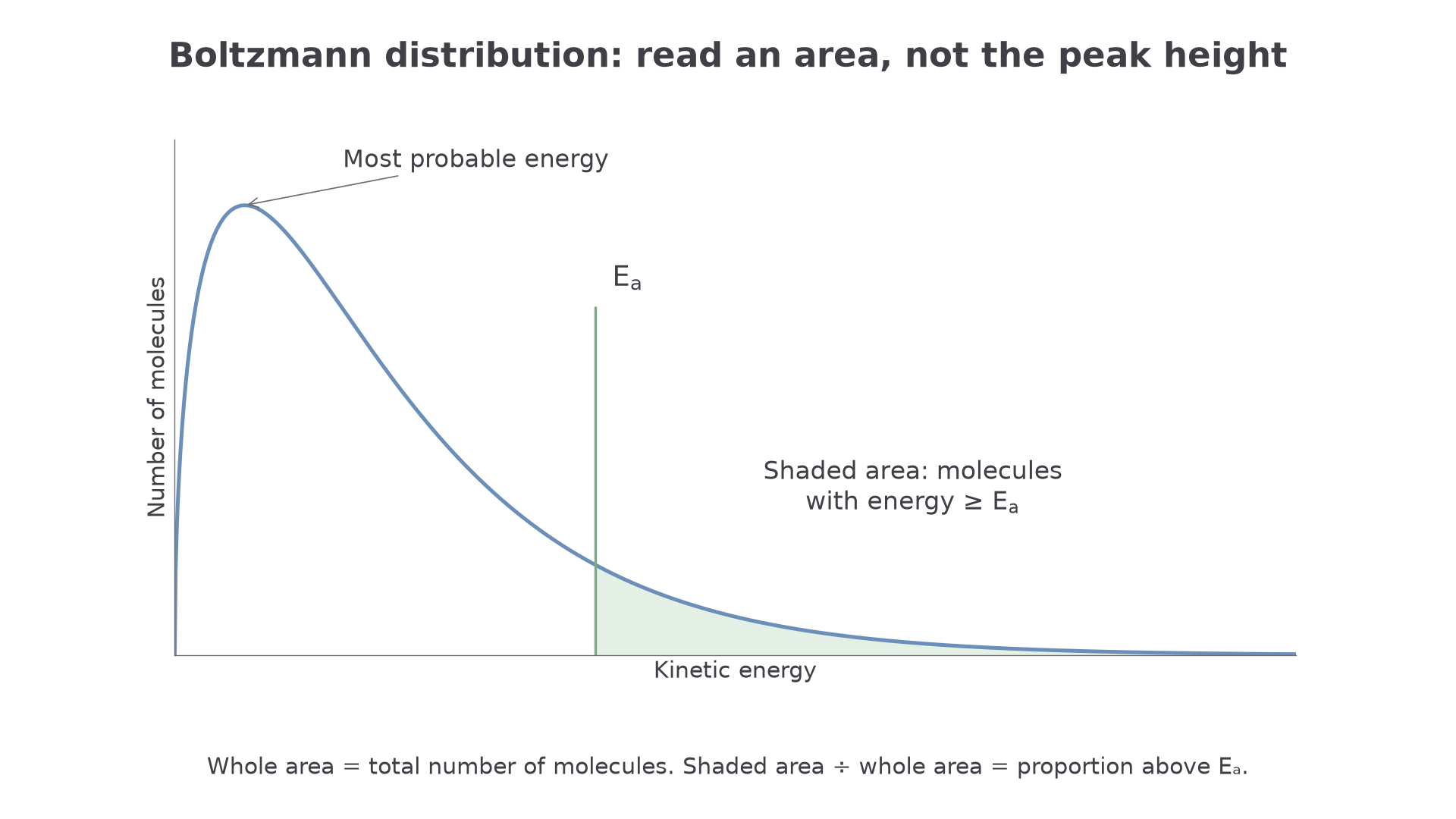
The y-axis is the number of molecules, or number of particles. The x-axis is kinetic energy. Do not label the x-axis as enthalpy; an enthalpy profile is a different kind of graph.
The curve has several important features:
- it starts at the origin, because no molecules have zero kinetic energy
- it rises to a peak, the most probable energy
- it has a long tail at high energy and does not meet the x-axis again
- the area under the whole curve represents the total number of molecules
Boltzmann Distribution
A Boltzmann distribution is a graph showing the distribution of molecular kinetic energies in a sample at a particular temperature.
Worked reasoning: reading the curve
If two samples contain the same total number of molecules, the total area under their Boltzmann curves is the same. A taller peak does not mean "more molecules overall"; it means more molecules are concentrated around that particular kinetic energy range. The graph is about distribution, not the sample size unless the total area changes.
More precisely, the curve shows numbers in equal small energy intervals. Area over an energy interval represents a number of molecules; dividing by the total area gives a proportion. Doubling the number of molecules at the same temperature doubles the height at each energy and both areas, so the proportion above a fixed threshold is unchanged. For a fixed sample heated to a higher temperature, the total area stays the same: molecules are redistributed, not created.
Activation Energy and Area
For a collision to lead to reaction, the colliding particles must have energy equal to or greater than the activation energy, Ea. On a Boltzmann distribution, Ea is shown as a vertical threshold on the kinetic-energy axis.
Activation Energy
Activation energy is the minimum energy that colliding particles must have for a reaction to occur.
The number of molecules with sufficient energy is represented by the area under the curve to the right of Ea. The proportion is this area divided by the whole area; for the same number of molecules, comparing the shaded areas compares the proportions. This is a qualitative area comparison: you do not calculate the area in this lesson. A larger area beyond Ea means a larger proportion of molecules have enough kinetic energy to react when they collide.
Worked example: comparing two activation energies
Imagine the same Boltzmann curve at one temperature. Reaction A has a low activation energy, so its Ea line is fairly far left. Reaction B has a higher activation energy, so its Ea line is further right in the tail.
Reaction A has a larger area to the right of its Ea line. Therefore a greater proportion of molecules have enough energy to react in Reaction A. If the other collision factors were similar, Reaction A would be expected to have a faster rate.
A common mistake is to say "molecules have activation energy". A better OCR-style phrase is: molecules have energy equal to or greater than the activation energy.
Continue this lesson.
You’re previewing NovaLearn without an account. Create a free account to read the rest.
Create free account