4.2.3(b)-(c) - Two-stage organic synthesis
Organic synthesis is the planning side of organic chemistry: you start with one molecule and choose reactions that turn it into another. In this lesson, you will learn how to recognise several functional groups in the same molecule, predict the reactions each group can undergo, and build two-stage routes using the Module 4 transformations already met.
Spot the functional groups
A functional group is the part of an organic molecule responsible for its characteristic reactions. In synthesis questions, the rest of the molecule can look complicated, but the reaction usually depends on the functional group that changes.
For OCR 4.2.3, you must be able to identify individual functional groups in a molecule that contains more than one. Up to this point in Module 4, the most important functional groups and reaction sites are:
| Feature in the molecule | What to call it | Key prediction from Module 4 |
|---|---|---|
| C=C | alkene | addition reactions; bromine water is decolourised |
| C-X, where X is Cl, Br or I | haloalkane | nucleophilic substitution / hydrolysis can form an alcohol |
| -OH in an alcohol | alcohol | can combust; can be oxidised if primary or secondary; can eliminate water to form an alkene; can substitute to form a haloalkane |
| -CHO | aldehyde | formed from controlled oxidation of a primary alcohol; can be oxidised further to a carboxylic acid |
| >C=O within a carbon chain | ketone | formed by oxidation of a secondary alcohol |
| -COOH | carboxylic acid | acidic functional group; formed by full oxidation of a primary alcohol |
The skill is not just naming. If a molecule contains both C=C and -OH, you should be able to say that the C=C can undergo addition reactions, while the alcohol group can be oxidised, eliminated or substituted depending on its structure and the reagent.
Worked example: identify the functional groups in .
The CH2=CH- part contains a carbon-carbon double bond, so it has an alkene group. The -CH2OH part is a primary alcohol group. Therefore this molecule could decolourise bromine water at the C=C bond, and the primary alcohol could be oxidised to an aldehyde or carboxylic acid under suitable conditions.
The module 4 route map
A two-stage synthesis has three organic compounds in order:
starting compound intermediate target compound
The intermediate is the compound made after stage 1 and used in stage 2. It is not a mechanism intermediate such as a carbocation or radical. It is an actual organic compound that could, in principle, be isolated or shown in a reaction scheme.
[DIAGRAM: asset_name: Lesson 4.2.3b-c: Two-stage organic synthesis - diagram 01; asset_slug: 04_02_03b_two_stage_organic_synthesis__diagram_01; recommended_method: drawn_chem; description: Three original worked two-stage routes via primary or secondary alcohols, with reagents, conditions and final products.]
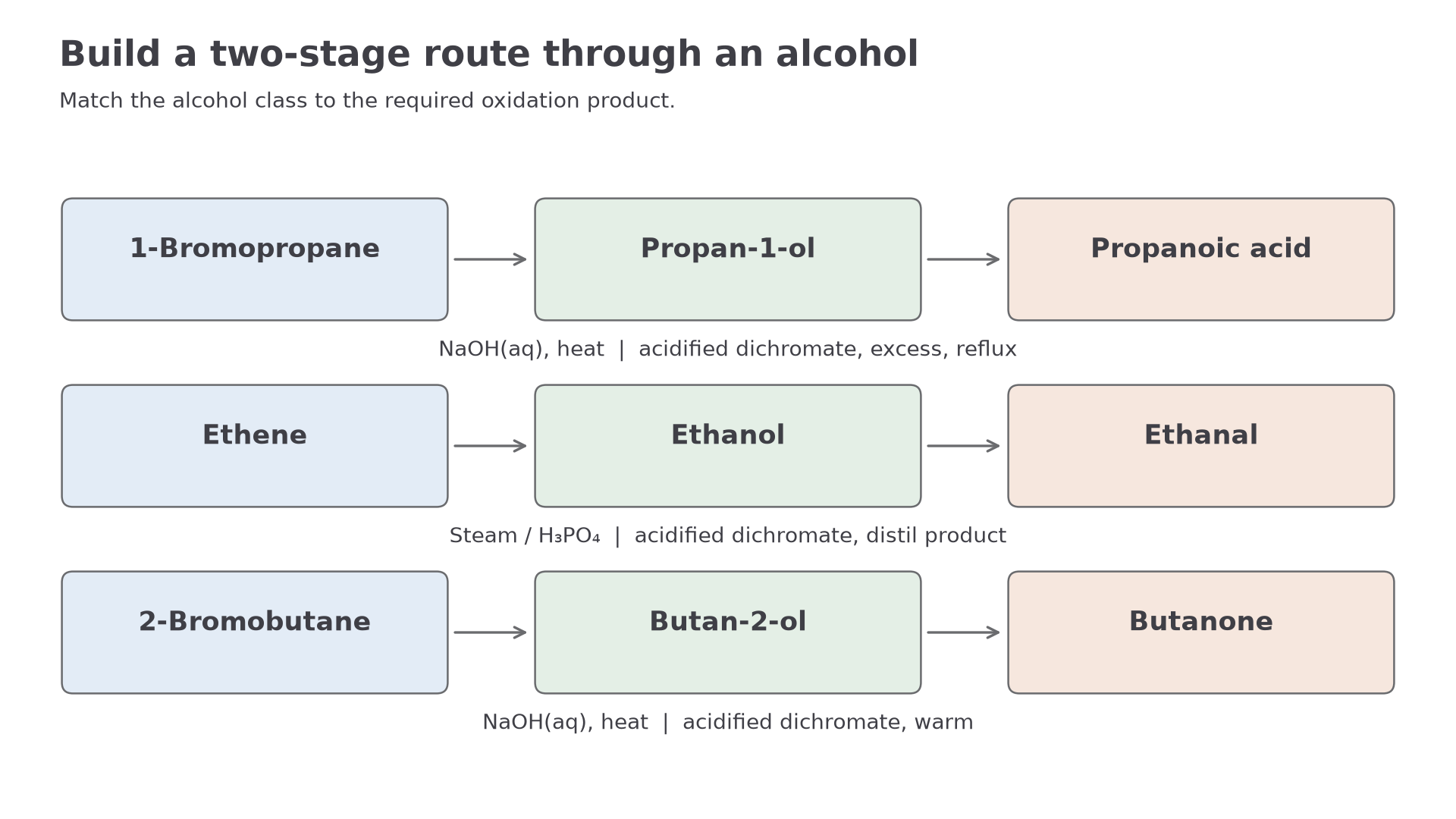
The arrows must represent reactions you can actually choose. Alkenes add hydrogen with a nickel catalyst and heat to form alkanes; bromine adds across C=C to form a vicinal dibromo compound; HBr adds to form a bromoalkane. Alkanes undergo radical substitution with chlorine or bromine under UV, but mixtures of substitution products can make this a poor preparation route. These transformations preserve carbon count.
Hydration of an unsymmetrical alkene can give different alcohols; use the major-product reasoning already learned for electrophilic addition. Propene mainly forms propan-2-ol, so hydration then oxidation mainly makes propanone, not propanal. Ethene is symmetric and gives ethanol, making the route to ethanal unambiguous.
Use the map in both directions when planning. If you need to make a carboxylic acid from a haloalkane, the map shows that a sensible intermediate is an alcohol:
haloalkane alcohol carboxylic acid
If you need to make an aldehyde from an alkene, the intermediate is again an alcohol, but the second stage needs controlled oxidation:
alkene alcohol aldehyde
The exam trap is to write every reagent you remember. OCR mark schemes often penalise extra contradictory reagents because they make the intended transformation unclear. A good synthesis answer gives the stage, the reagent or condition, and the organic product for that stage.
Worked route from haloalkane to acid
Suppose the task is to prepare ethanoic acid from bromoethane in two stages.
First compare the starting compound and target compound:
- bromoethane, , has a haloalkane group
- ethanoic acid, , has a carboxylic acid group
- the carbon chain length stays at two carbons
There is no direct Module 4 reaction from haloalkane to carboxylic acid. The useful intermediate is ethanol because haloalkanes can be hydrolysed to alcohols, and primary alcohols can be oxidised to carboxylic acids.
Stage 1: hydrolyse bromoethane to ethanol using aqueous hydroxide ions.
Stage 2: heat ethanol under reflux with acidified potassium dichromate(VI).
Continue this lesson.
You’re previewing NovaLearn without an account. Create a free account to read the rest.
Create free account