3.2.1(e), 3.2.1(h) - Calorimetry and enthalpy determination
Calorimetry turns a temperature change into an enthalpy change. In this lesson you will learn how to use , how to scale the energy change to kJ mol⁻¹, and how practical choices affect the result. The aim is not just to get a number: it is to know what the number means, why the sign is positive or negative, and which assumptions the experiment is making.
What calorimetry measures
In calorimetry, the reacting chemicals are the system. The water, solution, cup, thermometer and surrounding air are the surroundings. A simple school calorimeter usually measures the temperature change of the water or solution around the reaction, so it measures energy transferred to or from the surroundings.
Calorimetry
Calorimetry is the measurement of energy transferred as heat by using a temperature change.
For direct enthalpy determination, the reaction is carried out and the temperature change is measured directly. The basic relationship is:
Energy transferred
where q is energy transferred in J, m is mass in g, c is specific heat capacity in J g⁻¹ K⁻¹, and is the temperature change in K or degrees C.
For aqueous solutions at this level, questions normally use the specific heat capacity of water:
The temperature interval is the same size in K and degrees C, so a rise from 20.0 degrees C to 26.5 degrees C gives:
The mass in is the mass of the water or solution whose temperature changes, not automatically the mass of the limiting reactant. If 50.0 cm³ of dilute aqueous solution is used and the question tells you to assume density is 1.00 g cm⁻³, its mass is:
The sign comes from the reaction, not from the arithmetic alone:
- If the temperature rises, the surroundings gain energy. The reaction has released energy, so the reaction enthalpy change is negative.
- If the temperature falls, the surroundings lose energy. The reaction has absorbed energy, so the reaction enthalpy change is positive.
gives the heat energy change for the material whose temperature is measured. The molar enthalpy change belongs to the reaction and has the opposite sign for an exothermic temperature rise.
From q to molar enthalpy
Enthalpy changes are usually reported in kJ mol⁻¹. That means the energy change must be divided by the relevant amount in mol. The usual route is:
- Find m and .
- Calculate in J.
- Convert J to kJ.
- Find the amount in mol that the enthalpy change is defined for.
- Divide the energy by that amount and assign the correct sign.
For many direct experiments:
Molar enthalpy from calorimetry
when q is the energy gained by the surroundings and n is the amount in mol for the reaction definition.
The minus sign is a reminder that an exothermic reaction warms the surroundings but has a negative reaction enthalpy change.
Worked example: enthalpy change of neutralisation
25.0 cm³ of 1.00 mol dm⁻³ hydrochloric acid is mixed with 25.0 cm³ of 1.00 mol dm⁻³ sodium hydroxide. The temperature rises from 20.2 degrees C to 26.8 degrees C.
Calculate the enthalpy change of neutralisation. Assume the density of the final solution is 1.00 g cm⁻³ and c = 4.18 J g⁻¹ K⁻¹.
The total solution volume is:
So the mass of solution is:
The temperature change is:
Calculate the energy gained by the solution:
Convert to kJ:
The neutralisation equation is:
Amount of acid:
The ratio HCl : H₂O is 1 : 1, so:
The temperature rose, so the reaction is exothermic:
To three significant figures:
For neutralisation, divide by the amount of water formed, not blindly by the amount of acid or alkali. This becomes important for acids such as sulfuric acid, where 1 mol of acid can form 2 mol of water in complete neutralisation.
Solution calorimetry method
Solution calorimetry is used for reactions such as neutralisation or dissolving a solid in water. The practical aim is to capture as much of the heat transfer as possible in a measured mass of solution.
A reliable method uses this sequence:
- Measure the reacting solutions using suitable volumetric apparatus.
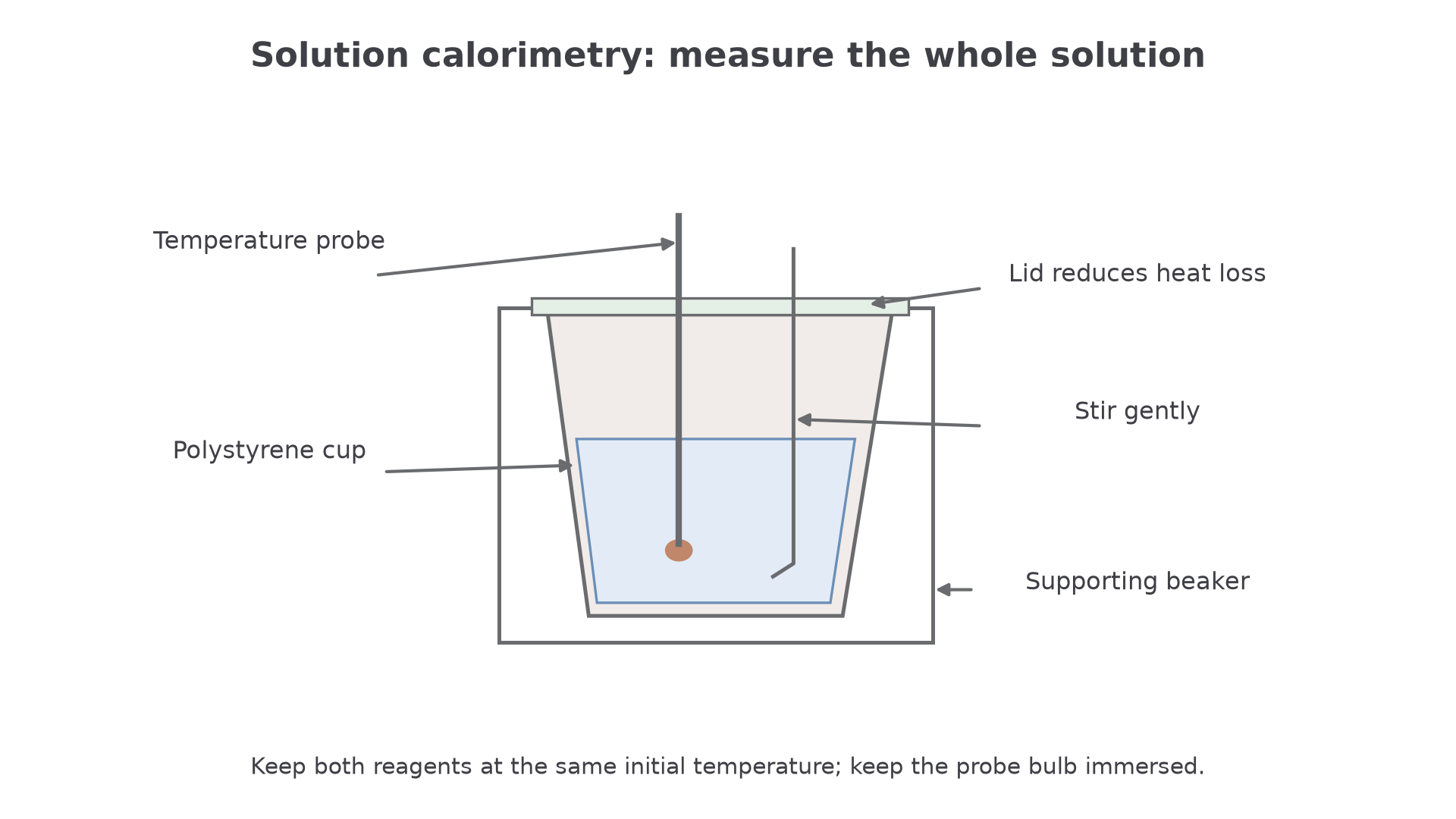
- Put the main solution in an expanded polystyrene cup supported by a beaker. Fit a lid with a hole for the temperature probe; immerse the whole sensing bulb in the liquid without touching the cup, and allow space to stir.
- Measure the initial temperature. If two solutions are being mixed, they should start at the same temperature, or a mass-weighted average should be used if the heat capacities are equivalent and the masses differ. Prefer matched initial temperatures.
- Add the second reagent quickly, replace the lid, stir, and record the highest or lowest temperature reached.
- Use the measured in .
- Convert the energy change into kJ mol⁻¹ using the correct amount in mol.
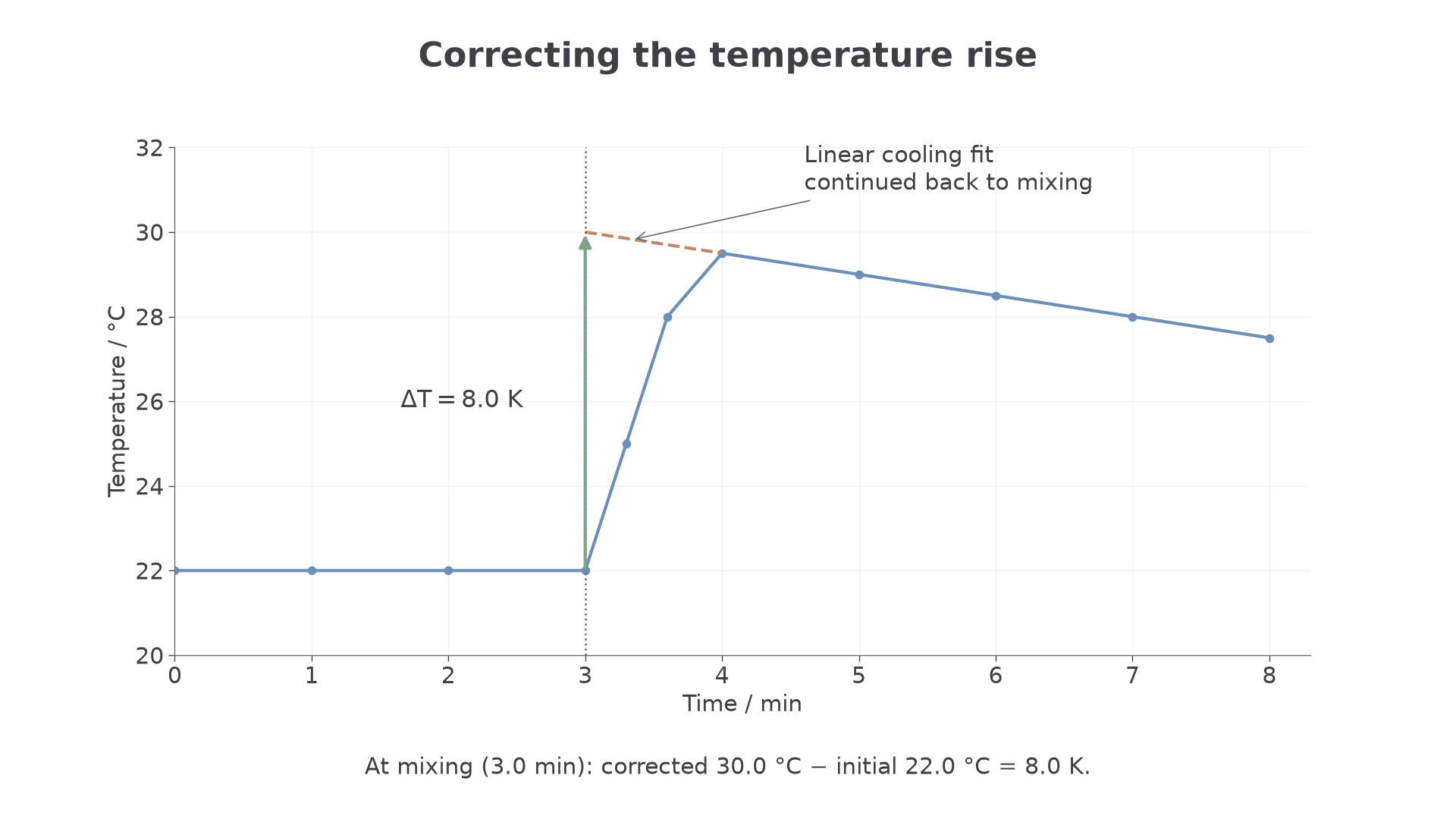
For more careful work, record temperature at regular time intervals and plot a temperature-time graph.
The graph helps because heat is lost to the surroundings while the reaction mixture is warming and cooling. A common method is to fit the approximately linear cooling data after the reaction is complete and extrapolate that line back to the time of mixing, then use that corrected maximum temperature to find .
The main sources of uncertainty and error are predictable:
- heat transfer to the air, cup, beaker and thermometer
- heat loss while reagents are being added and mixed
- thermometer or temperature probe resolution
- assuming dilute solutions have the density and specific heat capacity of water
- incomplete reaction if a reagent is not in excess when completion is needed
- not using the correct mass in
If a solid is added to a solution and fully dissolves or reacts to become part of the solution, include the mass of the solid in the mass heated, unless the question tells you otherwise.
Improvements should target the problem. A lid and better insulation reduce heat loss. A temperature probe or data logger improves the temperature-time data. Repeats help identify anomalous readings. Using one reagent in excess can ensure the limiting reagent reacts completely, provided the mole calculation still uses the limiting amount.
Safety still matters even when the calculation is the focus. Acids and alkalis can be irritants or corrosive depending on concentration, so use eye protection and clean spills promptly. Hot solutions and glassware should be handled carefully.
[DIAGRAM: asset_name: 03_02_01b_calorimetry_and_direct_enthalpy_determination__diagram_01; asset_slug: 03_02_01b_calorimetry_and_direct_enthalpy_determination__diagram_01; recommended_method: drawn_chem; description: Insulated cup supported by beaker, immersed probe, lid and stirrer; labels clear of apparatus.]
[DIAGRAM: asset_name: 03_02_01b_calorimetry_and_direct_enthalpy_determination__diagram_02; asset_slug: 03_02_01b_calorimetry_and_direct_enthalpy_determination__diagram_02; recommended_method: drawn_chem; description: Temperature versus time with a linear cooling segment extrapolated to mixing; corrected rise is 8.0 K.]
Continue this lesson.
You’re previewing NovaLearn without an account. Create a free account to read the rest.
Create free account