4.2.1(d)-(e) - Elimination and substitution of alcohols
Alcohols are useful because the -OH functional group can be changed into other functional groups. In this lesson, you will learn two OCR routes: eliminating water from an alcohol to make an alkene, and substituting the -OH group using acidified halide ions to make a haloalkane. The exam focus is reagents, conditions and organic products; mechanisms are not required for either route.
Two routes from alcohols
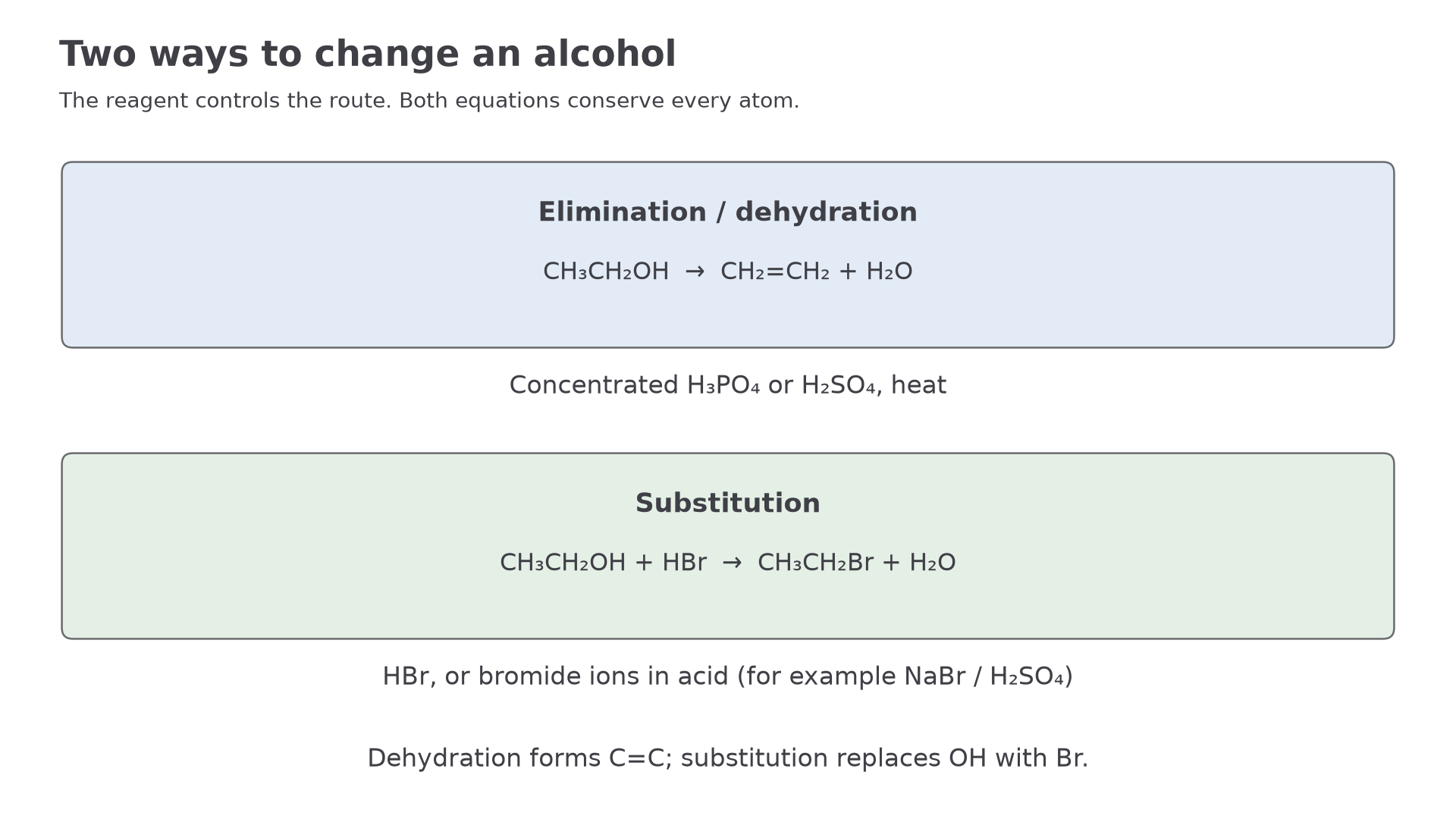
The same alcohol can be sent down two different reaction routes depending on the reagents and conditions.
[DIAGRAM: asset_name: Lesson 4.2.1d-e: Elimination and substitution of alcohols - diagram 01; asset_slug: 04_02_01c_elimination_and_substitution_of_alcohols__diagram_01; recommended_method: drawn_chem; description: A clean 16:9 reaction-route map with alcohol in the centre-left branching to alkene plus water using H3PO4 or H2SO4 and heat, and to haloalkane plus water using NaBr/H2SO4 or acidified halide ions. Include the boundary note that mechanisms are not required.]
Elimination
An elimination reaction removes atoms or groups from a molecule to form a double bond. In this lesson, alcohols eliminate to form alkenes.
Substitution
A substitution reaction replaces one atom or group with another. In this lesson, the -OH group in an alcohol is replaced by a halogen atom to form a haloalkane.
The key contrast is the product:
| Route | Reagents and conditions | Organic product |
|---|---|---|
| Elimination | or , heat | Alkene |
| Substitution | Halide ions in acid, for example NaBr/ | Haloalkane |
The two routes can look similar because both involve acid. The acid in the elimination route is paired with heat and forms an alkene. The acid in the substitution route is paired with a halide ion source and forms a haloalkane.
Elimination to alkenes
In the elimination reaction, an alcohol loses . The -OH group and a hydrogen atom from a neighbouring carbon are removed, leaving a carbon-carbon double bond. The reaction needs an acid catalyst, such as or , and heat.
For ethanol:
The organic product is ethene, an alkene. is also formed, which is why the reaction is often called dehydration.
Worked example: butan-1-ol
Butan-1-ol has the structure . Removing water from the end of the chain forms a double bond between carbon 1 and carbon 2:
The alkene product is but-1-ene. A strong OCR-style answer would give both the condition and the organic product:
- reagent/catalyst: or
- condition: heat
- organic product: but-1-ene,
Do not use or steam as a reagent for this route. That would suggest hydration of an alkene in the reverse direction, not dehydration of an alcohol.
Substitution to haloalkanes
In the substitution reaction, the -OH group in the alcohol is replaced by a halogen atom. OCR describes this as substitution with halide ions in the presence of acid. A common example is NaBr/, which supplies bromide ions in acidic conditions and forms a bromoalkane.
The general organic change is:
Here, X is a halogen such as Cl, Br or I. If the product is a bromoalkane, the halide source must provide bromide, for example NaBr in acid or HBr. If the product is a chloroalkane, the reagent must provide chloride. The reagent and product must match.
For ethanol forming bromoethane:
Continue this lesson.
You’re previewing NovaLearn without an account. Create a free account to read the rest.
Create free account