6.1.1(a)-(c) - Benzene models, evidence and aromatic nomenclature
Benzene is the starting point for aromatic chemistry. In this lesson, you will compare the older Kekulé model with the delocalised model, use experimental evidence to decide which model is better, and name simple substituted aromatic compounds using systematic locants.
Benzene models
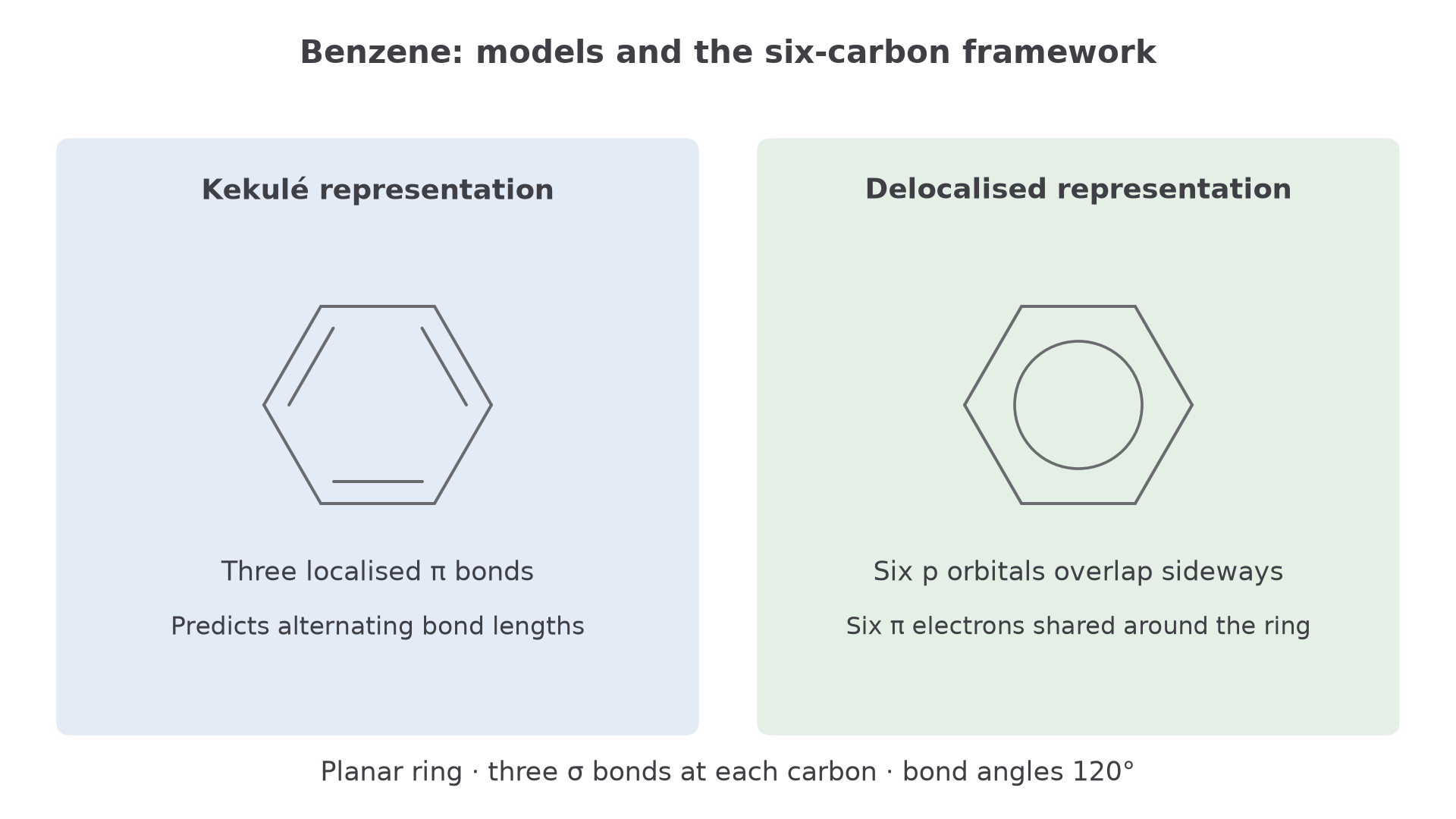
Benzene has the molecular formula . In the older Kekulé model, benzene is shown as a six-membered ring with alternating C-C single bonds and C=C double bonds. That model was useful historically because it matched the formula and gave each carbon four bonds, but it predicts three localised pi bonds.
The delocalised model is different. Each carbon atom in the benzene ring is bonded to two other carbon atoms and one hydrogen atom by sigma bonds. Each carbon also has one p orbital perpendicular to the plane of the ring. The six p orbitals overlap sideways to form one delocalised pi-system above and below the ring.
Delocalised pi-system
A delocalised pi-system is a set of pi electrons spread over more than two atoms rather than being fixed between one pair of atoms.
For equations and mechanisms, OCR allows benzene to be represented either as a hexagon with alternating double bonds or as a hexagon with a circle. The circle representation is the better model of the bonding because it shows that the pi electrons are delocalised around the whole ring.
This is also a good example of how scientific models develop. The Kekulé model was not simply "silly" or useless; it was a model that was later replaced because new evidence supported a better explanation.
The sigma framework is a planar regular hexagon with bond angles of about . Each carbon contributes one electron to the six-electron pi-system. The circle is a symbol for shared electron density, not a circular covalent bond or a path followed by one electron.
[DIAGRAM: asset_name: 6.1.1a-c - Benzene models, evidence and aromatic nomenclature - diagram 01; asset_slug: 06_01_01a_benzene_models_evidence_and_aromatic_nomenclature__diagram_01; recommended_method: drawn_chem; description: Kekule and aromatic-circle structures with planar geometry.]
Bond length evidence
If the Kekulé model were an accurate picture of benzene, the ring would contain alternating long C-C single bonds and shorter C=C double bonds. A typical C-C single bond is about , and a typical C=C double bond is about .
Experimental bond-length evidence shows something else: all six carbon-carbon bonds in benzene have the same length, about . That value is between a C-C single bond and a C=C double bond.
The conclusion is not just that benzene is "in between" two formulae. The equal bond lengths support the delocalised model because no carbon-carbon bond in benzene owns a fixed pair of localised pi electrons. The pi electron density is spread around the whole ring, so all six C-C bonds are equivalent.
Equal intermediate C-C bond lengths support the delocalised model and contradict the idea of fixed alternating C-C and C=C bonds.
Hydrogenation enthalpy evidence
Hydrogenation adds hydrogen across a carbon-carbon double bond. Cyclohexene contains one C=C bond and has an enthalpy change of hydrogenation of about .
If benzene really behaved like cyclohexa-1,3,5-triene with three separate C=C bonds, you would predict roughly three times that enthalpy change:
Predicted hydrogenation enthalpy for the Kekulé model
Actual benzene is hydrogenated to cyclohexane with an enthalpy change of about . This is less exothermic than , so less energy is released than the Kekulé model predicts.
Worked example: comparing hydrogenation enthalpies
Both routes finish at cyclohexane. Because the product is the same, the difference in the energy released tells us about the difference between the starting structures.
Predicted for three localised C=C bonds: .
Actual for benzene: .
Difference in energy released:
So benzene is about more stable than the Kekulé prediction. The key exam wording is that benzene's hydrogenation is less exothermic than expected. Saying "more exothermic" reverses the evidence.
Continue this lesson.
You’re previewing NovaLearn without an account. Create a free account to read the rest.
Create free account