4.2.1(c) - Oxidation of alcohols
Alcohol oxidation is one of the first places where organic chemistry becomes a controlled choice rather than a single fixed reaction. The same primary alcohol can give an aldehyde or a carboxylic acid, depending on the conditions used. In this lesson you will learn how acidified dichromate(VI) oxidises primary and secondary alcohols, why tertiary alcohols resist oxidation, and how OCR expects equations and observations to be written.
The oxidation model
In this OCR topic, alcohols are oxidised using an oxidising agent such as acidified dichromate(VI). You may see this written as /, or more practically as /. The dichromate(VI) ions are the oxidising agent; the acid provides the acidic conditions needed for the redox reaction.
For organic equations in this lesson, OCR expects the oxidising agent to be represented by [O]. That symbol does not mean a free oxygen atom is floating around. It is a shorthand showing that the organic molecule has been oxidised.
Oxidation of an alcohol
Organic oxidation involves gain of oxygen and/or loss of hydrogen. Converting an alcohol to a carbonyl compound removes two hydrogen atoms: one from O–H and one from the carbon bearing OH.
The visible clue is useful in practical work. Acidified potassium dichromate(VI) is orange. When it oxidises a primary or secondary alcohol, the dichromate(VI) is reduced to chromium(III), so the solution turns green.
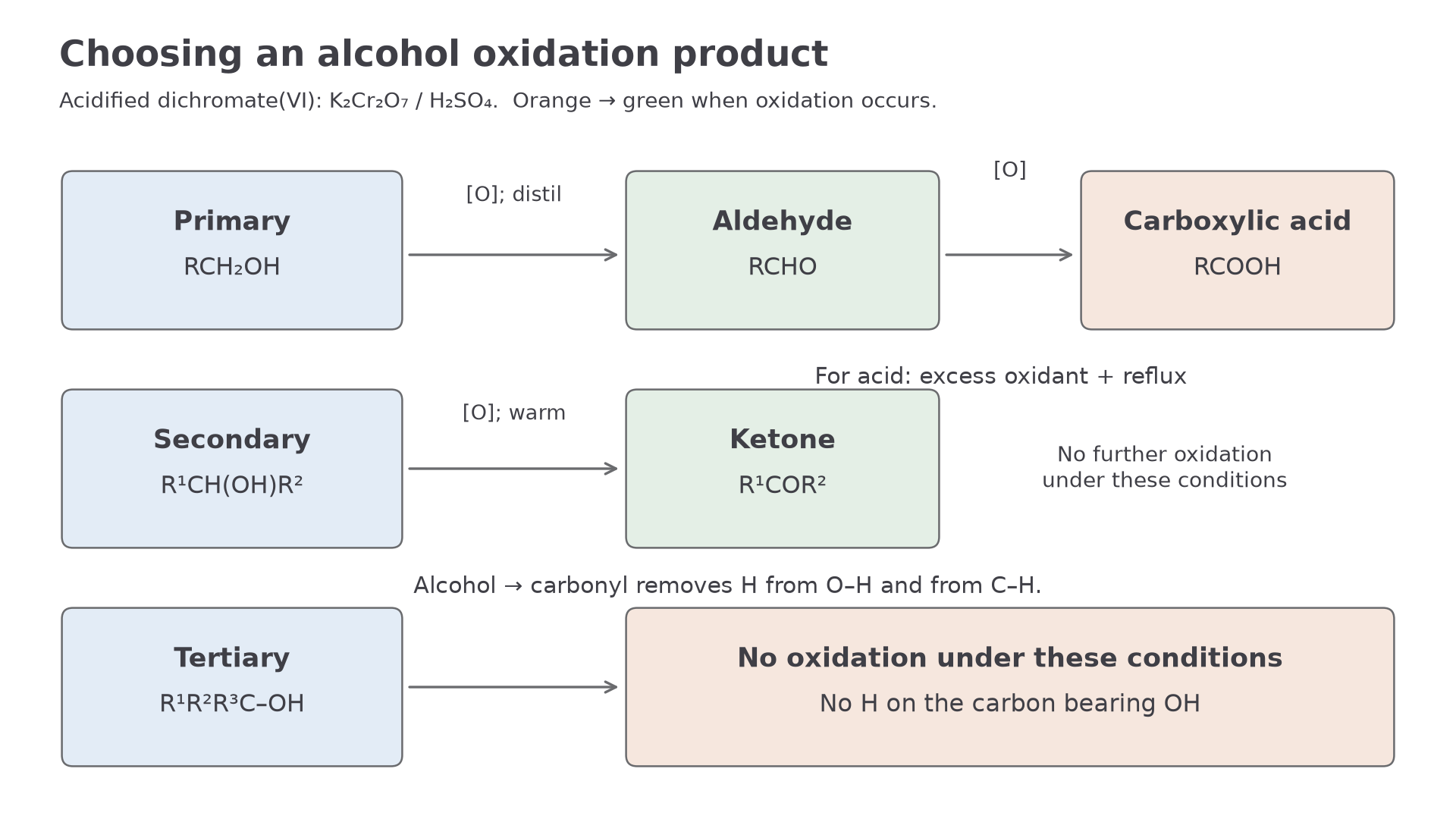
[DIAGRAM: asset_name: Lesson 4.2.1c: Oxidation of alcohols - diagram 01; asset_slug: 04_02_01b_oxidation_of_alcohols__diagram_01; recommended_method: drawn_chem; description: Reaction map showing primary alcohol oxidation to aldehyde by distillation or carboxylic acid by reflux, secondary alcohol oxidation to ketone, and tertiary alcohol resistance, with acidified dichromate orange-to-green observation.]
Primary alcohols to aldehydes
A primary alcohol has the -OH group on a carbon atom that is bonded to either one other carbon atom, or no other carbon atoms in methanol. On oxidation, a primary alcohol can first form an aldehyde.
The general simplified equation is:
Primary alcohol to aldehyde
For example, ethanol can be oxidised to ethanal:
The problem is that aldehydes are also easily oxidised. If ethanal stays in the hot oxidising mixture, it can be oxidised further to ethanoic acid. To make the aldehyde, the reaction is warmed and the aldehyde is distilled off as it forms. Distillation removes the aldehyde from the oxidising mixture before much further oxidation can happen.
Worked example: write the partial oxidation equation for butan-1-ol.
First identify it as a primary alcohol: . Oxidising the end -CH2OH group gives the aldehyde group -CHO.
The product is butanal, and the controlling condition is distillation.
The aldehyde normally has a lower boiling point than its parent alcohol because it cannot form hydrogen bonds with itself. This makes removal by distillation practical. Use a controlled addition and heating procedure with alcohol in excess where appropriate; excess oxidant and prolonged contact favour further oxidation. Distillation controls contact with the oxidant, rather than chemically preventing the aldehyde from reacting.
Primary alcohols to carboxylic acids
If a primary alcohol is heated under reflux with excess acidified dichromate(VI), the aldehyde stays in the reaction mixture and is oxidised further. The final organic product is a carboxylic acid.
Primary alcohol to carboxylic acid
For ethanol, the full simplified organic equation is:
Notice the two important differences from aldehyde formation. The equation uses 2[O], and the condition is reflux rather than immediate distillation. Reflux allows volatile reactants and intermediates to boil and condense back into the flask, so the aldehyde remains exposed to the oxidising agent.
Continue this lesson.
You’re previewing NovaLearn without an account. Create a free account to read the rest.
Create free account