6.3.2(a) - Carbon-13 NMR spectroscopy
Carbon-13 NMR is a structural analysis method for organic molecules. In this lesson you will learn how a carbon-13 spectrum tells you how many different carbon environments are present, how chemical shift values suggest the types of carbon environment, and how to combine those clues to suggest possible structures.
What the Spectrum Shows
A carbon-13 NMR spectrum is a graph of signals from carbon atoms in an organic molecule. The horizontal axis is chemical shift, measured in ppm. In OCR questions, chemical-shift reference data are supplied on the data sheet, so the skill is interpretation, not memorising a whole table.
Carbon Environment
A carbon environment is a set of carbon atoms in a molecule that have the same bonding surroundings and the same position by symmetry. Carbon atoms in the same environment give one carbon-13 NMR signal.
For this OCR point, all assessed carbon-13 NMR spectra are proton decoupled. That means each carbon environment appears as a single signal, rather than a split pattern caused by neighbouring hydrogen atoms. Routine proton-decoupled carbon-13 peak intensities are not quantitative atom counts. Do not use the rule, integration traces, or peak areas in this lesson; those belong to proton NMR or later NMR work.
Worked example: a proton-decoupled carbon-13 NMR spectrum has three signals. This shows that the molecule contains three different carbon environments. It does not necessarily mean the molecule contains only three carbon atoms, because two or more equivalent carbon atoms can give the same signal.
The most common first mark in carbon-13 NMR reasoning is therefore simple but precise:
number of carbon-13 signals = number of different carbon environments
Counting Environments
To count carbon environments, ask whether two carbon atoms are genuinely equivalent. Equivalent carbon atoms have the same bonding surroundings and can be swapped by symmetry without changing the molecule.
Start with simple carbon skeletons:
- In ethane, CH₃CH₃, the two carbon atoms are equivalent, so there is one carbon environment.
- In propane, CH₃CH₂CH₃, the two end CH₃ carbons are equivalent, and the middle CH₂ carbon is different, so there are two carbon environments.
- In butane, CH₃CH₂CH₂CH₃, the two end CH₃ carbons are equivalent, and the two middle CH₂ carbons are equivalent, so there are two carbon environments.
Now compare isomers. Propanone and propanal have the same molecular formula, C₃H₆O, but different carbon environments.
[DIAGRAM: asset_name: Lesson 6.3.2a: Carbon-13 NMR spectroscopy - diagram 02; asset_slug: 06_03_02a_carbon_13_nmr_spectroscopy__diagram_02; recommended_method: drawn_chem; description: NovaLearn grey linework comparison of proton-decoupled carbon-13 stick spectra for propanone and propanal, showing two signals for propanone because its methyl carbons are equivalent and three signals for propanal because all carbon atoms are different.]
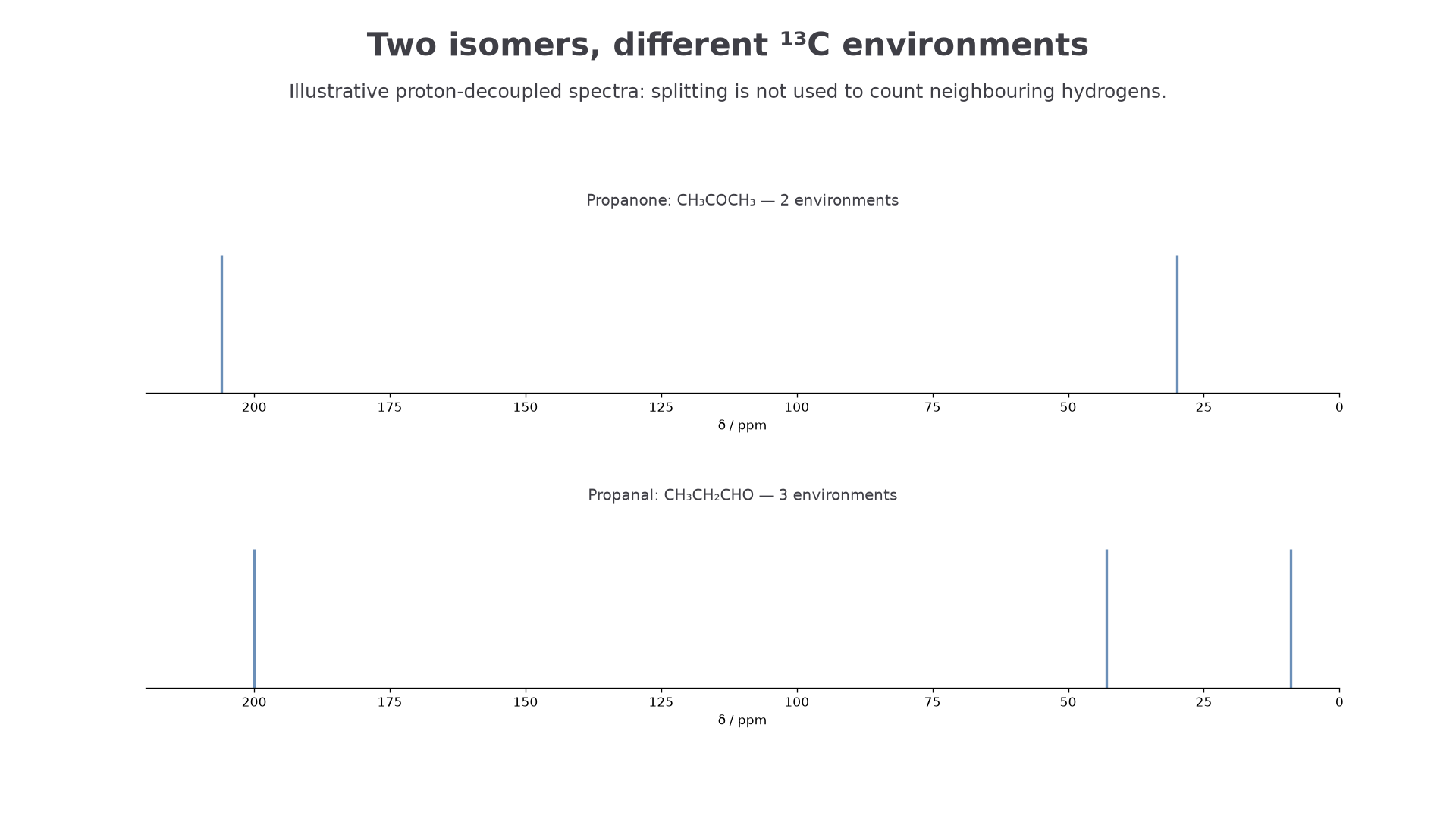
Worked example: propanone is CH₃COCH₃. The two CH₃ groups are on opposite sides of the same group, so those two methyl carbon atoms are equivalent. The carbonyl carbon is different. Propanone therefore has two carbon environments and two carbon-13 signals.
Worked example: propanal is CH₃CH₂CHO. The CH₃, CH₂, and carbonyl carbon are all in different surroundings. Propanal therefore has three carbon environments and three carbon-13 signals.
Aromatic symmetry example. Number the ring of methylbenzene from the carbon bearing CH₃. Reflection through carbons 1 and 4 exchanges 2 with 6 and 3 with 5. Thus the ring has four carbon environments (1; 2/6; 3/5; 4), plus the methyl carbon: five signals from seven carbons. Compare the entire ring substitution pattern, not just whether a carbon bears H.
A common error is to count carbon atoms rather than carbon environments. Another is to assume that two CH₃ groups are always equivalent. They are equivalent only if they have the same surroundings in the molecule.
Using Chemical Shifts
The number of signals tells you how many different carbon environments there are. The chemical shift tells you what type of environment each signal is likely to represent.
Continue this lesson.
You’re previewing NovaLearn without an account. Create a free account to read the rest.
Create free account