3.1.2(d)-(e) - Group 2 oxides, hydroxides and uses
Group 2 oxides and hydroxides are useful because they are basic. In this lesson you will learn how Group 2 oxides react with water, why the resulting solutions become more alkaline down the group, and how selected Group 2 compounds neutralise acids in soils and in the stomach.
Group 2 Oxides with Water
In this lesson, the Group 2 trend means the elements from magnesium to barium: Mg, Ca, Sr and Ba. Their oxides have the general formula , where is a Group 2 metal ion with charge . When these oxides react with water, they form hydroxides with the general formula .
Group 2 oxide + water gives a Group 2 hydroxide.
The general equation is:
For example:
The state symbol for the hydroxide depends on how much dissolves. Magnesium hydroxide is only sparingly soluble, so a mixture made from magnesium oxide and water is often a white suspension with only a small amount dissolved. Calcium hydroxide is slightly soluble. Strontium hydroxide and barium hydroxide are more soluble.
You can also show the dissolved ions formed. For calcium oxide, the dissolved calcium hydroxide gives calcium ions and hydroxide ions:
Combining the steps gives:
The hydroxide ions are what make the solution alkaline.
Worked example: write the oxide-water equation
Write a balanced equation for strontium oxide reacting with water.
Strontium is a Group 2 metal, so its ion is . Oxide is , so strontium oxide is . Hydroxide is , so two hydroxide ions are needed for one :
The balanced equation is:
No hydrogen gas is produced in this reaction. Hydrogen gas is made when some Group 2 metals react with water, but this lesson is about Group 2 oxides reacting with water.
Increasing Alkalinity Down Group 2
An alkaline solution contains hydroxide ions, . The more hydroxide ions there are in solution, the higher the pH.
Alkali
An alkali is a soluble base that releases hydroxide ions, , in aqueous solution.
The important trend is:
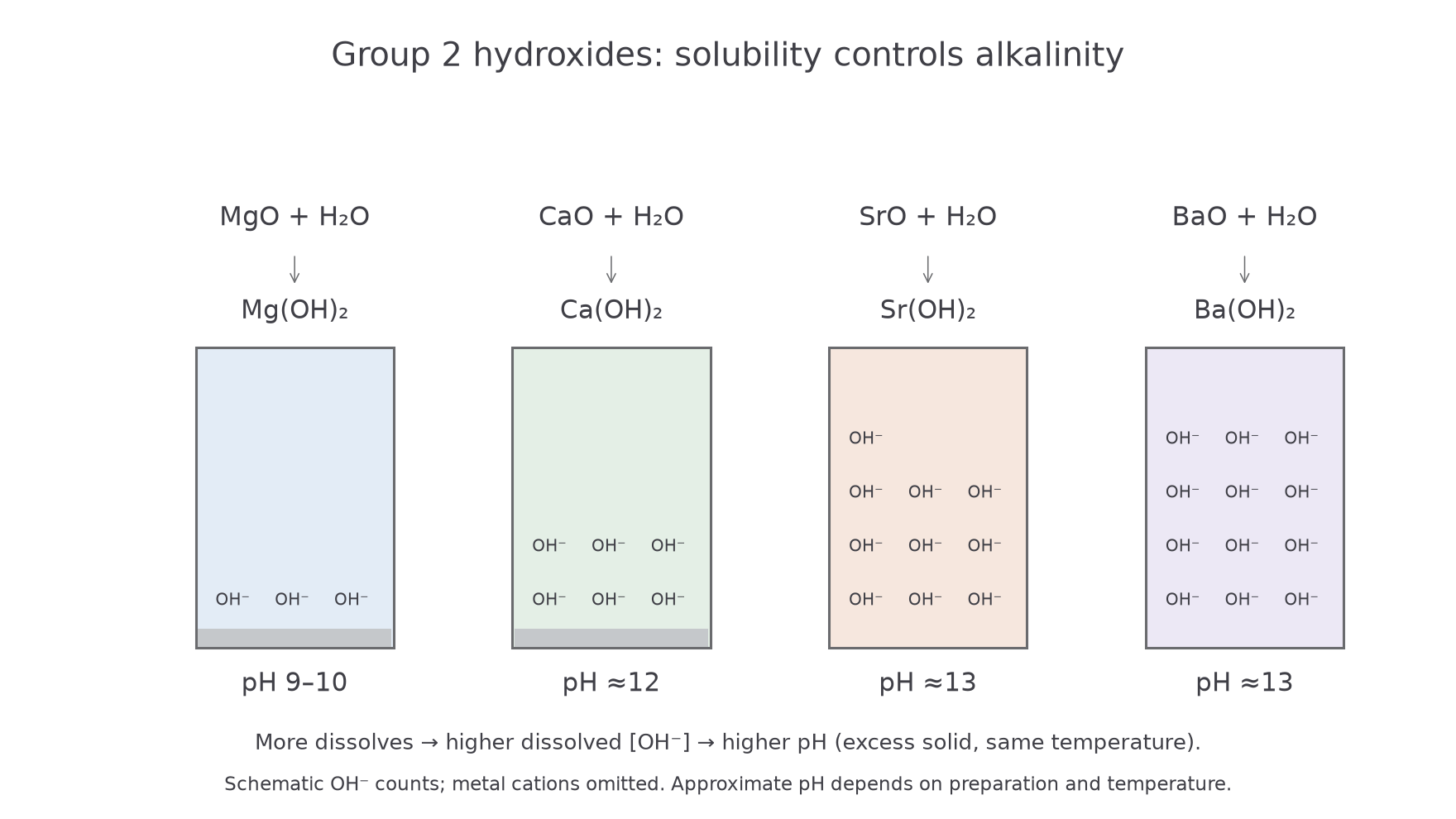
The trend happens because the hydroxides become more soluble down the group. If more dissolves, more ions enter the solution, so the pH increases.
| Oxide added to water | Hydroxide formed | What the mixture is like | Approximate pH |
|---|---|---|---|
| sparingly soluble; often a white suspension | - | ||
| slightly soluble; limewater is alkaline | about | ||
| more soluble | about | ||
| more soluble; strongly alkaline | about |
Compare solutions equilibrated with excess solid at the same temperature. If instead fully dissolved hydroxides have the same molar concentration, each formula unit supplies two hydroxide ions, so solubility alone does not predict a different pH. More solid floating in a suspension does not necessarily mean a higher dissolved hydroxide concentration.
These pH values are approximate. They depend on concentration, temperature and whether the solution is saturated. The assessment point is the trend and its reason: more soluble hydroxide means more dissolved , so higher pH.
Misconception contrast
Do not say that the hydroxide ion itself becomes more alkaline down the group. The ion is still . The change is that more hydroxide ions dissolve in the water.
Worked reasoning: compare magnesium oxide and barium oxide in water
Magnesium oxide reacts with water to form magnesium hydroxide:
Only a small amount of dissolves, so the concentration of in solution is relatively low. The pH is only mildly alkaline, about -.
Barium oxide reacts with water to form barium hydroxide:
Barium hydroxide is much more soluble, so the concentration of in solution is higher. The solution is strongly alkaline, about pH .
[DIAGRAM: asset_slug: 03_01_02b_group_2_oxides_hydroxides_and_uses__diagram_01; description: Oxide-to-hydroxide changes and schematic dissolved hydroxide populations, with excess-solid comparison condition.]
Continue this lesson.
You’re previewing NovaLearn without an account. Create a free account to read the rest.
Create free account