4.2.1(a)-(b) - Alcohol properties, classification and combustion
Alcohols look a lot like alkanes with one important change: an -OH group has replaced a hydrogen atom. That hydroxyl group makes alcohols polar, able to form hydrogen bonds, and much less volatile than comparable alkanes. In this lesson you will use that same structural idea to explain solubility, classify alcohols, and write combustion equations.
The polar hydroxyl group
An alcohol is an organic compound containing the hydroxyl group, -OH. In the simple alcohols in this part of the course, the -OH group is attached to a carbon chain.
The key bond is the O-H bond. Oxygen is more electronegative than hydrogen, so the bonding pair is pulled towards oxygen:
This makes the O-H region of an alcohol polar. The oxygen atom also has lone pairs, so an alcohol molecule can take part in hydrogen bonding.
Hydrogen bond
A hydrogen bond is a strong intermolecular attraction involving a hydrogen atom bonded to a very electronegative atom, such as oxygen, and a lone pair on an electronegative atom in a neighbouring molecule.
[DIAGRAM: asset_name: Lesson 4.2.1a-b: Alcohol properties, classification and combustion - diagram 01; asset_slug: 04_02_01a_alcohol_properties_classification_and_combustion__diagram_01; recommended_method: drawn_chem; description: Two-panel deterministic diagram showing alcohol-water hydrogen bonding from the polar O-H group and classification of primary, secondary and tertiary alcohols by the carbon attached to OH.]
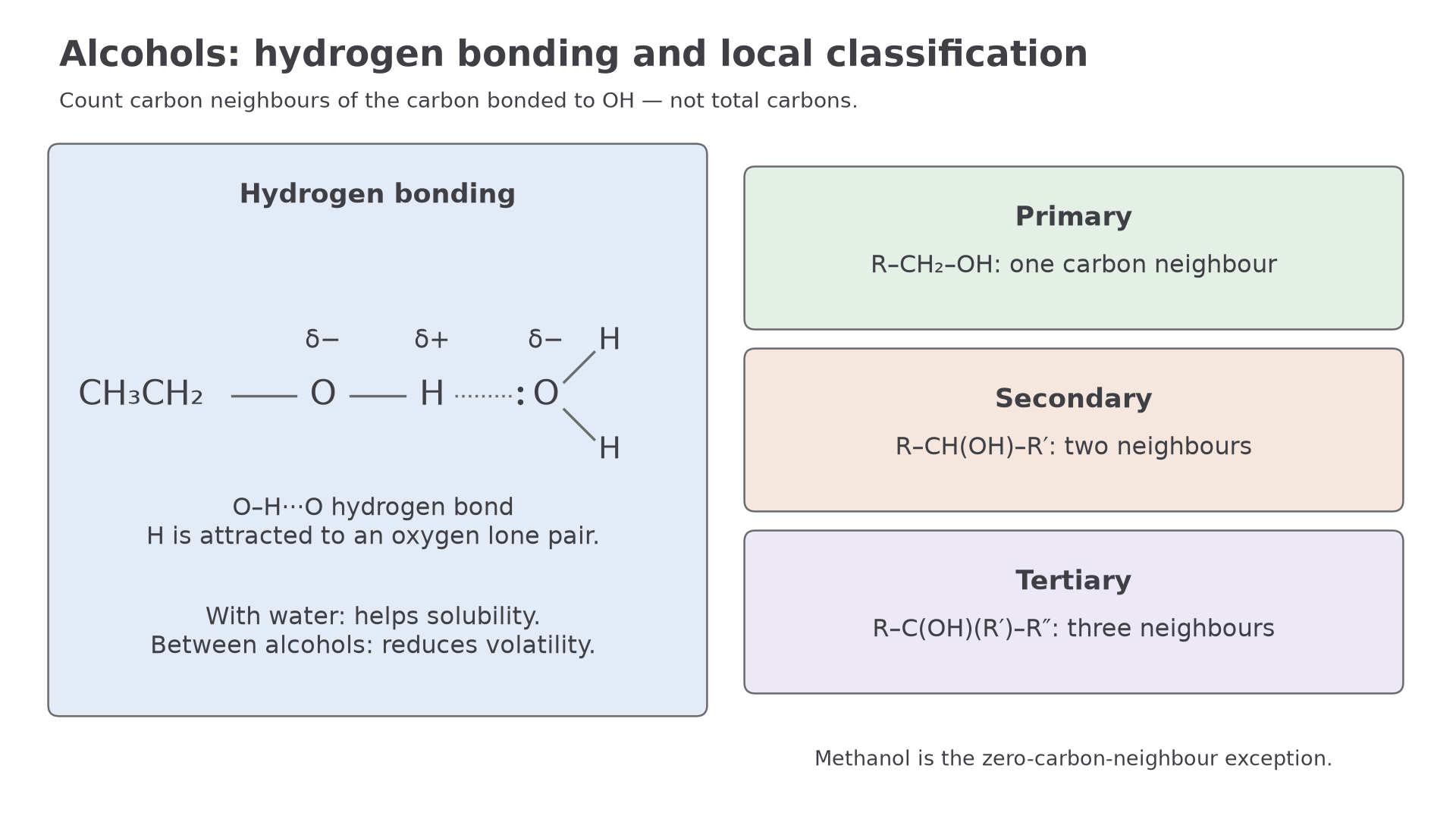
The diagram shows the two ideas OCR expects you to connect: the polar O-H group allows hydrogen bonding, and the carbon bonded to OH is the carbon used for classification.
Water solubility of alcohols
Water molecules are polar and can form hydrogen bonds with each other. Alcohol molecules can fit into that hydrogen-bonding network because the alcohol's -OH group can form hydrogen bonds with water.
For example, ethanol dissolves well in water because ethanol molecules and water molecules can attract each other through hydrogen bonds. Hexane does not dissolve in water because hexane is non-polar and cannot form hydrogen bonds with water.
The carbon chain still matters. The -OH group is the water-friendly part, but the hydrocarbon chain is non-polar. As the chain becomes longer, the non-polar part has a larger effect and water solubility decreases. OCR normally wants the reason, not a memorised cut-off.
Alcohols are much more water soluble than comparable alkanes because alcohol molecules can form hydrogen bonds with water; alkanes cannot.
Low volatility compared with alkanes
Volatility is about how easily a substance vaporises. A more volatile liquid evaporates more readily and usually has a lower boiling point.
Volatility
Volatility is the tendency of a substance to vaporise. A liquid with lower volatility is less easily converted into a gas.
When an alcohol evaporates or boils, the molecules have to separate from each other. This means overcoming intermolecular forces, not breaking covalent bonds inside the molecules.
Alkanes are non-polar. Between alkane molecules, the main attractions are induced dipole-dipole interactions. Alcohols have these attractions too, but they also have hydrogen bonds between alcohol molecules. Hydrogen bonds are stronger, so more energy is needed to overcome the intermolecular attractions in alcohols.
That is why alcohols are relatively less volatile than comparable alkanes. For a fair comparison, use molecules with similar size or molecular mass: an alcohol is not automatically less volatile than every possible alkane.
A common trap is to compare two alcohols and say only one can hydrogen bond. For example, butan-1-ol and 2-methylpropan-2-ol both contain -OH and both can hydrogen bond. Differences between their boiling points then need another argument, such as molecular shape and the strength of induced dipole-dipole interactions.
Continue this lesson.
You’re previewing NovaLearn without an account. Create a free account to read the rest.
Create free account