5.3.1(d)-(e) - Ligands, complex ions and coordination number
Transition metal ions often do not sit alone in solution: they are surrounded by molecules or ions that bond to them using lone pairs. In this lesson, you will learn the exact OCR language for ligands, complex ions and coordination number, then use it to recognise octahedral, tetrahedral and square planar complexes.
Ligands and coordinate bonds
A transition metal ion can accept a lone pair of electrons from a nearby molecule or ion. When both electrons in the shared pair come from the same species, the bond formed is a coordinate bond, also called a dative covalent bond.
Coordinate bond
A coordinate bond is a covalent bond in which both electrons in the shared pair are donated by one atom.
Ligand
A ligand is a molecule or ion that donates a lone pair of electrons to a metal ion or metal atom to form a coordinate bond.
OCR expects you to describe the donation clearly. The ligand is not simply "near" the metal ion; it uses a lone pair to form a coordinate bond to the metal ion. The atom in the ligand that supplies the lone pair is the donor atom.
The required monodentate examples are:
| Ligand | Donor atom | Why it can bond to a metal ion |
|---|---|---|
| O | Oxygen has lone pairs. | |
| N | Nitrogen has a lone pair. | |
| Chloride has lone pairs and a negative charge. |
Do not write that the metal ion donates the lone pair. In this topic the ligand is the electron-pair donor, and the metal ion or metal atom is the electron-pair acceptor.
Monodentate and bidentate ligands
The word dentate describes how many coordinate bonds one ligand can form to the same central metal ion.
Monodentate ligand
A monodentate ligand forms one coordinate bond to the central metal ion.
Water, ammonia and chloride ions are monodentate in the OCR examples. Each one donates one lone pair to form one coordinate bond.
Bidentate ligand
A bidentate ligand forms two coordinate bonds to the central metal ion.
OCR's required bidentate example is ethane-1,2-diamine:
Ethane-1,2-diamine
This ligand is often abbreviated as . The two nitrogen atoms each have a lone pair, so one molecule can attach to the same metal ion at two points. That means one ligand contributes two coordinate bonds.
Worked example:
A complex contains two ligands and two chloride ligands attached to one metal ion. The two ligands contribute coordinate bonds. The two ligands contribute coordinate bonds. The total number of coordinate bonds is therefore .
The key point is that two ligands are not the same as two coordinate bonds. Bidentate ligands use up two bonding positions each.
[DIAGRAM: asset_name: Lone-pair donation by water, ammonia and chloride; both nitrogen donor atoms in ethane-1,2-diamine; asset_slug: 05_03_01b_ligands_complex_ions_and_coordination_number__diagram_01; recommended_method: drawn_chem; description: Lone-pair donation by water, ammonia and chloride; both nitrogen donor atoms in ethane-1,2-diamine]
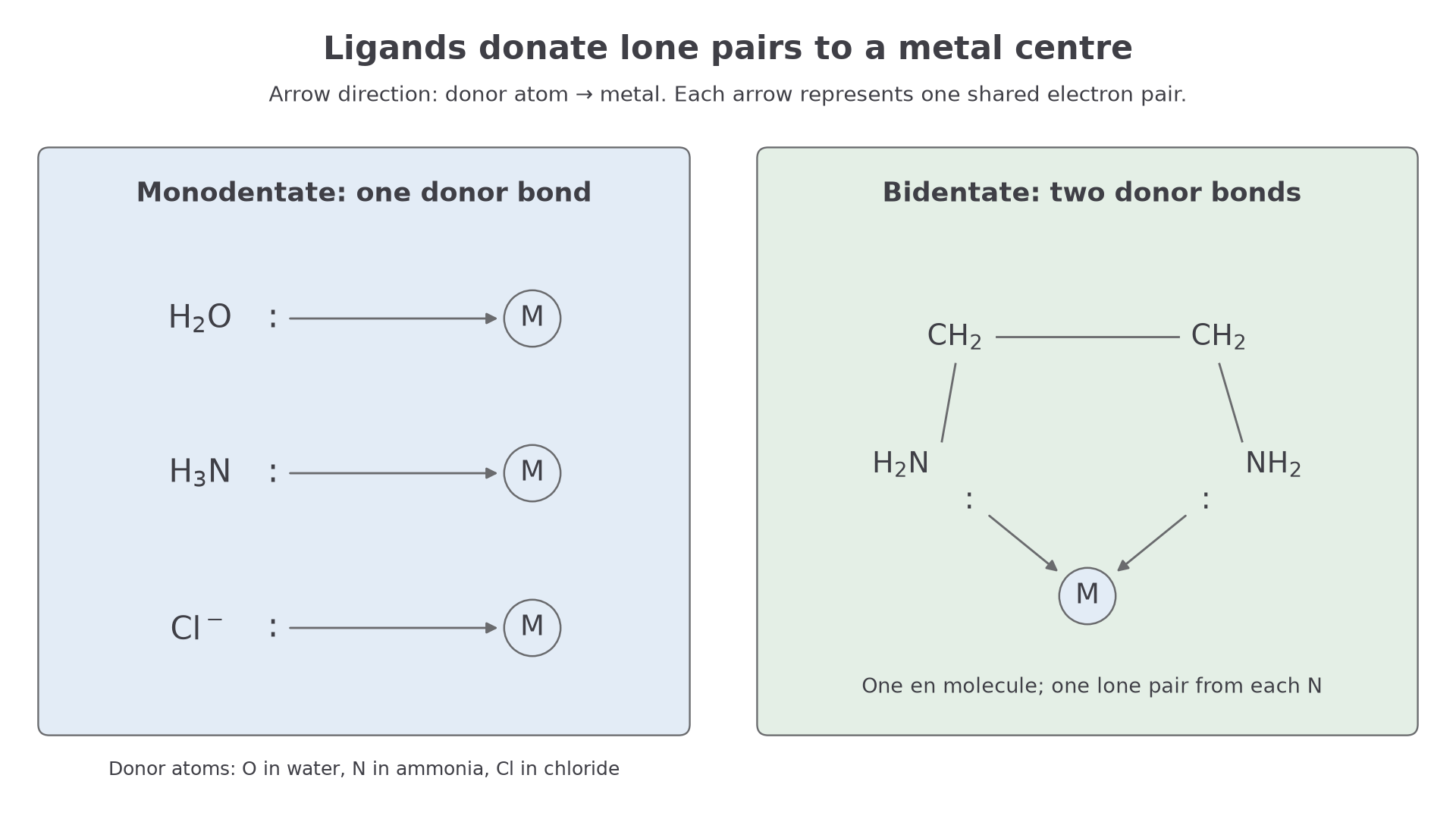
For an unfamiliar ligand, inspect the donor atoms rather than count all lone pairs. Ethanedioate, , can use one oxygen on each carboxylate group to donate two lone pairs to the same metal. Its charge is , whereas en is neutral. A ligand's charge and its denticity are independent properties.
Complex ions and charge
A complex is a central metal ion or metal atom with ligands bonded around it by coordinate bonds. If the whole complex has an overall charge, it is a complex ion.
Complex ion
A complex ion is a charged species made from a central metal ion surrounded by ligands joined by coordinate bonds.
Formulae for complex ions use square brackets around the central metal ion and the ligands. The charge written outside the brackets belongs to the whole complex ion, not to one ligand.
For example:
Hexaaquacopper(II) ion
The six ligands are neutral. The complex ion has a 2+ charge because the central copper ion is .
Tetrachlorocuprate(II) ion
Here the central ion is and each chloride ligand is . The total charge is:
Charge calculation
So the charge is written outside the brackets as .
Platinum complexes such as are useful OCR examples of square planar complexes. This one is neutral overall: is balanced by two ligands, while the two ligands are neutral. Because it is neutral, it is a complex but not a complex ion.
Continue this lesson.
You’re previewing NovaLearn without an account. Create a free account to read the rest.
Create free account