6.2.2(a)-(b) - Amino acids and amides
Amino acids contain two reactive functional groups in the same molecule: a carboxylic acid group and an amine group. In this lesson, you will use that structure to predict the OCR-required reactions with alkalis, alcohols and acids. You will also learn how to recognise primary and secondary amide structures without confusing them with amines.
Alpha-amino acid skeleton
An alpha-amino acid has an amine group, NH₂, and a carboxylic acid group, , attached to the same carbon atom. OCR gives the general formula as:
General alpha-amino acid formula
The group is the side chain. It can be as simple as in glycine, or a carbon chain in other amino acids. For this specification point, the key idea is not the identity of ; it is that the molecule contains both NH₂ and .
[DIAGRAM: asset_name: Lesson 6.2.2a-b: Amino acids and amides - diagram 01; asset_slug: 06_02_02a_amino_acids_and_amides__diagram_01; recommended_method: drawn_chem; description: Deterministic OCR 6.2.2a reaction map showing the alpha-amino acid formula RCH(NH2)COOH and the three required reactions: COOH with alkali to a carboxylate salt, COOH ester formation with alcohol and acid catalyst, and NH2 with acid to an ammonium salt.]
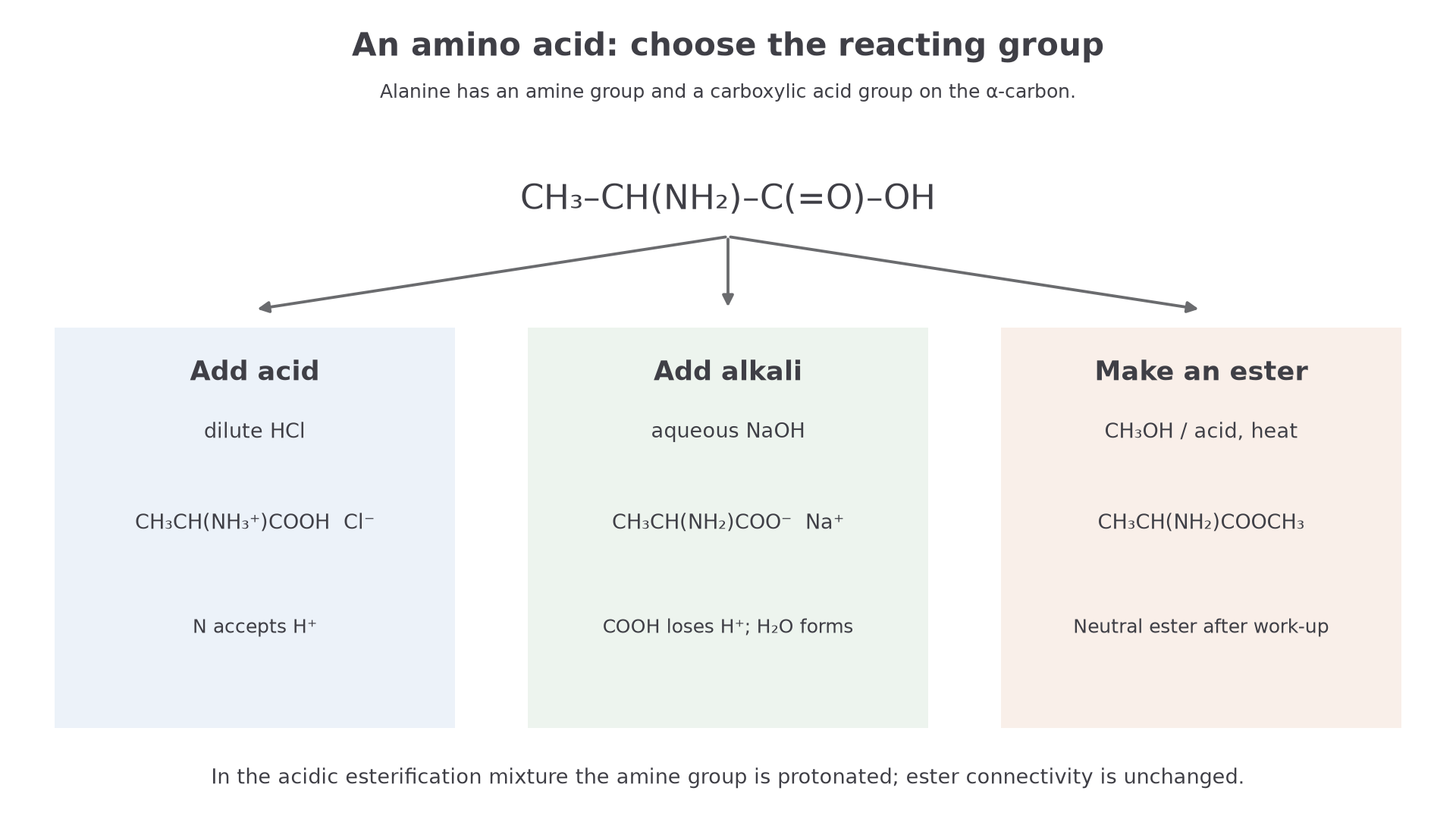
It helps to read the formula as H₂N-CH(R)-COOH. The central carbon carries four different attachments in many amino acids, but chirality and optical isomerism belong to the next lesson. Here, focus on which functional group reacts.
Carboxylic acid group with alkalis
The group in an amino acid reacts as a carboxylic acid. With an alkali such as sodium hydroxide, the acid loses H⁺ from the group and forms a carboxylate salt.
Using the general formula:
The NH₂ group is not the group being changed in this reaction. The product is not an amide and not an ester. It is an amino acid carboxylate salt.
Worked example: glycine with sodium hydroxide
Glycine is H₂NCH₂COOH. Sodium hydroxide reacts with the carboxylic acid group:
The carbon skeleton is unchanged. The acidic hydrogen is removed as a proton and the sodium ion is a counter-ion to ; do not draw a covalent O–Na bond.
In alkali, write the acid-derived product as a carboxylate salt, or , not as .
Ester formation from the carboxylic acid group
The same group can form an ester with an alcohol. This is the amino-acid version of esterification from carboxylic acids: the part of is replaced by .
Amino acid ester formation
A suitable condition is an acid catalyst, such as concentrated sulfuric acid. OCR's focus here is the product connectivity: the ester must contain , with the carbonyl carbon still part of the original amino acid.
Worked example: alanine with methanol
Alanine is CH₃CH(NH₂)COOH. Methanol supplies the methyl group after the ester oxygen:
The ester product can be described as methyl 2-aminopropanoate. The neutral ester formula shown represents the product after suitable work-up. In the acidic reaction mixture the amino group is protonated, giving an ammonium ester salt. This acid-base change does not alter the ester connectivity: esterification changes into . A correctly drawn protonated ester with its counter-ion is also a valid representation of the acid-mixture product.
Continue this lesson.
You’re previewing NovaLearn without an account. Create a free account to read the rest.
Create free account