5.2.2(a)-(c) - Entropy and entropy change
Entropy describes how energy is dispersed and helps explain thermodynamic stability when considered alongside enthalpy and conditions. In this lesson, you will learn entropy as a model for energy dispersal and disorder, compare entropy in solids, liquids and gases, and calculate the entropy change of a reaction from supplied entropy data.
Entropy as energy dispersal
In chemistry, a system is the chemical reaction or physical process you are focusing on. For this lesson, entropy means the entropy of that system, not the surroundings.
Entropy
Entropy is a measure of the dispersal of energy in a system. A system has greater entropy when its energy is more spread out and the particles are more disordered.
The word "disordered" is useful, but it is not the whole definition. OCR's wording puts energy dispersal first: the more ways energy can be spread among particles and arrangements, the higher the entropy.
This model helps explain thermodynamic stability. Greater entropy can favour thermodynamic stability when other factors are comparable because more arrangements are available. Entropy alone does not determine feasibility; the next lesson combines entropy with enthalpy and temperature. For example, particles in a gas can move through a large volume and have many possible positions and speeds, so the energy is more dispersed than in a rigid solid.
Do not treat entropy as a judgement about neatness. A tidy-looking beaker of gas still has high entropy compared with a solid because the particles and their energy are much more spread out.
Comparing entropy magnitudes
The physical state of a substance has a large effect on its entropy. For the same substance, entropy usually increases in this order:
Entropy and physical state
In a solid, particles vibrate around fixed positions, so the particles and energy have relatively few arrangements. In a liquid, particles are still close together but can move past each other, so there are more arrangements. In a gas, particles are far apart and move freely, so there are many more possible arrangements and much greater energy dispersal.
[DIAGRAM: asset_name: Lesson 5.2.2a-c: Entropy and entropy change - diagram 01; asset_slug: 05_02_02a_entropy_and_entropy_change__diagram_01; recommended_method: drawn_chem; description: Deterministic teaching diagram comparing solid, liquid and gas particle arrangements and showing that a reaction forming more gaseous molecules usually has a positive entropy change for the system.]
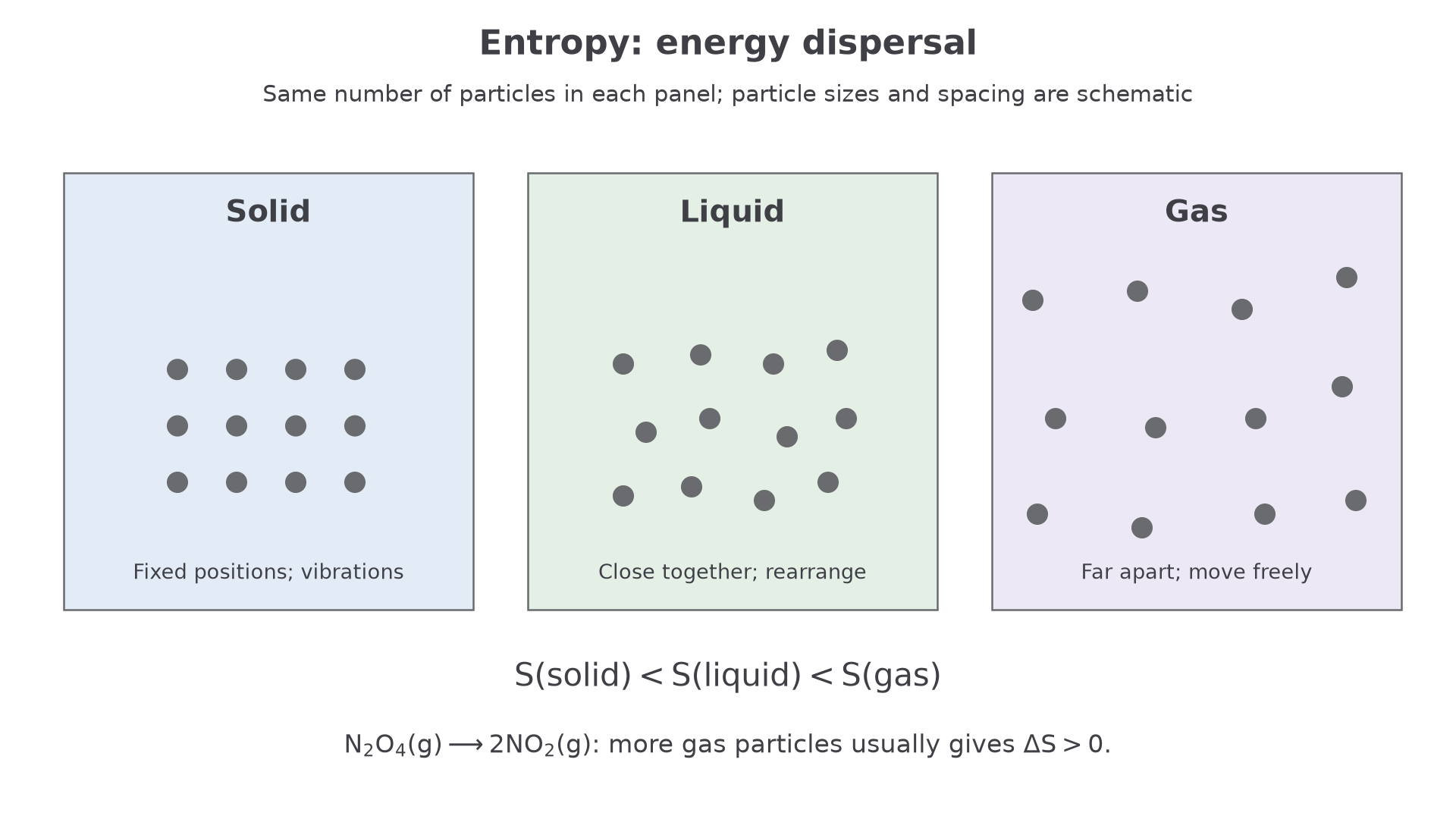
A standard molar entropy compares one mole of each substance. If you compare of a gas with of a solid, explain particle freedom and energy dispersal; do not use the coefficients of a reaction as the reason. Coefficients enter only when finding the entropy change for the whole balanced reaction. Elements also have non-zero standard molar entropies at ordinary temperatures: do not confuse with the zero standard enthalpy of formation convention.
For reactions, changes in the number of gaseous molecules are especially important. If a reaction forms more moles of gas than it uses, the entropy of the system usually increases. If it uses up gas molecules and forms fewer gas molecules, the entropy of the system usually decreases.
Worked reasoning:
One mole of gaseous molecules becomes two moles of gaseous molecules. The products have more independently moving gas particles, so the entropy change of the system is likely to be positive.
Now compare:
Three moles of gaseous molecules become two moles of gaseous molecules. The products have fewer gas particles, so the entropy change of the system is likely to be negative.
This is a prediction rule, not a replacement for calculation. When entropy values are supplied, use the values.
Calculating entropy change
Entropy values for substances are usually given as standard molar entropies. Their unit is:
Standard entropy unit
Continue this lesson.
You’re previewing NovaLearn without an account. Create a free account to read the rest.
Create free account