4.1.2(a)-(c) - Alkane structure, shape and physical properties
Alkanes are the first hydrocarbon family in OCR organic chemistry. In this lesson, you will connect their bonding model to their 3-D shape and then use that structure to explain boiling-point trends. The aim is not just to remember that alkanes are "single-bonded", but to explain why that matters in OCR-style wording.
Saturated hydrocarbons and sigma bonds
An alkane is a hydrocarbon, so it contains carbon and hydrogen atoms only. It is also saturated, which means its carbon skeleton contains only single bonds between carbon atoms; there are no C=C double bonds.
Saturated hydrocarbon
A saturated hydrocarbon contains carbon and hydrogen atoms only, with only single carbon-carbon bonds in the carbon chain.
In alkanes, the single C-C bonds and the single C-H bonds are all sigma bonds, written as σ-bonds. A σ-bond is formed by direct overlap of orbitals along the line between the two bonding atoms. At A level, you do not need to describe hybridisation; the required model is simply direct orbital overlap.
Sigma bond
A σ-bond is a covalent bond formed by overlap of orbitals directly between the two bonding atoms.
That direct overlap matters because a C-C σ-bond can rotate. If you imagine looking along the C-C bond in ethane, the two CH₃ groups can turn relative to each other without breaking the σ-bond. The molecule is still ethane; only the temporary 3-D arrangement has changed.
[DIAGRAM: asset_name: Lesson 4.1.2a-c: Alkane structure, shape and physical properties - diagram 01; asset_slug: 04_01_02a_alkane_structure_shape_and_physical_properties__diagram_01; recommended_method: drawn_chem; description: Two-panel line diagram showing direct orbital overlap forming a C-C sigma bond in ethane and a tetrahedral carbon with 109.5 degree bond angles, using wedge, dash and plain bond conventions.]
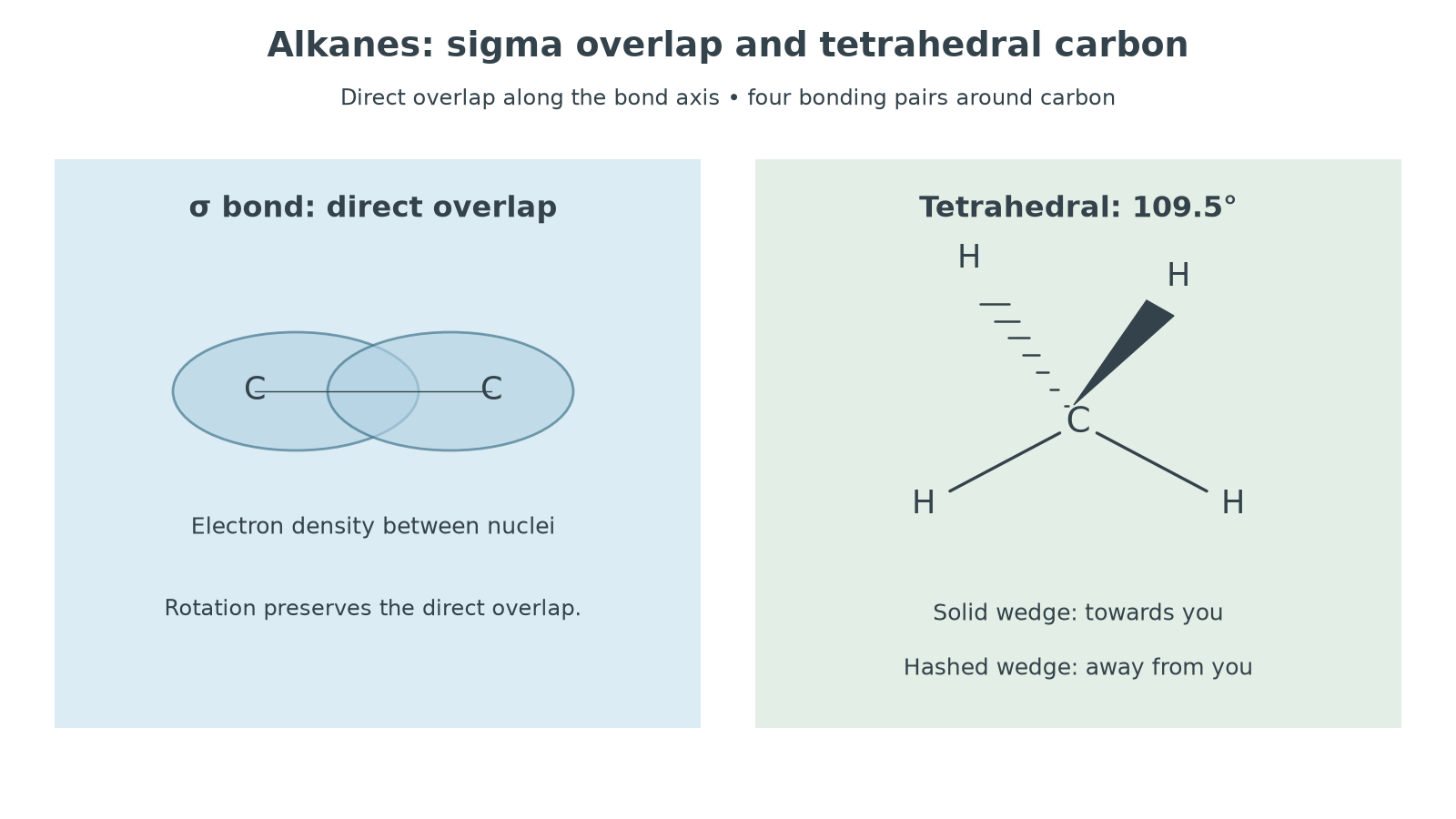
A common trap is to treat "free rotation" as if atoms are moving randomly through space. They are not detaching from carbon. Rotation is specifically around the axis of the C-C σ-bond.
For propane, , count eight C–H bonds and two C–C bonds: ten σ bonds in total. Count each connection only once; each single bond is one σ bond.
Tetrahedral carbon atoms
Every carbon atom in an alkane forms four single covalent bonds. Around that carbon there are four bonded pairs of electrons. These bonded electron pairs repel one another and spread out as far apart as possible.
The result is a tetrahedral arrangement around each carbon atom, with bond angles of about 109.5 degrees. This applies to methane, to each carbon in ethane, and to each carbon in longer or branched alkanes. The groups attached to a carbon may be different, but the local arrangement around a saturated alkane carbon is still tetrahedral.
For an alkane carbon: four bonded electron pairs repel as far apart as possible, giving a tetrahedral shape and a bond angle of about 109.5 degrees.
The wording matters. OCR marks the explanation in terms of electron pair repulsion, not "atoms repel". Atoms are attached to the carbon, but it is the electron pairs in the bonds that are used to explain the shape.
When you draw a 3-D alkane carbon on paper, use the usual convention:
- a straight line for a bond in the plane of the page
- a solid wedge for a bond coming out of the page
- a dashed wedge for a bond going behind the page
To draw methane, put C at the centre, draw two ordinary C–H lines in the page, one solid wedge that broadens towards an H in front, and one hashed wedge towards an H behind. The wedge is narrow at C. A flat cross of four lines does not communicate the tetrahedral shape. A longer unbranched chain is drawn as a zig-zag because successive C–C–C angles are about 109.5°, not 180°.
This is a representation skill, not a new kind of bond. All four bonds around that carbon are still σ-bonds.
Chain length and boiling points
Boiling an alkane separates its molecules from one another. It does not break the covalent C-C or C-H bonds inside each molecule. The energy supplied is used to overcome intermolecular forces between alkane molecules.
Alkanes are non-polar or nearly non-polar molecules, so the key intermolecular forces between them are induced dipole-dipole interactions, also called London forces. These arise because electron clouds are constantly moving; a temporary dipole in one molecule can induce a dipole in a neighbouring molecule.
Continue this lesson.
You’re previewing NovaLearn without an account. Create a free account to read the rest.
Create free account