5.3.2 - Transition metal qualitative analysis
Qualitative analysis identifies which ions are present in an unknown compound from test-tube observations. In this lesson you will combine the earlier carbonate, sulfate, halide and ammonium tests with the transition-metal cation tests for , , , and . The important skill is not just remembering colours: it is using a clean sequence, recording exact observations and making a justified inference.
Testing an unknown
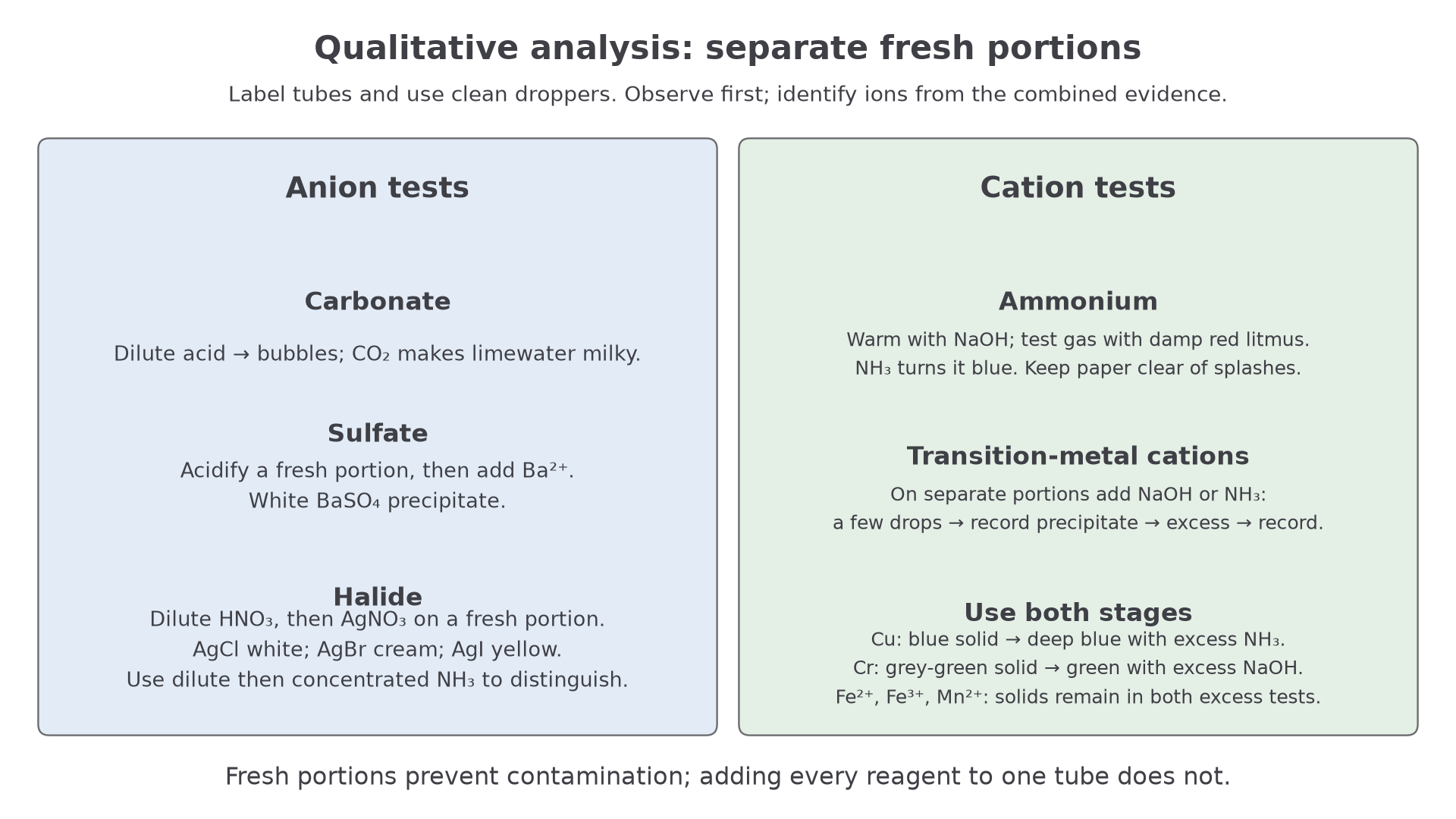
Qualitative analysis is done on a small scale, using clean test tubes or a microscale tray. For an unknown compound, use fresh small portions of the solution wherever possible. That stops one reagent from contaminating the next test and makes the observations easier to interpret.
Qualitative Analysis
Qualitative analysis identifies which substance or ion is present. It gives identity from observations, not the amount of the substance present.
For each test, write evidence in this order:
| stage | what to record |
|---|---|
| reagent and condition | for example, added dropwise, then in excess |
| observation | colour, precipitate, effervescence, gas test or dissolving behaviour |
| inference | the ion identified, such as or |
| equation | an ionic equation for a positive reaction where the chemistry is required |
[DIAGRAM: asset_name: Lesson 5.3.2: Transition metal qualitative analysis - diagram 01; asset_slug: 05_03_02_transition_metal_qualitative_analysis__diagram_01; recommended_method: drawn_chem; description: 16:9 workflow map showing fresh portions, the carbonate-sulfate-halide anion sequence, ammonium testing, and transition-metal cation testing with dropwise and excess NaOH(aq)/NH3(aq), with key observations for Cu2+, Fe2+, Fe3+, Mn2+ and Cr3+.]
PAG4 practical work also expects sensible risk management. Wear eye protection, use small volumes, warm gently, point heated test tubes away from people, and do not smell gases directly. Barium salts, silver nitrate, ammonia, sodium hydroxide and transition-metal solutions all need careful handling and waste disposal as instructed.
Worked reasoning: why fresh portions matter
Carbonate can produce a white barium precipitate and interfere with the sulfate test. Acidifying that fresh portion removes carbonate before barium ions are added. The order of tests is a planning aid, not permission to add every reagent to one tube. For halides, nitric acid removes carbonate without introducing chloride; ammonia solubility then helps identify the silver halide.
Carrying out and checking the tests
Label separate tubes for carbonate, sulfate, halide and cation tests. Dissolve a small amount of solid in deionised water if it is soluble, and divide it into small portions. Use separate clean droppers so reagents do not cross-contaminate stock bottles. Compare against a white background and record dropwise and excess-reagent observations separately. Repeat an ambiguous test on a fresh portion; a known positive sample and a deionised-water blank help distinguish failed reagent from contamination.
A negative result means the ion was not detected under the test conditions, not proof that no trace exists. Check that enough sample was used and that the correct reagent was added before ruling an ion out. Written planning practises PAG4 reasoning, but actual practical competence requires carrying out the tests under supervision.
Anion evidence
The anions in this lesson are , , , and . A useful planning order is:
- carbonate
- sulfate
- halide
The order helps interpret possible interference. Carbonate can form white barium carbonate, so acidify the fresh sulfate-test portion with dilute or first, allowing any carbonate effervescence to finish before adding barium ions. If sulfate is present at sufficiently high concentration, a white silver precipitate needs care: use the full halide colour and ammonia-solubility evidence rather than colour alone. Keep every test on a fresh portion; never use the chloride-containing sulfate-test tube for a halide test.
| ion | test | positive observation | ionic equation |
|---|---|---|---|
| add dilute acid; test the gas with limewater | effervescence; limewater turns milky | ||
| add aqueous barium ions after acidifying a fresh portion with dilute or to remove carbonate | white precipitate | ||
| acidify with dilute nitric acid, then add | white precipitate, dissolves in dilute ammonia | ||
| acidify with dilute nitric acid, then add | cream precipitate, dissolves in concentrated ammonia | ||
| acidify with dilute nitric acid, then add | yellow precipitate, insoluble in concentrated ammonia |
Dilute nitric acid is used before silver nitrate because it acidifies without adding chloride, bromide or iodide ions. Do not use hydrochloric acid before the halide test, because it adds and can create a false white precipitate.
Worked example: anion deduction
An unknown solution gives no effervescence with dilute acid. A fresh portion gives no precipitate with aqueous barium ions. Another fresh portion is acidified with dilute nitric acid and silver nitrate is added. A cream precipitate forms. The precipitate does not dissolve in dilute ammonia but dissolves in concentrated ammonia.
No effervescence means carbonate is not detected. No precipitate with barium ions means sulfate is not detected. The cream silver halide precipitate that dissolves only in concentrated ammonia identifies :
Cation strategy
The cations in this lesson are , , , , and .
Ammonium is different from the transition-metal cations. It is detected by producing ammonia gas:
Continue this lesson.
You’re previewing NovaLearn without an account. Create a free account to read the rest.
Create free account