5.1.3(g)-(h) - Weak acid pH calculations and approximations
Weak acid calculations are equilibrium calculations written in pH language. You will use , pH and concentration data to find pH, , or a related quantity for a weak monobasic acid. The important skill is knowing exactly when the usual shortcut is sensible, because OCR expects you to understand the approximation rather than solve a quadratic equation.
Weak Acid Model
A weak acid only partially dissociates in aqueous solution. For a weak monobasic acid, one molecule of acid can donate one proton, so the general dissociation can be written as:
Here, is the undissociated acid and is its conjugate base. OCR usually writes hydrogen ions as , even though in water the proton is hydrated.
Weak Monobasic Acid
A weak monobasic acid is an acid that partially dissociates in water and can donate one proton per molecule in an acid-base reaction.
The acid dissociation constant, , measures the position of this acid dissociation equilibrium:
Acid Dissociation Constant
The square brackets mean equilibrium concentrations, usually in . For this weak monobasic acid expression, has units of .
At the same temperature and comparable initial acid concentration, a larger means a greater proportion of the acid dissociates. A smaller means the acid is weaker.
OCR Approximations
Suppose the initial concentration of the weak acid is . Let be the concentration of acid that dissociates, so is also the equilibrium concentration of from the acid.
Ignoring the negligible contribution from water for this model, the equilibrium concentrations are then:
| species | equilibrium concentration |
|---|---|
That would give:
If is very small compared with , then is almost the same as . OCR states this as:
or:
The second approximation is:
For a solution made from the weak acid alone, each dissociated acid molecule produces one and one . Their concentrations are therefore approximately equal when water's contribution is negligible. This assumption does not apply to a buffer with a substantial amount of conjugate base deliberately added; there must be included separately in the expression.
[DIAGRAM: asset_name: Lesson 5.1.3g-h: Weak acid pH calculations and approximations - diagram 01; asset_slug: 05_01_03c_weak_acid_ph_calculations_and_approximations__diagram_01; recommended_method: drawn_chem; description: Deterministic flow diagram showing HA equilibrium, starting concentration c, change x, equilibrium concentrations c - x, x and x, the two OCR approximations, the simplified formula [H+] ~ sqrt(Ka c), and the caution that a large x/c makes the approximation unreliable.]
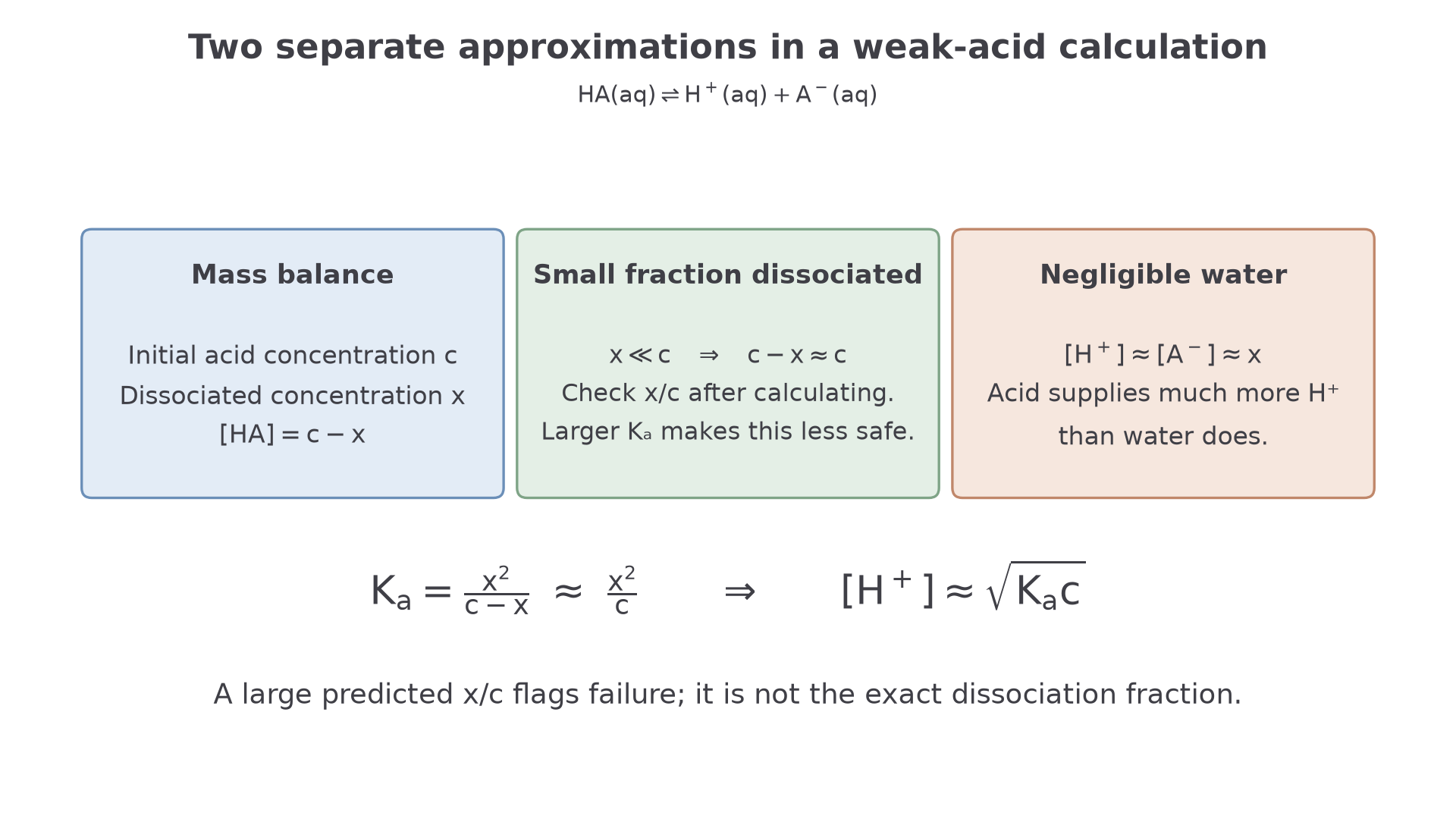
Using both approximations:
so:
This is the central shortcut for weak acid pH calculations. The word "approximate" matters: OCR will not require you to solve the quadratic equation if the approximation is poor, but you may need to explain why it is poor.
pH from and Concentration
When and the initial acid concentration are known, the route is:
- Use .
- Calculate pH using .
- Round the answer sensibly, or as requested in the question.
Displayed intermediate values are rounded for readability. Carry the full calculator value into the next step and round only the final answer.
Worked example: finding pH
Calculate the pH of ethanoic acid at 25 °C, using .
First calculate :
Then calculate pH:
Check the approximation as well as the pH: . The estimated amount dissociated is small compared with the initial concentration. Its pH is also above 1.00, as expected for partial rather than complete dissociation of a 0.100 monobasic acid.
Common errors are forgetting the square root, using directly as the pH, or treating the weak acid as if equals the full acid concentration.
Continue this lesson.
You’re previewing NovaLearn without an account. Create a free account to read the rest.
Create free account