5.1.1(a)-(c) - Rate equations, orders and rate constants
Rate equations let you turn rate data into a compact mathematical model for a reaction. In this lesson you will learn the required rate terms, use initial-rates data to deduce orders, write rate equations, and calculate the rate constant with its units. The important habit is to let the evidence decide the rate equation: it is not copied from the balanced chemical equation.
Kinetic Terms
A reaction rate describes how quickly a reaction changes. For rate equations, OCR usually expresses rate as the change in concentration per unit time, so a common unit is .
Rate of Reaction
Rate of reaction is the change in concentration of a reactant or product per unit time. If a reactant is being used up, chemists usually quote the positive size of the rate of disappearance.
Order
The order with respect to a reactant is the power to which that reactant concentration is raised in the rate equation.
Overall Order
The overall order is the sum of the individual orders in the rate equation.
Rate Constant
The rate constant, , is the constant that links the rate to the concentration terms in the rate equation for a stated reaction at a stated temperature.
Two other terms belong in this topic, even though later lessons use them more deeply.
Half-life
Half-life is the time taken for the concentration of a reactant to fall to half its original value.
Rate-determining Step
The rate-determining step is the slowest step in a multi-step reaction mechanism.
A key boundary for this lesson is that half-life calculations from integrated rate equations are not being taught here. For now, you need the term and the idea. You will use graph evidence and first-order half-life relationships in the next rates lesson.
Worked example: recognising the terms
For the rate equation
the reaction is second order with respect to , first order with respect to , and third order overall. The rate constant is ; its units cannot be known until the full rate equation and the rate unit are considered.
What a Rate Equation Means
A rate equation shows how the rate depends on reactant concentrations. At A level, the required form is:
Rate Equation Form
and mean concentrations, usually in . The powers and are the orders with respect to A and B. In this lesson those orders are 0, 1 or 2.
The powers have precise meanings:
| Order with respect to A | What happens when doubles and other conditions are constant | Meaning in the rate equation |
|---|---|---|
| 0 | rate does not change | , so A is omitted |
| 1 | rate doubles | rate is proportional to |
| 2 | rate becomes four times larger | rate is proportional to |
This is where students often lose marks: the orders are found from experimental data, not from the coefficients in the overall balanced equation. If a balanced equation says , that does not prove the rate equation is . The reaction may occur by several steps, and the measured rate depends on the slow step and on the experimental conditions.
[DIAGRAM: asset_name: Lesson 5.1.1a-c: Rate equations, orders and rate constants - diagram 01; asset_slug: 05_01_01a_rate_equations_orders_and_rate_constants__diagram_01; recommended_method: drawn_chem; description: A clean 16:9 workflow diagram showing initial-rates analysis: choose two experiments where only one concentration changes, compare concentration ratio to rate ratio, infer order 0/1/2, write rate = k[A]^m[B]^n, then calculate k and derive its units from the rate equation.]
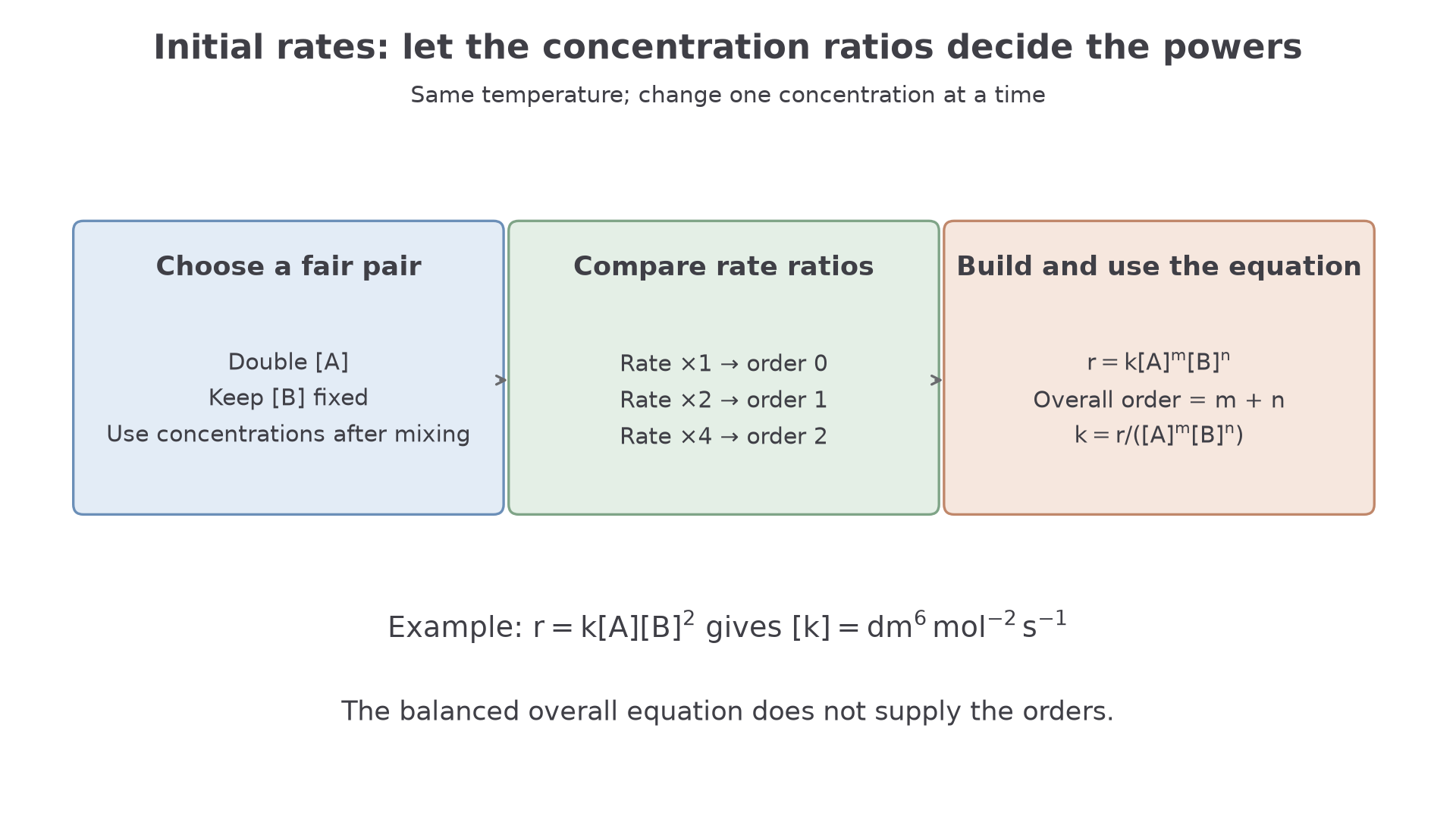
In an initial-rates investigation, each run starts with known initial concentrations. The rate is measured right at the start, or estimated from a fixed early change, so the concentrations have not yet changed much. The fair comparison is to change one initial concentration while keeping the other initial concentrations and temperature constant.
A rate equation is an experimental model: concentration data decide the powers, and the completed equation decides the units of .
Deducing Orders from Initial Rates
To deduce an order, compare two experiments where only one reactant concentration changes. Keep your reasoning in ratios:
Worked example: finding orders from a table
The initial rates below were measured at the same temperature.
| Experiment | / | / | / | Initial rate / |
|---|---|---|---|---|
| 1 | 0.100 | 0.200 | 0.500 | |
| 2 | 0.200 | 0.200 | 0.500 | |
| 3 | 0.100 | 0.400 | 0.500 | |
| 4 | 0.100 | 0.200 | 1.000 |
Compare experiments 1 and 2. Only changes. doubles from 0.100 to 0.200, and the rate doubles from to .
So the order with respect to A is 1.
Compare experiments 1 and 3. Only changes. doubles from 0.200 to 0.400, and the rate becomes four times larger.
So the order with respect to B is 2.
Compare experiments 1 and 4. Only changes. doubles, but the rate is unchanged.
So the order with respect to C is 0. C is not written in the rate equation because .
The rate equation is therefore:
The overall order is:
Notice the careful language: C may still be present in the reaction mixture, but changing its concentration does not affect the measured rate under these conditions.
Worked example: both concentrations change
Sometimes no convenient pair keeps the second concentration fixed. First use a simpler pair to find one order, then remove its known effect from the mixed comparison. Suppose separate evidence establishes first order in A. In another pair, triples, halves and the rate becomes 0.750 times its previous value.
so : B is second order. The rate did not simply follow B's change because A changed as well. Check the conclusion: , exactly the observed factor. This is a ratio calculation; no absolute value of is needed.
Continue this lesson.
You’re previewing NovaLearn without an account. Create a free account to read the rest.
Create free account