3.2.3(a)-(d) - Dynamic equilibrium and Le Chatelier's principle
Equilibrium is what happens when a reversible reaction stops changing in appearance, even though particles are still reacting both ways. In this lesson you will learn how to recognise dynamic equilibrium, predict qualitative shifts when conditions change, and explain why catalysts speed up equilibrium without changing where it lies. You will also meet the kind of simple colour-change experiments used to investigate equilibrium position.
Dynamic equilibrium in a closed system
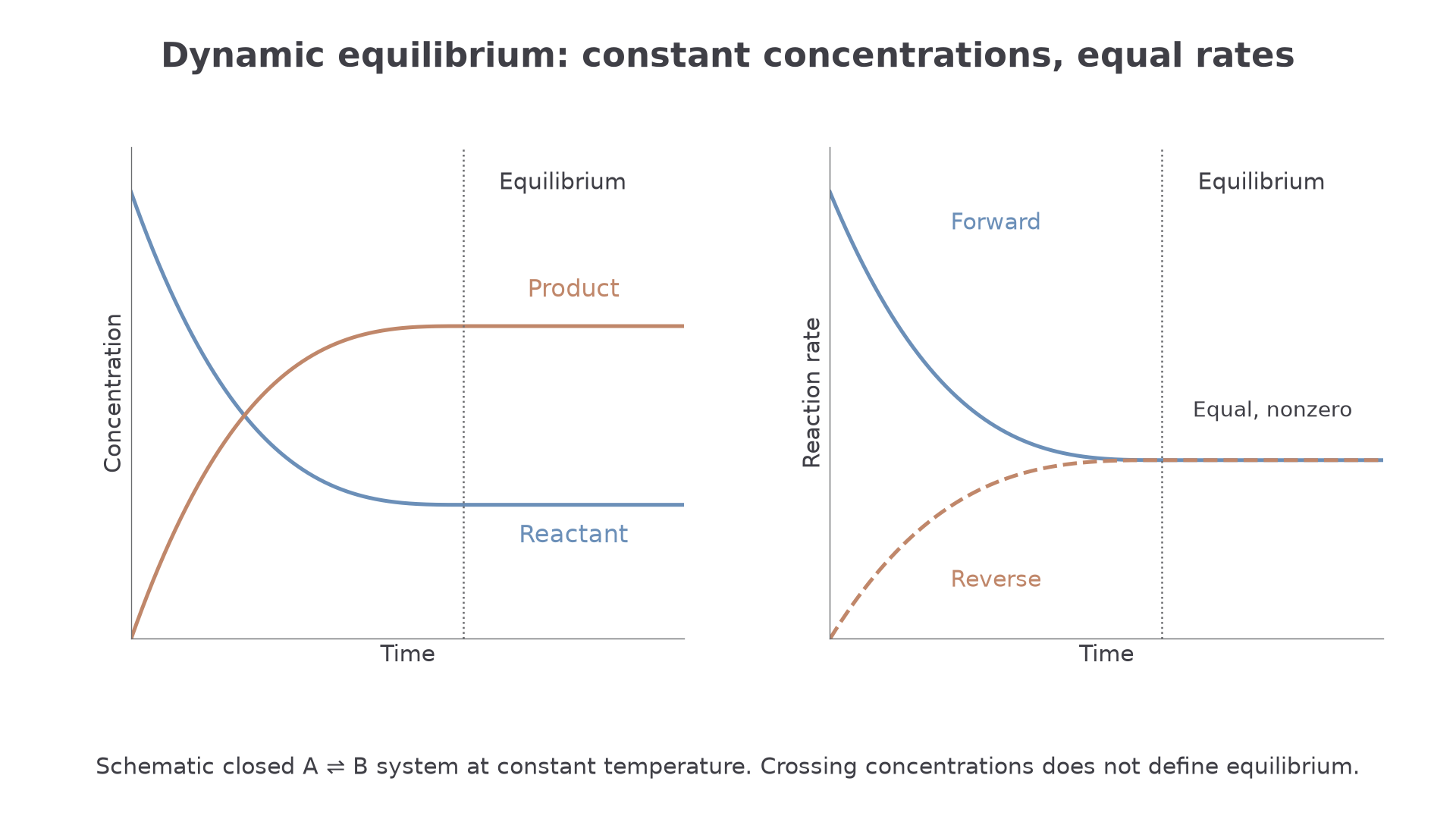
On a concentration–time graph, equilibrium begins when the concentrations become horizontal and remain constant, though reactant and product concentrations need not be equal. A marker placed while either concentration is still changing would be incorrect.
A reversible reaction can go in both directions. The forward reaction makes products from reactants; the reverse reaction makes reactants from products. A reversible reaction is usually written with the equilibrium arrow, ⇌.
For example:
At the start, if only hydrogen and iodine are mixed, the forward reaction is faster because there are many reactant particles and no product particles. As hydrogen iodide forms, the reverse reaction becomes possible and gradually gets faster. Eventually the two rates become equal.
Dynamic equilibrium
A dynamic equilibrium exists in a closed system when the rate of the forward reaction is equal to the rate of the reverse reaction, so the concentrations of reactants and products do not change.
A closed system is essential because no reactants or products can escape or be added from outside. In a closed flask, hydrogen iodide can decompose back to hydrogen and iodine, and hydrogen and iodine can react again. In an open system, a gas might escape, or a volatile product might be lost, so the mixture may not settle into a true equilibrium.
The word dynamic matters. At equilibrium, reactions have not stopped. Particles are still reacting forward and backward, but the two changes balance exactly. That is why concentrations stay constant.
A common mistake is to say equilibrium happens when the reactant and product concentrations become equal. They do not have to be equal. They only have to be constant. One equilibrium mixture may contain mostly products; another may contain mostly reactants. In both cases, it is the equal forward and reverse rates that define equilibrium.
[DIAGRAM: asset_name: 03_02_03a_dynamic_equilibrium_and_le_chateliers_principle__diagram_01; asset_slug: 03_02_03a_dynamic_equilibrium_and_le_chateliers_principle__diagram_01; recommended_method: drawn_chem; description: Paired schematic concentration and rate graphs: concentrations settle at different levels, forward and reverse rates settle at the same nonzero level.]
Position of equilibrium and concentration changes
The position of equilibrium tells you which side of the reversible reaction is favoured in the equilibrium mixture. If the position lies to the right, the mixture contains a relatively large amount of products. If it lies to the left, it contains a relatively large amount of reactants.
When a system at equilibrium is disturbed, the mixture changes until a new equilibrium is reached. For this lesson, you only need qualitative predictions: which direction the position of equilibrium moves, and what happens to the amounts of substances in the mixture.
The useful working idea is:
If a condition is changed in a system at equilibrium, the position of equilibrium shifts in the direction that tends to oppose the change.
For concentration changes, focus on the substance that has been added or removed.
Suppose this homogeneous equilibrium is established:
If more A(aq) is added, the mixture responds by using up some of the added A(aq). The position shifts to the right, making more C(aq).
If some C(aq) is removed, the mixture responds by replacing some of the removed C(aq). The position also shifts to the right.
If more C(aq) is added, the mixture responds by using up some of the added C(aq). The position shifts to the left, making more A(aq) and B(aq).
Worked example:
The product ion is red in solution. If more SCN⁻(aq) is added, the position of equilibrium shifts to the right to use up some of the added thiocyanate ions. More forms, so the red colour becomes more intense. If is removed, the position shifts left to replace some , so less red product is present.
Notice the careful wording: adding a reactant does not mean all of the added reactant disappears. It means the system shifts in the direction that reduces the change compared with doing nothing.
Pressure and temperature changes
Pressure changes caused by changing the container volume affect the position of equilibrium when gases are involved and the two sides of the equation contain different total numbers of gas molecules. For this lesson, count the moles of gaseous species in the balanced equation.
For the Haber equilibrium:
There are 4 moles of gas on the left and 2 moles of gas on the right. Increasing the pressure shifts the position of equilibrium to the right, towards fewer gas molecules. Decreasing the pressure shifts the position to the left, towards more gas molecules.
If both sides have the same number of gas molecules, changing pressure has no effect on the position of equilibrium. For example:
There are 2 moles of gas on the left and 2 moles of gas on the right, so changing pressure does not favour either side.
Temperature changes are different because you must use the enthalpy change. Treat heating as favouring the endothermic direction and cooling as favouring the exothermic direction.
Continue this lesson.
You’re previewing NovaLearn without an account. Create a free account to read the rest.
Create free account