6.2.1 - Basicity and preparation of amines
Amines are organic nitrogen compounds whose reactions are controlled by a lone pair on nitrogen. In this lesson, you will use that lone pair to explain why amines behave as bases, how amines form salts with dilute inorganic acids, and how amines are prepared from haloalkanes or nitroarenes.
Amines as bases
An amine contains a nitrogen atom bonded to carbon atoms and/or hydrogen atoms. The important feature for OCR 6.2.1 is the lone pair on nitrogen.
Amine basicity
An amine acts as a base because the nitrogen lone pair can accept a proton, H⁺.
When an amine accepts a proton, the lone pair forms a new N-H bond. The nitrogen now has four bonds and carries a positive charge, forming an ammonium ion.
For a primary amine, the general equation is:
With dilute hydrochloric acid, the chloride ion is the counter-ion:
For example, ethylamine forms ethylammonium chloride:
Worked reasoning: releasing a free amine. Adding aqueous sodium hydroxide to methylammonium chloride removes a proton from nitrogen: . The carbon skeleton is unchanged; this is acid–base neutralisation, not reduction or replacement of the amine group.
The same proton-acceptance idea works for secondary and tertiary amines. A secondary amine forms R₂NH₂⁺; a tertiary amine forms R₃NH⁺. The key point is always the same: the nitrogen lone pair accepts H⁺. In the reverse reaction, aqueous alkali removes a proton from the ammonium ion: . This regenerates the free amine; it does not reduce the molecule.
OCR does not require comparison of the basicity of different amines in this lesson. Explain basicity using proton acceptance by the nitrogen lone pair, not by ranking amines.
Salts and limiting reagent
Amines and hydrochloric acid react in a 1:1 mole ratio. This can appear as a short calculation because one mole of amine accepts one mole of H⁺.
Worked example: ethylamine with hydrochloric acid
1.35 g of ethylamine, CH₃CH₂NH₂, reacts with 20.0 cm³ of 2.00 mol dm⁻³ hydrochloric acid. The product is ethylammonium chloride.
First find the moles of ethylamine. The relative formula mass is 45.0.
Now find the moles of hydrochloric acid:
The reaction ratio is 1:1, so ethylamine is the limiting reagent. Therefore 0.0300 mol of ethylammonium chloride forms.
Assume that adding the amine does not change the solution volume appreciably. Using the final solution volume of 20.0 cm³:
The common mistake is to use the moles of acid just because acid is present. The product amount is controlled by the limiting reagent.
Route map for amines
The same nitrogen lone pair explains both parts of this lesson. It accepts protons in acid-base reactions, and it can also attack the electron-deficient carbon in a haloalkane during substitution.
[DIAGRAM: asset_name: Lesson 6.2.1: Basicity and preparation of amines - diagram 01; asset_slug: 06_02_01_basicity_and_preparation_of_amines__diagram_01; recommended_method: drawn_chem; description: OCR 6.2.1 route map linking amine basicity and salt formation with aliphatic amine preparation from haloalkanes using excess ethanolic ammonia or amines, and aromatic amine preparation from nitroarenes using tin and concentrated hydrochloric acid.]
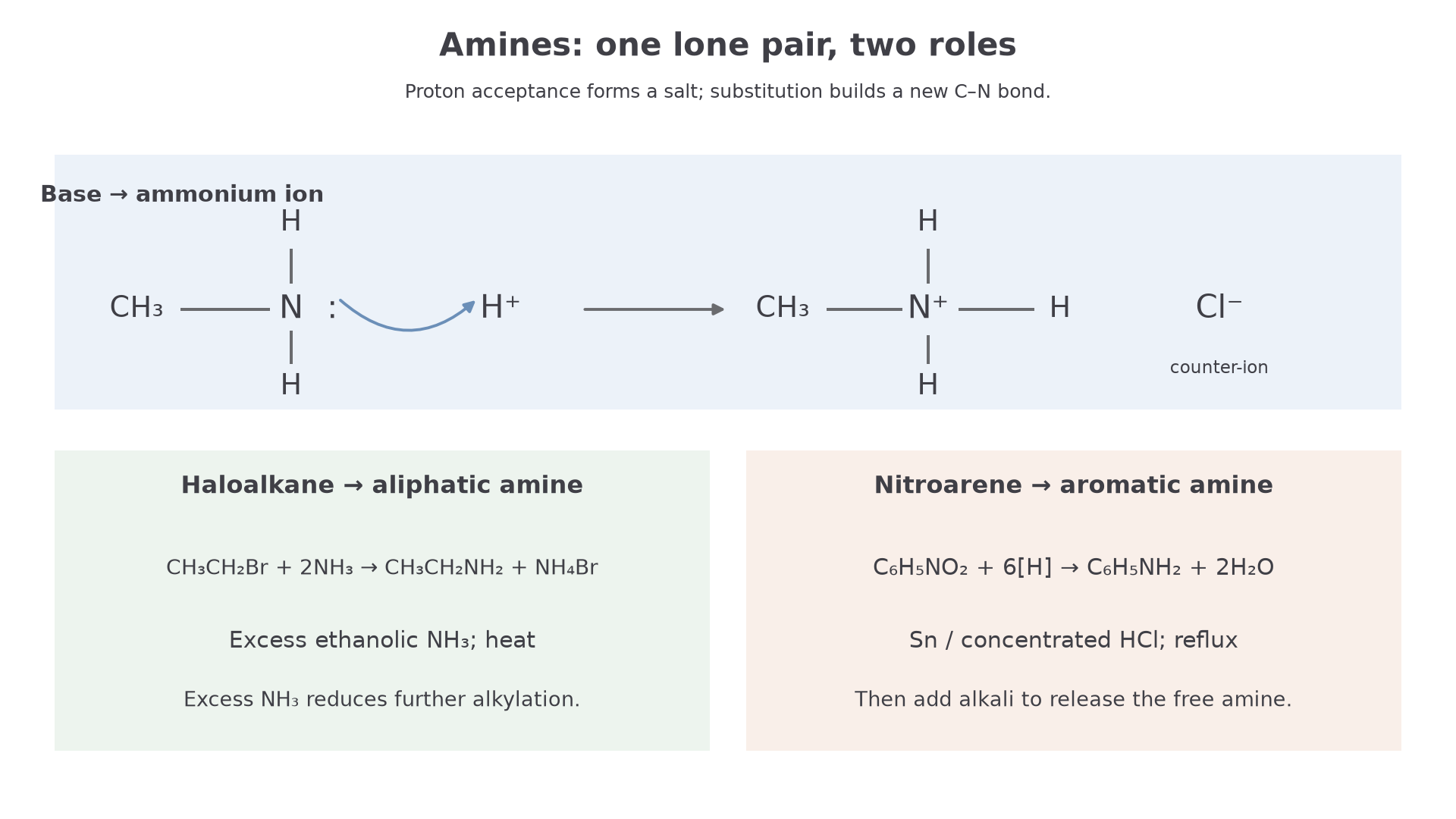
For this lesson, there are three reaction families to keep separate:
- amine + dilute inorganic acid → ammonium salt
- haloalkane + excess ethanolic ammonia or amine → aliphatic amine
- nitroarene + tin and concentrated hydrochloric acid → aromatic amine
Do not mix the conditions. A haloalkane-to-amine route needs ethanolic ammonia or an amine reagent, not aqueous hydroxide. A nitroarene-to-aromatic-amine route needs tin and concentrated hydrochloric acid, not the haloalkane substitution conditions.
Primary aliphatic amines
An aliphatic amine has the nitrogen attached to an aliphatic carbon chain rather than directly to a benzene ring. OCR requires preparation of aliphatic amines by substitution of haloalkanes with excess ethanolic ammonia.
The haloalkane can be written as , where is , or . Ammonia has a nitrogen lone pair, so it can act as a nucleophile and substitute for the halogen.
For a primary amine:
Continue this lesson.
You’re previewing NovaLearn without an account. Create a free account to read the rest.
Create free account