4.1.3(a)-(b), 4.1.3(e) - Alkene bonding, shape and reactivity
Alkenes are the first hydrocarbons where a carbon-carbon double bond changes both shape and reactivity. In this lesson, you will build the C=C model from two different bond components, use that model to explain restricted rotation, then connect the shape and bonding to why alkenes react more readily than alkanes.
Alkenes and unsaturation
A hydrocarbon is a compound containing carbon and hydrogen only. An alkene is a hydrocarbon containing at least one carbon-carbon double bond, C=C.
Alkene
An alkene is an unsaturated hydrocarbon containing a C=C bond.
The word unsaturated is used because the molecule contains a multiple bond. For this lesson, the key sign of unsaturation is the C=C bond itself. Ethene, , and propene, , are alkenes because each molecule contains a C=C bond and contains only carbon and hydrogen.
A useful way to read an alkene formula is to locate the C=C first. The rest of the molecule may contain C-H or C-C single bonds, but the C=C is the feature that controls this lesson's bonding, shape and reactivity.
Worked example: identifying an alkene
Butane, , is a hydrocarbon, but it is not an alkene because it has no C=C bond. But-1-ene, , is an alkene because it is a hydrocarbon and it contains a C=C bond.
Sigma and pi bonding in C=C
A C=C double bond is not simply "two of the same bond". It contains one sigma bond and one pi bond.
Sigma bond
A sigma bond is formed by overlap of orbitals directly between the bonding atoms.
The pi bond uses a different overlap geometry.
Pi bond
A pi bond is formed by sideways overlap of adjacent p orbitals above and below the bonding carbon atoms.
In the C=C bond, the sigma bond lies directly along the line joining the two carbon nuclei. The pi bond is different: it comes from the sideways overlap of adjacent p orbitals, producing electron density above and below the plane of the bonding atoms.
[DIAGRAM: asset_name: Lesson 4.1.3a-b,e: Alkene bonding, shape and reactivity - diagram 01; asset_slug: 04_01_03a_alkene_bonding_shape_and_reactivity__diagram_01; recommended_method: drawn_chem; description: Combined ethene C=C model showing the sigma bond directly between the carbon atoms, adjacent p orbitals overlapping sideways above and below the bonding carbons to form a pi bond, and a separate trigonal planar 120 degree angle cue around one carbon.]
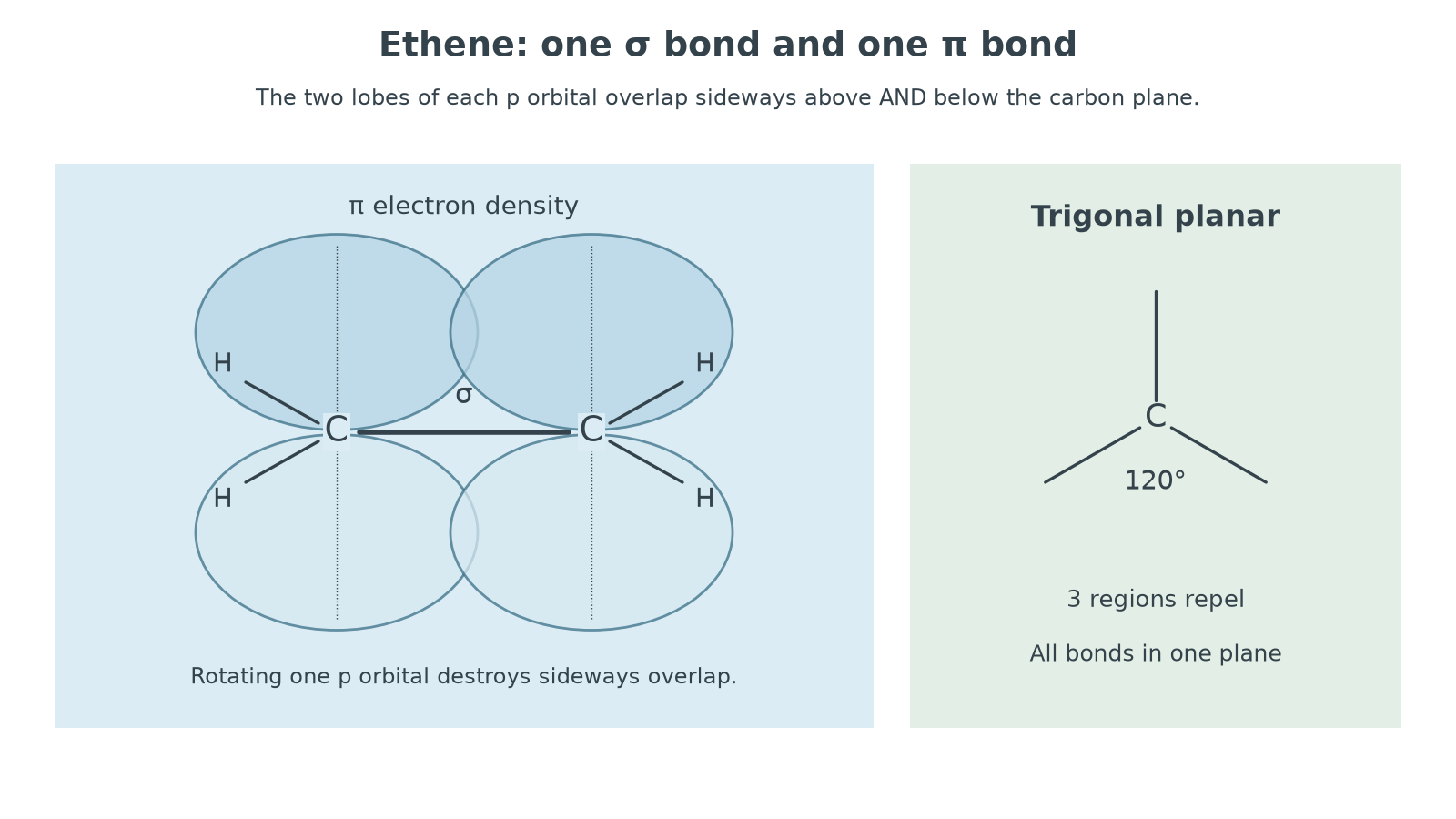
Exam questions often want the model, not just the symbol. Writing C=C tells someone that there is a double bond, but it does not by itself explain how the pi bond forms. For the pi bond model, the important phrase is sideways overlap of adjacent p orbitals.
Worked example: describing ethene's double bond
In ethene, , the two carbon atoms are joined by a C=C bond. That C=C contains one sigma bond from overlap directly between the carbon atoms and one pi bond from sideways overlap of adjacent p orbitals above and below the bonding carbon atoms.
Counting σ and π bonds
Propene, , has six C–H connections and two C–C connections. Each connection contributes one σ bond, so there are eight σ bonds. The one C=C contributes one extra π bond. Do not count a double bond as two σ bonds. For any larger structure, count the carbon skeleton and all hidden C–H bonds before adding one π bond for each C=C.
Restricted rotation
The pi bond explains why a C=C bond cannot rotate freely.
For the pi bond to exist, the adjacent p orbitals must stay lined up so that they overlap sideways. If one end of the double bond rotated relative to the other, the p orbitals would stop overlapping properly. In effect, rotation would require the pi bond to be broken.
That is why the C=C bond has restricted rotation. The sigma bond framework is still present, but the pi bond locks the two ends of the double bond into a fixed relationship unless enough energy is supplied to break the pi bond.
Restricted rotation around C=C comes from the pi bond, because rotating would disrupt the sideways p-orbital overlap.
This idea will matter in the next alkene lesson, where fixed positions around C=C can lead to stereoisomerism. Here the cause matters: rotation about the C=C would disrupt the π bond.
Worked reasoning: why C-C and C=C behave differently
Continue this lesson.
You’re previewing NovaLearn without an account. Create a free account to read the rest.
Create free account