5.1.2(a)-(c) - Equilibrium amounts and partial pressures
Equilibrium calculations begin before the equilibrium constant appears. In this lesson you will learn how to describe the amounts present in an equilibrium mixture, how gas amounts connect to mole fractions and partial pressures, and how chemists can measure equilibrium quantities experimentally. The focus is the quantity work: setting up the numbers cleanly so later and calculations have something reliable to use.
Equilibrium quantities
From earlier equilibrium work, a dynamic equilibrium is reached in a closed system when the forward and reverse reactions continue at the same rate. The amounts of reactants and products then stay constant, even though particles are still reacting both ways.
That gives an important phrase in this topic: quantities present at equilibrium. A quantity might be an amount in , a concentration in , or, for a gas, a partial pressure. It does not mean the reactants and products are present in equal amounts. It means their amounts are steady at that temperature and under those conditions.
For a reaction such as:
there might be more product than reactant at equilibrium, or more reactant than product. The balanced equation tells you the ratio of changes as equilibrium is reached; the data tell you the actual sizes of those changes.
At equilibrium, amounts are constant, not necessarily equal. The balanced equation controls how amounts change relative to each other.
Mole fraction and partial pressure
A mole fraction describes the share of the gas mixture belonging to one species. That same fraction gives its share of the total pressure.
Mole fraction
The mole fraction of a gas in a mixture is the amount of that gas divided by the total amount of all the gases in the mixture. It is a ratio, so it has no units.
Mole fraction
All the mole fractions in the gas mixture add up to 1.00. If a mixture contains 0.200 of A and 0.300 of B, the total gas amount is 0.500 , so:
Partial pressure
The partial pressure of a gas is the pressure that gas contributes to the total pressure of a gas mixture.
For OCR calculations, use the mole fraction to split the total pressure:
Partial pressure
The partial pressure has the same pressure unit as the total pressure, such as Pa or kPa. The partial pressures of all the gases add up to the total pressure.
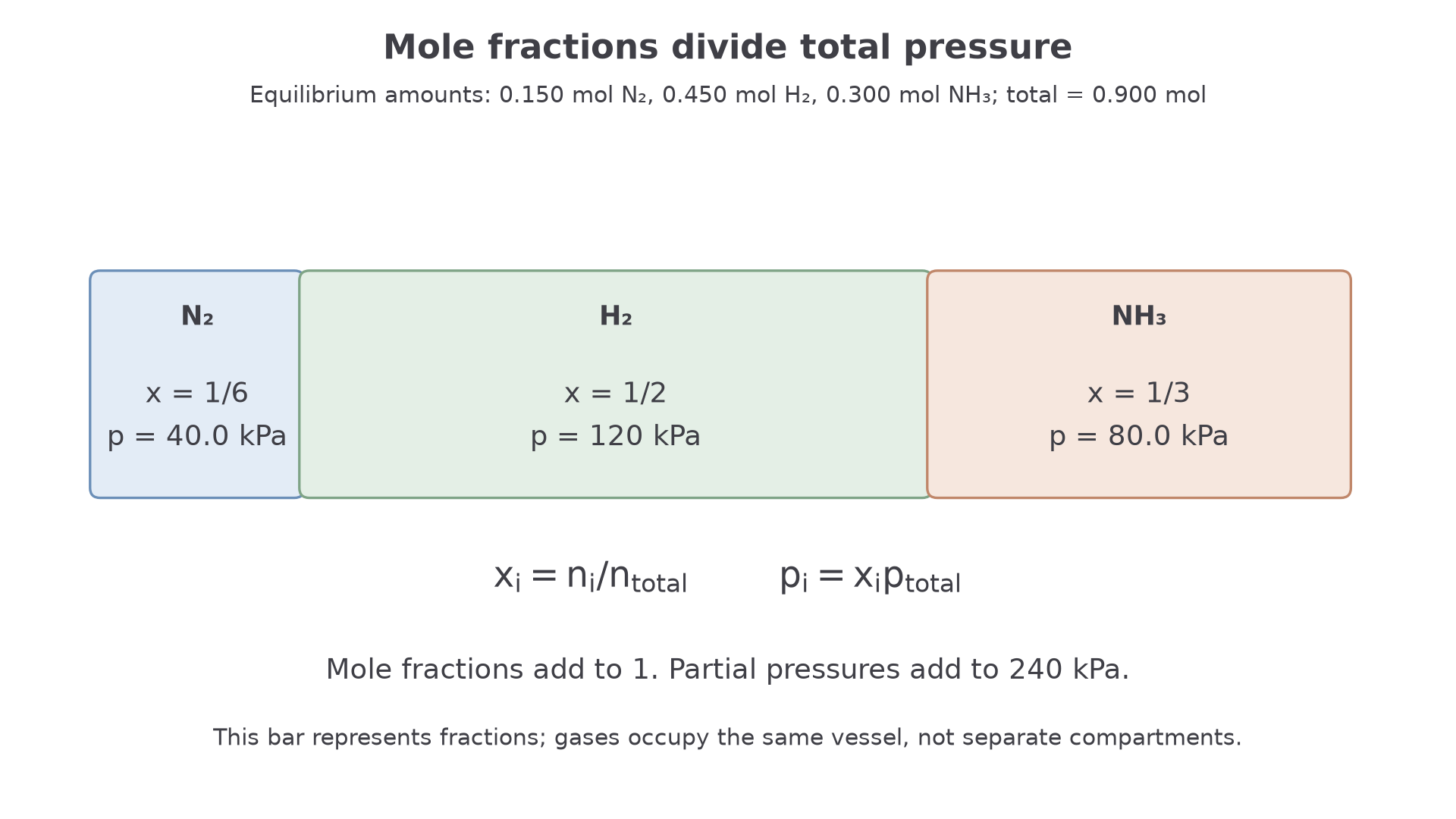
[DIAGRAM: asset_name: Lesson 5.1.2a-c: Equilibrium amounts, mole fraction and partial pressure - diagram 01; asset_slug: 05_01_02a_equilibrium_amounts_mole_fraction_and_partial_pressure__diagram_01; recommended_method: drawn_chem; description: 16:9 deterministic diagram showing total gas amount split into mole fractions and total pressure split into partial pressures for an equilibrium gas mixture.]
Worked example
An equilibrium gas mixture contains 0.150 of , 0.450 of and 0.300 of . The total pressure is 240 kPa.
First find the total gas amount:
Then find each mole fraction:
Now multiply by the total pressure:
Carry the unrounded mole fractions into the pressure calculation. The partial pressures add to exactly 240 kPa here.
A common exam error is to include substances that are not gases when calculating total gas amount for mole fractions. Another is to write partial pressures in square brackets, as if they were concentrations. Use pressure symbols such as , not concentration notation.
Calculating equilibrium amounts
When you are given appropriate data, the safest way to calculate quantities present at equilibrium is a RICE table:
- Ratio from the balanced equation
- Initial amounts
- Change as the reaction moves towards equilibrium
- Equilibrium amounts
The ratio line is the protection against most errors. If the equation says 1 of one gas forms 2 of another gas, the changes in amount must follow that 1:2 ratio.
Worked example:
At a certain temperature, 0.400 of is placed in a sealed container. At equilibrium, 0.120 of is present. Calculate the equilibrium amount of and the total amount of gas at equilibrium.
Set up the change. The equation shows that 1 of forms 2 of . If 0.120 of has formed, the amount of that reacted is half of this:
Now subtract this from the initial :
The amounts can now be checked together in the RICE table:
Continue this lesson.
You’re previewing NovaLearn without an account. Create a free account to read the rest.
Create free account