4.1.1(f)-(i) - Covalent fission, radicals and curly arrows
Organic mechanisms are a way of explaining reactions by following electrons. In this lesson, you will learn how covalent bonds can break, what a radical is, and how OCR expects electron-pair movement to be shown with curly arrows. This is the notation foundation for later organic reactions, so the goal is accuracy: where electrons start, where they go, and what charges or dots must be shown.
Electron accounting in bond fission
A covalent bond contains a shared pair of electrons. When a covalent bond breaks, those two electrons must go somewhere; they do not disappear, and they do not move randomly. Chemists call the breaking of a covalent bond covalent bond fission.
There are two possible electron-accounting patterns:
- In homolytic fission, the bonded pair is split evenly. Each bonding atom receives one electron.
- In heterolytic fission, the bonded pair is not split evenly. One bonding atom receives both electrons.
The important point is not just the products. It is the electron movement that explains the products. Homolytic fission makes species with single unpaired electrons. Heterolytic fission makes one electron-rich product and one electron-deficient product, often ions if the starting molecule was neutral.
Bond fission is electron accounting: homolytic means one electron to each bonded atom; heterolytic means both bonding electrons to one atom.
Homolytic fission and radicals
In homolytic fission, each atom from the broken bond receives one electron from the bonded pair. Because each atom now has one unpaired electron, the products are radicals.
Radical
A radical is a species with an unpaired electron.
OCR expects a single unpaired electron to be shown with a dot, •, in radical mechanisms. For example, a chlorine radical is written as Cl•, and a methyl radical is written as CH₃•.
A simple homolytic fission equation is:
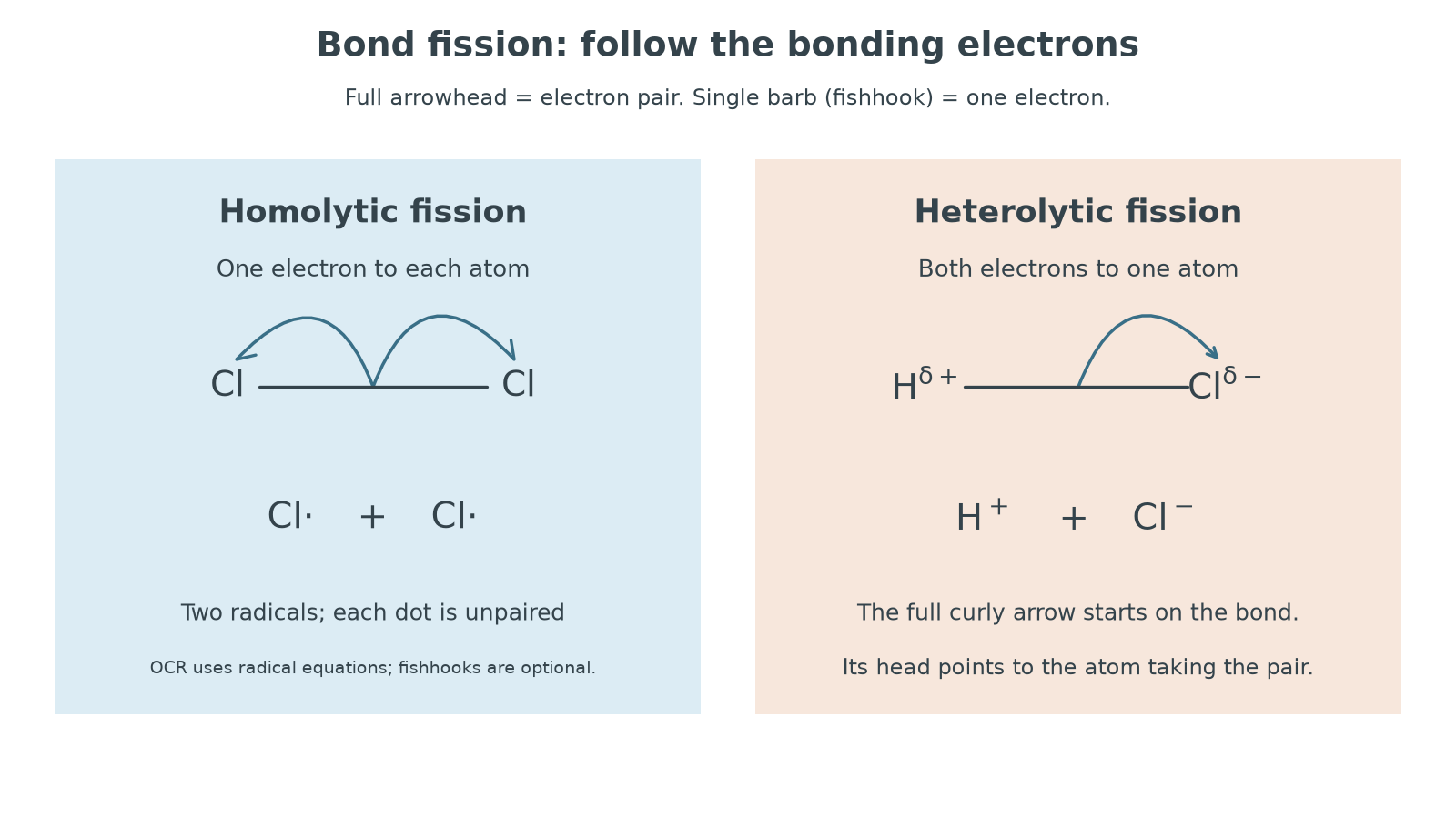
Read that equation carefully. The Cl-Cl bond contained two bonding electrons. After homolytic fission, one electron is on each chlorine atom, so each chlorine atom is a radical. OCR represents radical mechanisms by equations with radical dots. The diagram also shows optional single-barbed fishhooks, each carrying one electron; never substitute a full electron-pair arrow for these.
There is one OCR notation boundary to keep tidy: dots are required where there is a single unpaired electron, but dots are not required for species that are diradicals, such as O.
[DIAGRAM: asset_name: 4.1.1f-i - Covalent fission, radicals and curly arrows - diagram 01; asset_slug: 04_01_01d_covalent_fission_radicals_and_curly_arrows__diagram_01; recommended_method: drawn_chem; description: Homolytic Cl–Cl fission uses two single-barbed fishhooks from the bond; heterolytic H–Cl fission uses a full-headed curly arrow from the bond to Cl, with dipoles and ionic products.]
Heterolytic fission
In heterolytic fission, one of the bonding atoms receives both electrons from the bonded pair. If a neutral molecule undergoes heterolytic fission, the atom that takes the bonding pair becomes negatively charged and the other atom becomes positively charged.
For example, in a simplified electron-accounting picture:
The chlorine atom has received both electrons from the H-Cl bond. Hydrogen has received none of the bonding pair, so it is electron-deficient and is shown as H⁺. Relative to the neutral atoms, chlorine has gained one electron and hydrogen has lost one electron, explaining the −1 and +1 charges; receiving a bonding pair is not a gain of two electrons relative to the neutral chlorine atom.
Heterolytic fission is especially likely to be useful as a model when a bond is polar. In H-Cl, chlorine is more electronegative than hydrogen, so the bond is polarised as Hδ⁺ - Clδ⁻. That dipole helps explain why the electron pair moves towards chlorine when the bond breaks heterolytically.
Continue this lesson.
You’re previewing NovaLearn without an account. Create a free account to read the rest.
Create free account