5.2.3(f)-(i) - Electrode potentials and feasibility
Electrode potentials let you compare how strongly different redox systems tend to gain electrons. In this lesson, you will learn how standard electrode potentials are measured, how cell potentials are calculated from supplied data, and why a positive prediction still needs practical judgement about rate and concentration.
Why electrode potentials need a reference
A half-cell contains a redox equilibrium at an electrode surface. For example, a metal/ion half-cell may contain a metal in a solution of its own ions:
Metal/ion half-cell equilibrium
The electrode and the solution develop a potential difference, but you cannot measure the potential of one half-cell by itself. A voltmeter measures a difference between two points, so every electrode potential is measured by comparing one half-cell with a reference half-cell.
Standard electrode potential
The standard electrode potential, , of a redox system is the potential difference measured when that half-cell is connected to the standard hydrogen electrode under standard conditions.
The standard hydrogen electrode is assigned a value of 0.00 V. It contains hydrogen gas in contact with hydrogen ions, with a platinum electrode providing an inert conducting surface.
Standard hydrogen electrode equilibrium
The word standard matters. Standard electrode potentials are measured at 298 , with gases at 100 kPa, and with aqueous ion concentrations of 1.00 . For ions of the same element in different oxidation states, OCR allows the ion concentrations to be 1.00 or equimolar.
In a correctly assembled cell, the salt bridge completes the circuit by allowing ions to move between the two solutions. The wires connect the electrodes to the voltmeter, so electrons can move through the external circuit. A high-resistance voltmeter is used so that very little current is drawn; this helps the measured potential stay close to the equilibrium value.
[DIAGRAM: asset_name: Lesson 5.2.3f-i: Electrode potentials and feasibility - diagram 01; asset_slug: 05_02_03c_electrode_potentials_and_feasibility__diagram_01; recommended_method: drawn_chem; description: Standard hydrogen reference and iron(III)/iron(II) half-cell, with both platinum electrodes and both salt-bridge ends immersed; hydrogen contacts platinum under standard conditions.]
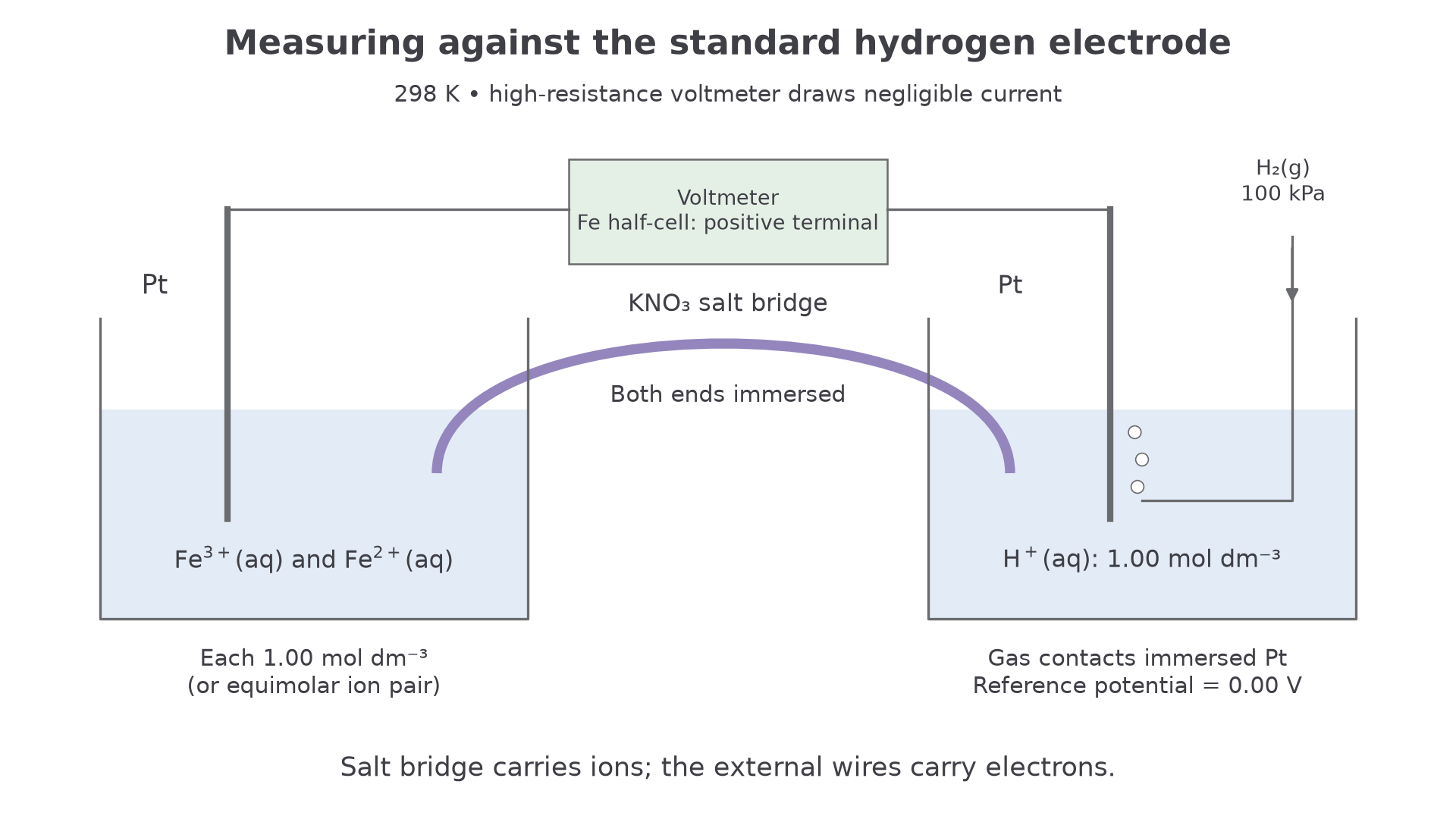
The gas inlet must deliver hydrogen to the platinum surface while that surface contacts the acid. Merely holding hydrogen above an unrelated metal strip does not make a hydrogen electrode. Record voltmeter polarity as well as magnitude: the reference is zero, and the sign shows which electrode has the more positive reduction potential.
Measuring practical cell potentials
OCR expects you to recognise two main half-cell arrangements in this topic.
In a metal/metal ion half-cell, the metal itself can act as the electrode. A zinc half-cell, for example, uses zinc metal in a solution containing . A copper half-cell uses copper metal in a solution containing . The solid metal provides the conducting surface and is also part of the redox equilibrium.
In a half-cell where both forms are aqueous ions, there is no conducting solid form of the redox system. The usual OCR example is /. A platinum electrode is used because platinum conducts electrons but does not take part in the redox reaction.
Non-metal half-cells may also need an inert electrode. For example, a redox system involving a gas and its aqueous ions needs a conducting surface because the gas and ions cannot themselves form a metal strip.
For a chlorine/chloride half-cell, pass at over platinum in chloride solution at , then connect to the hydrogen reference. For an iodine/iodide half-cell, platinum contacts the supplied iodine and iodide mixture. The platinum transfers electrons without being consumed; it does not supply the ions in the redox equation.
For PAG8 electrochemical cell work, the practical aim is to set up cells and measure voltages reliably. A suitable method uses clean electrodes, solutions of known concentration, a high-resistance voltmeter, connecting wires and a salt bridge made from filter paper soaked in a non-reacting salt solution such as potassium nitrate. The salt bridge should touch both solutions, but the two half-cell solutions should not be mixed directly.
Good practical technique is not decoration here; it changes the chemistry being measured. Dirty metal surfaces increase contact resistance. A salt bridge ion that reacts with one of the solutions can create a new equilibrium. Concentrations that are not standard mean the measured cell potential is not a standard cell potential.
Safety and risk management also belong in the method. Wear eye protection, use small volumes where possible, handle metal salt solutions as irritants or harmful where appropriate, keep hydrogen away from flames, and follow the specific risk assessment for any oxidising agents or acids used in the cell.
What an E value tells you
Standard electrode potential data are normally given as reduction half-equations. That means the electrons appear on the left-hand side. You use the values to compare how readily the species on the left gains electrons.
A more positive value means a greater tendency for the reduction half-equation to occur. The species being reduced is therefore a stronger oxidising agent, because it causes another species to lose electrons.
A more negative value means the reduction half-equation is less favoured. If that redox system is paired with a more positive one, its reduced form is more likely to run in reverse and be oxidised. That reduced form is acting as the stronger reducing agent.
Avoid the words "higher" and "lower" when values include negatives. They can be ambiguous in exam answers. Say "more positive" or "more negative".
Worked reasoning:
| Redox system | Supplied / V |
|---|---|
| +0.77 | |
| -0.76 |
Continue this lesson.
You’re previewing NovaLearn without an account. Create a free account to read the rest.
Create free account