5.1.2(d)-(e) - Kc and Kp expressions, calculations and units
Equilibrium constants let you turn an equilibrium mixture into a number. In this lesson you will learn how to write and expressions, how to handle homogeneous and heterogeneous equilibria, and how to calculate values and units without losing the chemistry inside the algebra.
What the constant uses
An equilibrium constant is linked to a balanced reversible equation. It is built from the equilibrium concentrations or partial pressures of products and reactants, with each term raised to the power of the coefficient in the balanced equation.
For OCR calculations, you will usually meet two versions.
\(K_c\)
is the equilibrium constant written in terms of equilibrium concentrations. Concentrations are normally in .
\(K_p\)
is the equilibrium constant written in terms of equilibrium partial pressures of gases. Pressures may be given in units such as , or ; use one pressure unit consistently in a calculation.
The same balanced equation controls both types of expression. The difference is the quantity used:
- uses square brackets, such as , to mean equilibrium concentration.
- uses partial-pressure symbols, such as , not square brackets.
A homogeneous equilibrium has all reacting species in the same phase. For example, all gases, or all species in one solution. A heterogeneous equilibrium has species in more than one phase, such as gases in contact with solids.
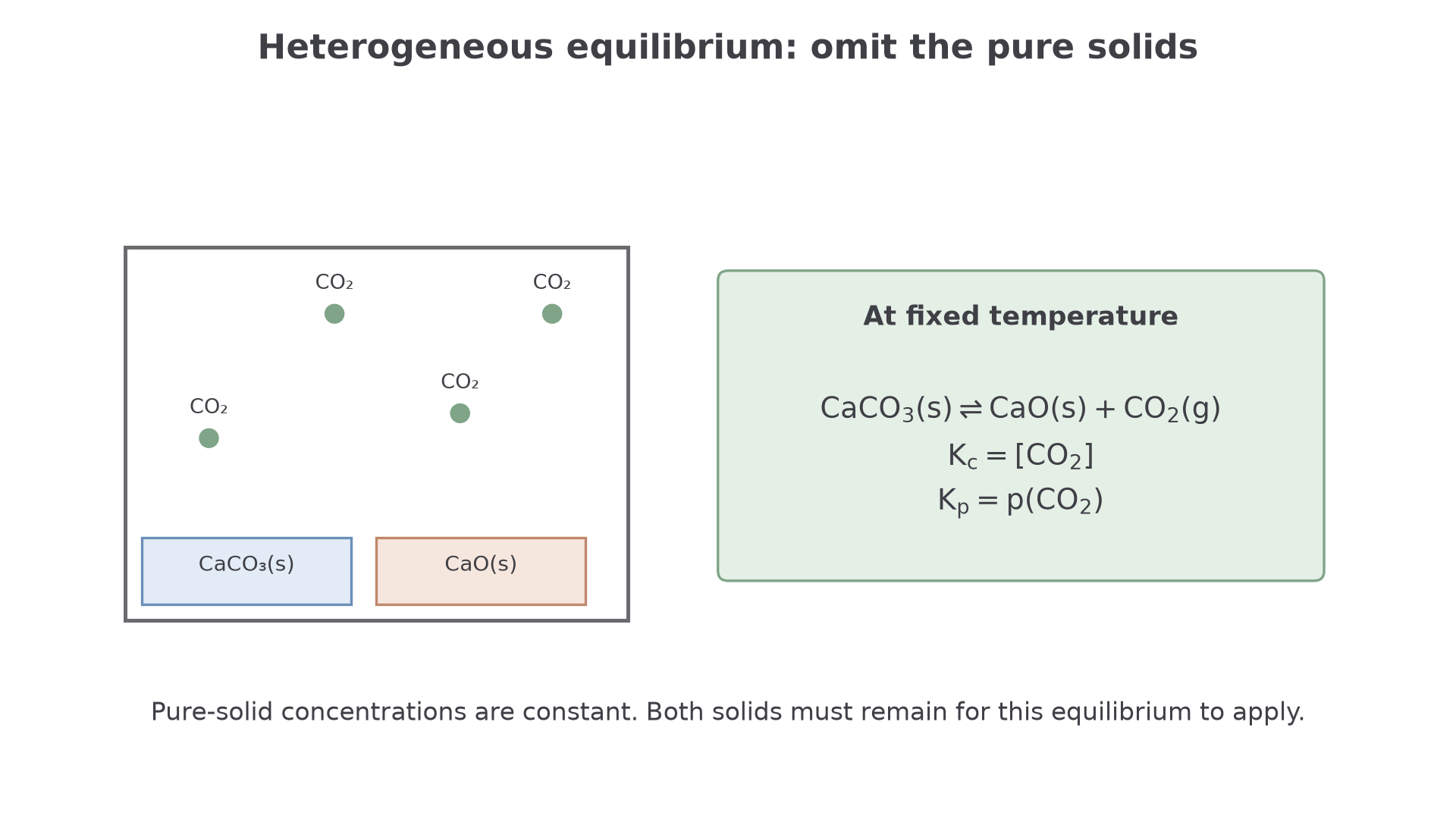
The important heterogeneous rule is simple: pure solids and pure liquids have constant concentrations, so they are omitted from and expressions. Aqueous solutes and gases can still appear where their concentration or partial pressure is part of the equilibrium mixture.
First decide whether the expression needs concentrations or partial pressures. Then use the balanced equation exactly as written.
Writing expressions
For a general homogeneous equilibrium:
General \(K_c\) expression
For a gaseous equilibrium using partial pressures:
General \(K_p\) expression
The top line is products. The bottom line is reactants. The powers are the balancing numbers. That means the equation and the constant are a pair: if the equation is reversed, the expression is inverted; if the equation is multiplied, the powers change.
Worked example: write and for the homogeneous gaseous equilibrium:
For , use equilibrium concentrations:
For , use equilibrium partial pressures:
Now compare that with a heterogeneous equilibrium:
The two solids are omitted because their concentrations are constant. The only variable gas term is carbon dioxide:
and, if using partial pressure,
Do not omit a species just because its coefficient is 1. A coefficient of 1 means the term is present to the power 1, which is normally left unwritten.
[DIAGRAM: asset_name: Heterogeneous equilibrium and constant; asset_slug: h432_512de_heterogeneous; recommended_method: drawn_chem; description: Calcium carbonate and calcium oxide solids coexist with carbon dioxide gas; pure solids are omitted and Kp equals carbon dioxide partial pressure while both solids remain.]
Units from expressions
Units are not guessed from the name or . They come from the expression.
The method is:
- Write the correct equilibrium-constant expression.
- Substitute the unit into every concentration or pressure term.
- Cancel powers carefully.
Worked example: find the units of for:
The expression is:
Substitute for each concentration:
The denominator contains four concentration terms in total. The numerator contains two. So:
Now simplify:
For , do the same thing with the pressure unit used in the question. For the same ammonia equation, if pressures are in :
If all powers cancel, the equilibrium constant has no units in that calculation. Do not force units onto a constant when the expression cancels them.
Calculating
A calculation is only as good as the equilibrium concentrations you put into it. Use equilibrium concentrations, not initial concentrations, unless the question tells you the initial and equilibrium values are the same for a particular species.
Continue this lesson.
You’re previewing NovaLearn without an account. Create a free account to read the rest.
Create free account