4.1.3(f)-(i) - Addition reactions and electrophilic addition
Alkenes are useful because the C=C double bond can be turned into several different functional groups. In this lesson, you will learn the addition reactions OCR expects for alkenes, how bromine water tests for unsaturation, why electrophiles react with the double bond, and how Markownikoff's rule predicts the major product when H-X adds to an unsymmetrical alkene.
Addition across the double bond
An addition reaction joins atoms or groups onto a molecule without losing atoms from the organic molecule. For alkenes, the important change is that the C=C double bond becomes a C-C single bond, and each carbon from the original double bond gains a new atom or group.
For this lesson, keep the idea very concrete: the double bond is the reactive site. Once addition has happened, the molecule is usually more saturated because the C=C bond has become a C-C single bond and new single bonds have formed to the added atoms.
OCR requires four addition reactions of alkenes:
| Reagent added to the alkene | Typical condition or catalyst | Product type |
|---|---|---|
| suitable catalyst, for example Ni | alkane | |
| halogen, for example or | room temperature is enough for the bromine-water test | dihaloalkane |
| hydrogen halide, H-X, for example HBr or HCl | OCR does not require a special condition here | haloalkane |
| steam, | acid catalyst, for example | alcohol |
Worked examples:
Ethene becomes ethane. Hydrogen has added across the double bond.
Ethene becomes 1,2-dibromoethane. One bromine atom has joined to each carbon from the original double bond.
Ethene becomes bromoethane. The H and Br from HBr have added across the double bond.
Ethene becomes ethanol. Steam supplies H and OH across the double bond, with an acid catalyst such as .
For an alkene addition reaction, first identify the C=C bond, then place one new atom or group onto each of the two carbons that used to be double bonded.
Bromine water and unsaturation
Bromine water is used as a test for unsaturation in a carbon chain. An unsaturated carbon chain contains a carbon-carbon multiple bond; in this lesson, the relevant functional group is the alkene C=C bond.
In the test, bromine water is added to the organic compound and the mixture is shaken. If a C=C bond is present, bromine adds across the double bond and the orange bromine water is decolourised.
For ethene:
Observation: orange bromine water turns colourless.
Inference: a C=C bond is present when distinguishing the alkane/alkene samples in this test. Other reactive functional groups can also decolourise bromine, so the observation alone does not identify every unknown organic molecule uniquely.
This is a qualitative test, so the observation matters. Writing only "bromine reacts" is weaker than giving the colour change and the functional-group inference.
PAG7 links this to organic functional-group analysis. The practical skill is not a complicated synthesis: it is using small-scale apparatus for a test-tube reaction, making a clear observation, and using that observation to identify a functional group. Organic compounds can be flammable or volatile, so tests are carried out on a small scale and away from naked flames.
Use a few drops with a small sample, wear eye protection and keep volatile samples away from flames. Compare samples under the same conditions and avoid UV light: otherwise an alkane can react with bromine by radical substitution. Record the observed colour before deciding the functional group; do not use a positive test to name a particular alkene.
Electrophiles and heterolytic fission
The C=C double bond contains a pi bond with high electron density. That electron-rich region attracts electron-poor species.
Electrophile
An electrophile is an electron pair acceptor.
Hydrogen bromide, HBr, is useful for seeing the pattern. The H-Br bond is polar because bromine is more electronegative than hydrogen, so the hydrogen atom is delta positive and can act as the electrophile.
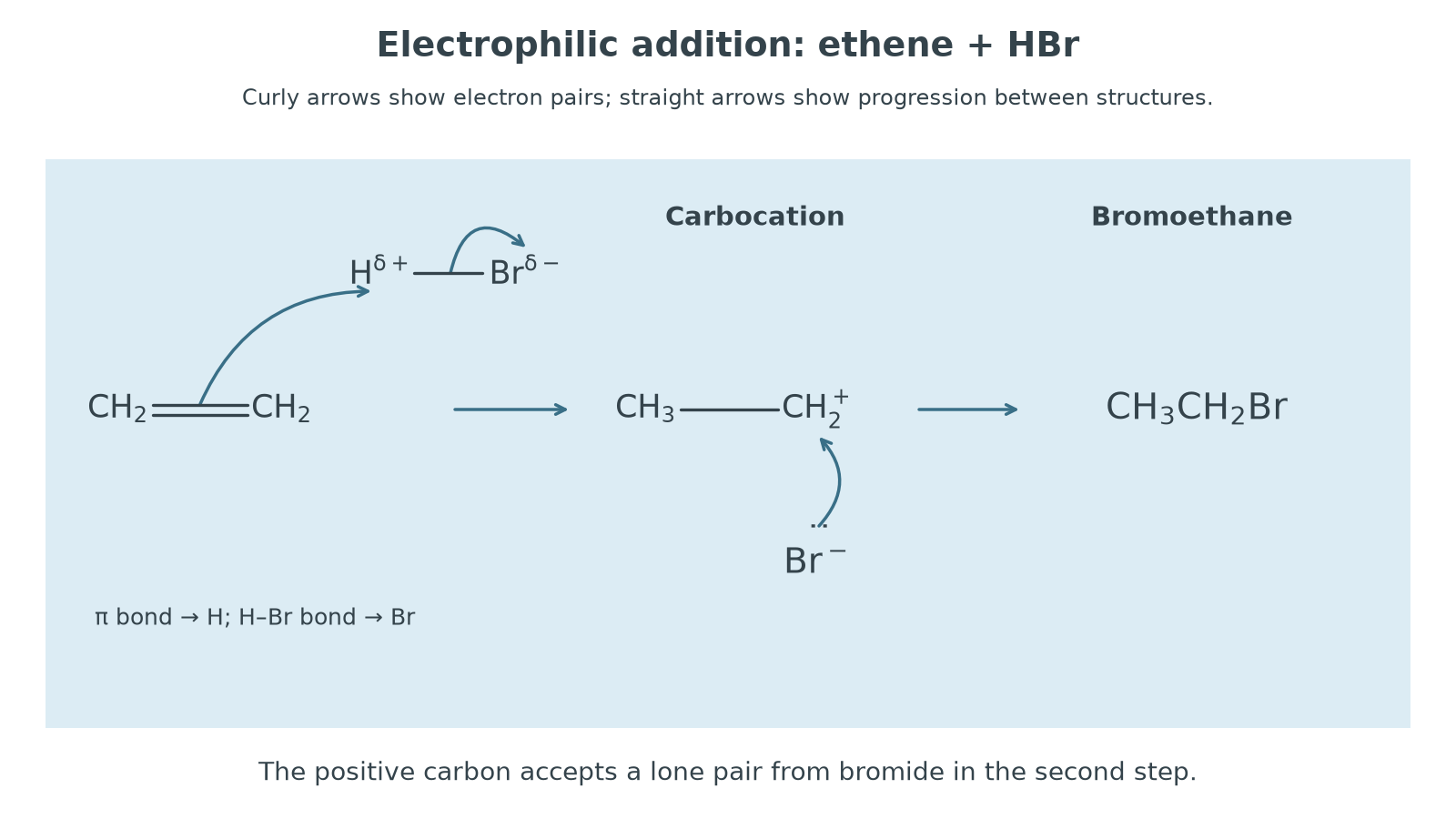
The first step is started by an electron pair in the C=C bond moving towards H(delta+) in HBr. At the same time, the H-Br bond breaks heterolytically: both electrons from the H-Br bond go to bromine, producing .
Heterolytic fission
Heterolytic fission is bond breaking where both bonding electrons go to one of the atoms, forming ions.
The alkene first forms a carbocation intermediate. A carbocation is an organic ion with a positively charged carbon atom. The ion then donates an electron pair to the positive carbon, forming the C-Br bond.
To draw this mechanism, use full-headed curly arrows to show movement of an electron pair. Start the first arrow on the C=C bond (not on a carbon label) and end it on H in HBr. Start the second on the H-Br bond and end it on Br. Draw the carbocation with its positive charge on carbon, and separately. In the second step start an arrow on a lone pair or negative charge of and end it on the positively charged carbon. Half-headed arrows represent single-electron movements and are not used here.
[DIAGRAM: asset_name: 4.1.3f-i - Addition reactions and electrophilic addition - diagram 01; asset_slug: 04_01_03c_addition_reactions_and_electrophilic_addition__diagram_01; recommended_method: drawn_chem; description: Ethene + polar HBr: full curly arrows begin at the C=C π bond and H–Br bond; a separate bromide lone pair attacks the positively charged carbocation carbon to form bromoethane.]
Continue this lesson.
You’re previewing NovaLearn without an account. Create a free account to read the rest.
Create free account