4.1.1(e) - Structural isomerism
Organic formulae can be a little deceptive: two compounds may contain exactly the same numbers of each atom, but those atoms may be joined in different ways. In this lesson you will learn the OCR definition of structural isomers and a systematic way to determine possible structural formulae from a molecular formula.
Same formula, different structure
A molecular formula tells you the number of atoms of each element in one molecule. For example, C₄H₁₀ says there are 4 carbon atoms and 10 hydrogen atoms, but it does not say how the carbon atoms are connected.
Structural Isomers
Structural isomers are compounds with the same molecular formula but different structural formulae.
The phrase "different structural formulae" is the important part. A structural formula shows the arrangement of atoms in a molecule, so structural isomerism is about different connectivity: atoms are joined to different atoms, or the same atoms are joined in a different order.
[DIAGRAM: asset_name: Lesson 4.1.1e: Structural isomerism - diagram 01; asset_slug: 04_01_01c_structural_isomerism__diagram_01; recommended_method: drawn_chem; description: Deterministic comparison of C4H10 and C3H7Br structural-isomer pairs, showing the same molecular formula but different structural formulae/connectivity.]
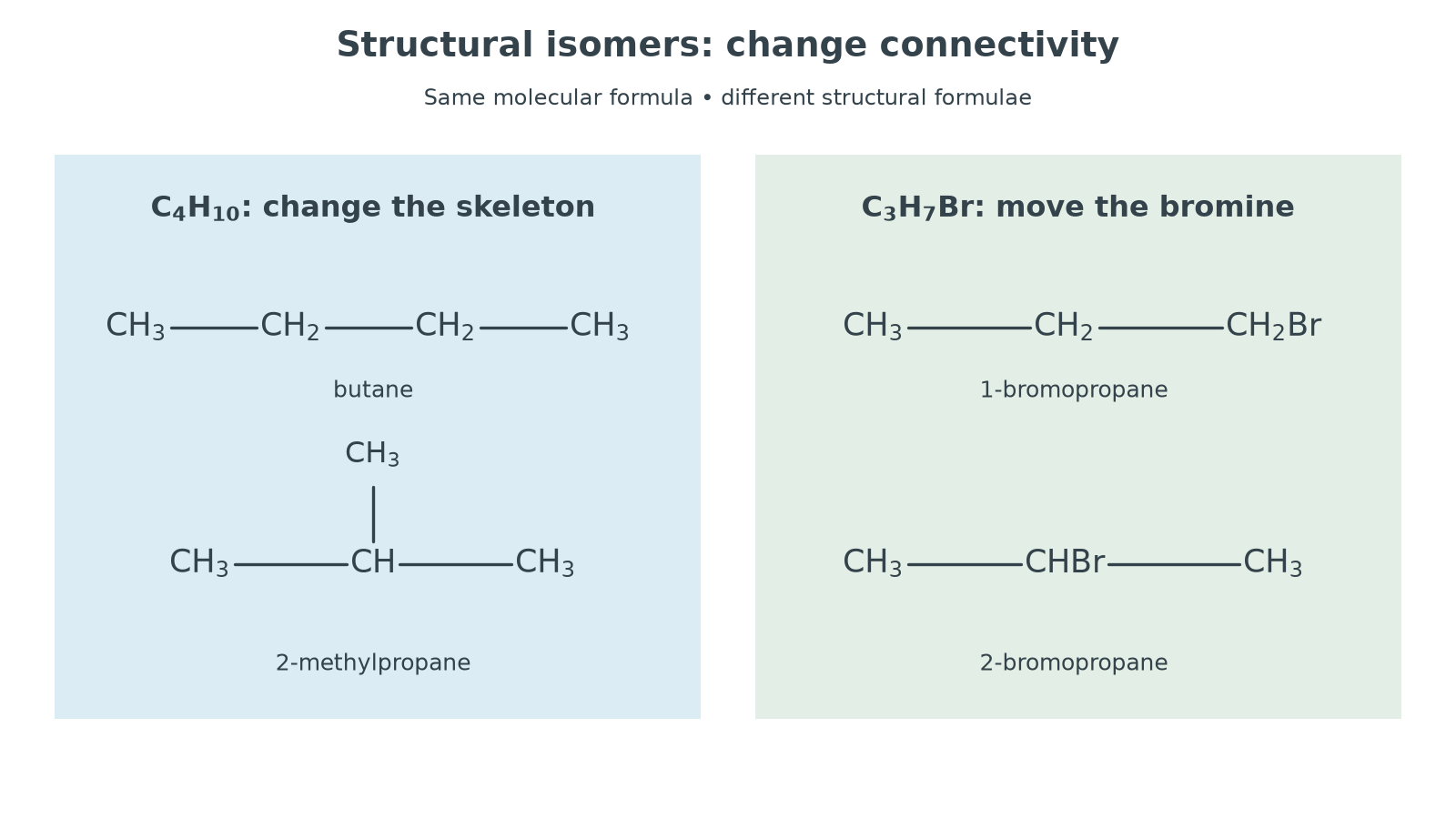
For C₄H₁₀, both butane and 2-methylpropane contain 4 carbon atoms and 10 hydrogen atoms. They are different compounds because the carbon skeleton is connected differently. For C₃H₇Br, 1-bromopropane and 2-bromopropane have the same molecular formula, but the bromine atom is attached to a different carbon atom.
A structural isomer pair must pass two tests: same molecular formula, different structural formula.
What does not count
A common mistake is to redraw the same molecule and think it has become a new isomer. It has not. If you can turn the page, rotate around a single bond, or number the carbon chain from the other end and get the same connectivity, you still have the same structural formula.
For example, these two condensed formulae are the same compound:
CH₃CH₂CH₂Br
BrCH₂CH₂CH₃
In both, bromine is attached to an end carbon of propane. The molecule has simply been written from opposite ends.
Another mistake is to use the wrong kind of formula comparison. Structural isomers must have the same molecular formula, not just the same empirical formula or the same general formula. C₂H₄ and C₃H₆ both fit the alkene general formula , but they are not structural isomers because their molecular formulae are different.
One final boundary: structural isomerism is not about 3-D spatial arrangement alone. If two compounds have the same molecular formula and the same structural formula but a different arrangement in space, that belongs to stereoisomerism, which is taught later.
A systematic search
When you are asked to determine possible structural formulae from a molecular formula, do not guess randomly. Use a repeatable sequence.
- Count the atoms in the molecular formula.
- Build a valid carbon skeleton.
- Move a branch, atom or group only to a non-equivalent position.
- Check whether the new structure is really different or just the same molecule written another way.
- Recount every atom in the final formula.
Here is the method for C₄H₁₀.
First, make the four-carbon unbranched skeleton:
CH₃CH₂CH₂CH₃
This uses 4 carbon atoms. The end carbons each have 3 hydrogen atoms, and the middle carbons each have 2 hydrogen atoms, giving C₄H₁₀.
Next, try a branched skeleton. Put three carbons in a row and attach the fourth carbon to the middle:
CH₃CH(CH₃)CH₃
This is also C₄H₁₀, but it has a different carbon skeleton, so it is a second structural formula.
Could there be a third? If you try to put the branch on an end carbon, you just make the unbranched four-carbon chain again. If you draw the three-carbon chain from the other direction, the middle carbon is still the same middle carbon. So C₄H₁₀ has two structural isomers.
Continue this lesson.
You’re previewing NovaLearn without an account. Create a free account to read the rest.
Create free account