6.1.3(a)-(b) - Carboxylic acid properties and reactions
Carboxylic acids are organic molecules containing the group. In this lesson you will explain why small carboxylic acids dissolve in water, then use the acidic hydrogen in to predict reactions with metals and bases in aqueous conditions. The same chemistry also gives a useful test-tube observation for identifying a carboxylic acid.
Hydrogen bonding with water
The carboxyl group is written as . It contains a carbonyl bond, , and an bond attached to the same carbon atom:
The important point for solubility is that the carboxyl group can form hydrogen bonds with water. Hydrogen bonding happens when a hydrogen atom bonded to oxygen is attracted to a lone pair on a oxygen atom in another molecule.
Hydrogen Bond
A hydrogen bond is an intermolecular attraction between a hydrogen atom bonded to a very electronegative atom, such as oxygen, and a lone pair on a very electronegative atom in another molecule.
For a carboxylic acid in water, both sides can matter:
- the carbonyl oxygen in can accept a hydrogen bond from a water molecule
- the hydrogen on the carboxylic acid bond can form a hydrogen bond to the oxygen of a water molecule
[DIAGRAM: asset_name: Lesson 6.1.3a-b: Carboxylic acid properties and reactions - diagram 01; asset_slug: 06_01_03a_carboxylic_acid_properties_and_reactions__diagram_01; recommended_method: drawn_chem; description: structural diagram showing a general carboxylic acid forming hydrogen bonds with water via the carbonyl oxygen as an acceptor and the carboxylic acid O-H hydrogen as a donor, with delta charges, dashed hydrogen bonds, and a caution that H-C is not a hydrogen-bond donor.]
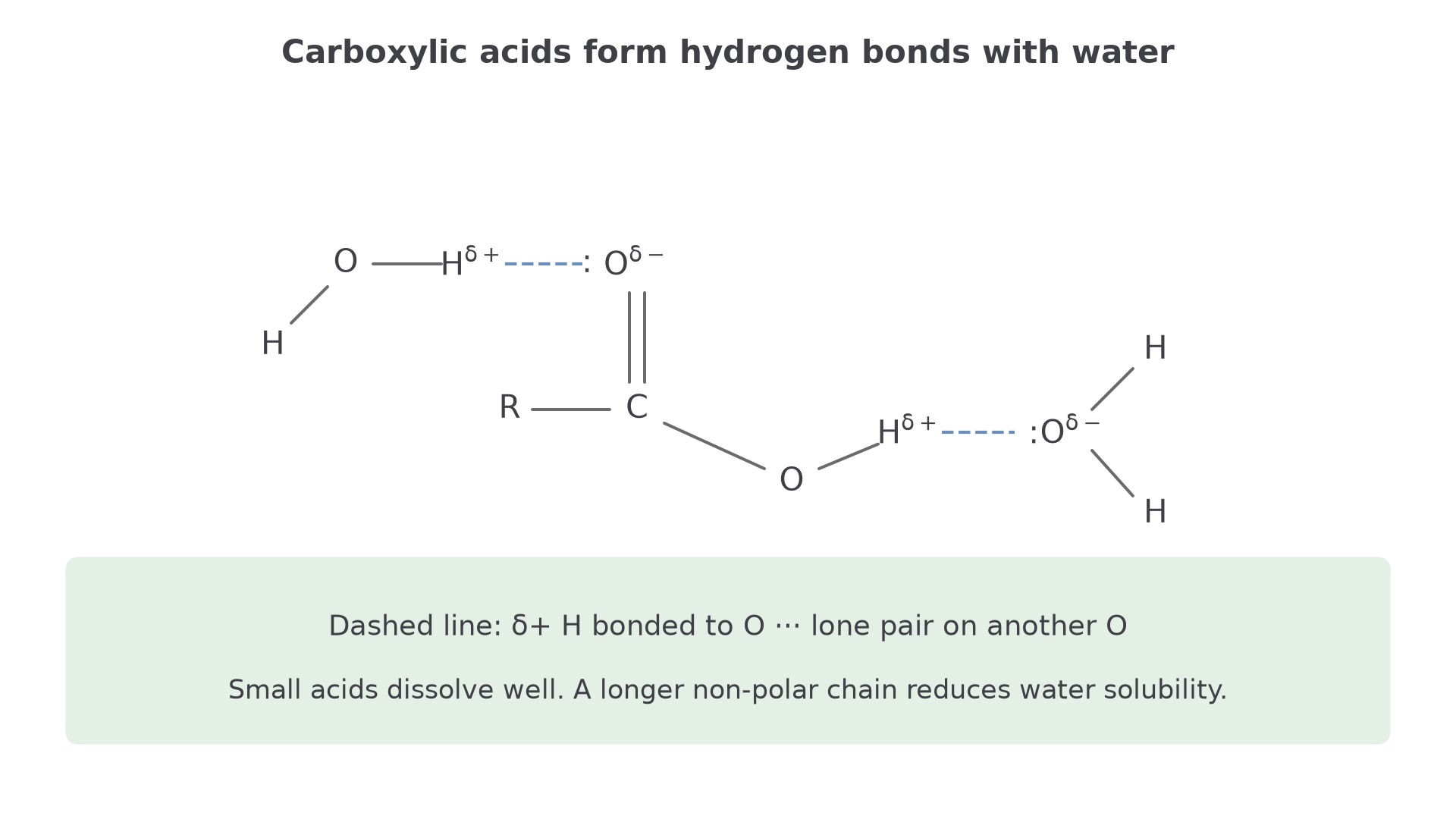
These hydrogen bonds are strong enough to let short-chain carboxylic acids, such as methanoic acid and ethanoic acid, mix well with water. As the hydrocarbon part becomes larger, the non-polar part of the molecule becomes more important, so the solubility falls. For OCR, the key explanation is always the hydrogen bonding between the group and water.
A common exam error is to draw a hydrogen bond from the hydrogen attached to carbon. A hydrogen is not sufficiently for the hydrogen-bonding model used here. Use the hydrogen on , or a hydrogen from water, not a hydrogen attached to carbon.
Forming carboxylate salts
In aqueous reactions with bases, the acidic hydrogen is the hydrogen in the group. When that hydrogen is removed as a proton, the remaining ion is a carboxylate ion:
The salt formed from a carboxylic acid is called a carboxylate. For example:
| acid | carboxylate ion | example sodium salt |
|---|---|---|
| methanoic acid, | methanoate, | sodium methanoate, |
| ethanoic acid, | ethanoate, | sodium ethanoate, |
| propanoic acid, | propanoate, | sodium propanoate, |
The name changes from -oic acid to -oate. The formula changes from to , then the positive ion balances the charge.
Worked example: writing a carboxylate salt formula
Write the formula of magnesium ethanoate.
Ethanoate is . Magnesium is , so two ethanoate ions are needed for each magnesium ion:
The brackets matter because the whole ethanoate ion is repeated twice.
Metals and alkalis
Carboxylic acids react in aqueous conditions with reactive metals to form a carboxylate salt and hydrogen gas. With ethanoic acid and magnesium:
Continue this lesson.
You’re previewing NovaLearn without an account. Create a free account to read the rest.
Create free account