5.3.1(a)-(c) - Transition element properties
Transition element chemistry starts with electron configurations. In this lesson, you will learn how to write configurations for Period 4 d-block atoms and ions, decide which of Sc–Zn count as transition elements in OCR Chemistry, and use examples to show their variable oxidation states, coloured ions and catalytic behaviour.
Period 4 d-block configurations
The Period 4 d-block elements run from scandium to zinc:
Sc Ti V Cr Mn Fe
They are called d-block elements because the sub-shell is being filled across this part of the periodic table. For neutral atoms in this range, use the same filling idea you learned earlier: the sub-shell is filled before the sub-shell.
d-block element
A d-block element is an element whose d sub-shell is being filled across the series.
The normal neutral-atom pattern from Sc to is:
, , ...
The two OCR-relevant neutral-atom exceptions are chromium and copper:
Cr:
:
Chromium has a half-filled sub-shell and copper has a full sub-shell. You do not need a deeper explanation for the stability here; you do need to remember the configurations when asked to write them.
For quick checking, the neutral atom endings after the argon core are:
| Element | Ending after |
|---|---|
| Sc | |
| Ti | |
| V | |
| Cr | |
| Mn | |
| Fe | |
In a full answer, write the whole configuration unless the question explicitly accepts a shortened argon-core form.
Worked example: iron atom
Iron has atomic number 26, so a neutral iron atom has 26 electrons. Fill up to argon, then place the remaining 8 electrons in and :
Fe:
Some working methods write before ; OCR mark schemes may allow either order for the neutral atom. The safest final format for this topic is to group the and terms clearly and keep every superscript count correct.
Writing d-block ion configurations
For d-block ions, the important rule changes:
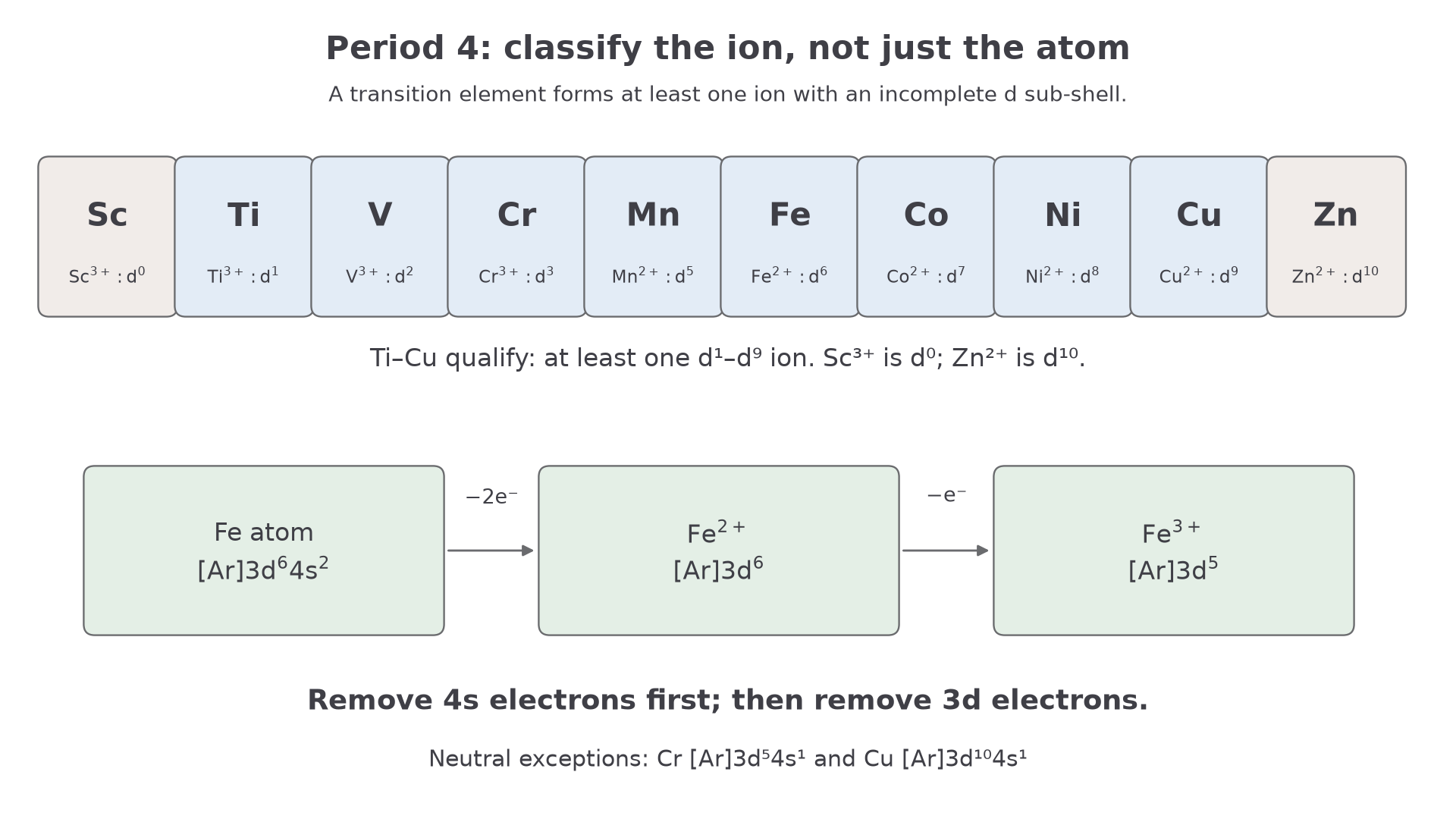
When Period 4 d-block atoms form positive ions, remove electrons from before removing electrons from .
This is the error OCR repeatedly catches. A neutral atom may be built by filling before , but a positive d-block ion loses its electrons first.
[DIAGRAM: asset_name: Lesson 5.3.1a-c: Transition element properties - diagram 01; asset_slug: 05_03_01a_transition_element_properties__diagram_01; recommended_method: drawn_chem; description: 16:9 summary showing Period 4 d-block Sc-Zn with Ti-Cu highlighted as transition elements, Sc3+ d0 and Zn2+ d10 exclusions, and Fe atom to Fe2+/Fe3+ electron configurations with 4s electrons removed before 3d.]
Worked example 1:
Start with the neutral iron atom:
Fe:
has lost 2 electrons. Remove the two electrons first:
:
Do not write as . That keeps the wrong electrons.
Worked example 2:
has lost 3 electrons. Remove both electrons, then one electron:
:
Worked example 3:
Vanadium atom:
V:
has lost 3 electrons: first the two electrons, then one electron.
:
Worked example: identify the metal from its ion
An unknown Period 4 metal forms with configuration . The ion has electrons. Because it has lost two electrons, the neutral atom has 27, so the metal is cobalt. Its atom is , and a further electron removed from gives , . Check the direction: a positive ion has fewer electrons than its neutral atom; forming the ion removes 4s before 3d.
Which d-block elements are transition elements
OCR does not treat every Period 4 d-block element as a transition element. The definition depends on ions, not just atoms.
Transition element
A transition element is a d-block element that forms at least one ion with an incomplete d sub-shell.
An incomplete d sub-shell means to . Empty and full do not count as incomplete.
At A level, the transition elements studied are:
Ti V Cr Mn Fe
Scandium and zinc are d-block elements, but they are not transition elements in this definition.
Scandium commonly forms :
Sc:
:
Continue this lesson.
You’re previewing NovaLearn without an account. Create a free account to read the rest.
Create free account