6.1.1(h)-(j) - Phenols, acidity and electrophilic substitution
Phenol looks a little like an alcohol because it contains an OH group, but its chemistry is different because the OH group is attached directly to a benzene ring. In this lesson, you will learn how phenol shows weak acidity, how it reacts with bromine and dilute nitric acid, and why its ring is more easily attacked by electrophiles than benzene.
Weak acidity of phenol
A phenol is an aromatic compound with an OH group attached directly to a benzene ring. The simplest phenol has the formula and is also called hydroxybenzene.
Phenol is a weak acid. At A level, the important evidence is practical and reaction-based: phenol can be neutralised by a strong alkali such as sodium hydroxide, but it does not react with carbonates.
When phenol reacts with sodium hydroxide, the acidic H from the OH group is removed and a salt, sodium phenoxide, is formed.
Neutralisation of phenol
[DIAGRAM: asset_name: Lesson 6.1.1h-j: Phenols, acidity and electrophilic substitution - diagram 01; asset_slug: 06_01_01c_phenols_acidity_and_electrophilic_substitution__diagram_01; recommended_method: drawn_chem; description: reaction and observation diagram showing phenol neutralisation by sodium hydroxide to sodium phenoxide and no reaction with sodium carbonate.]
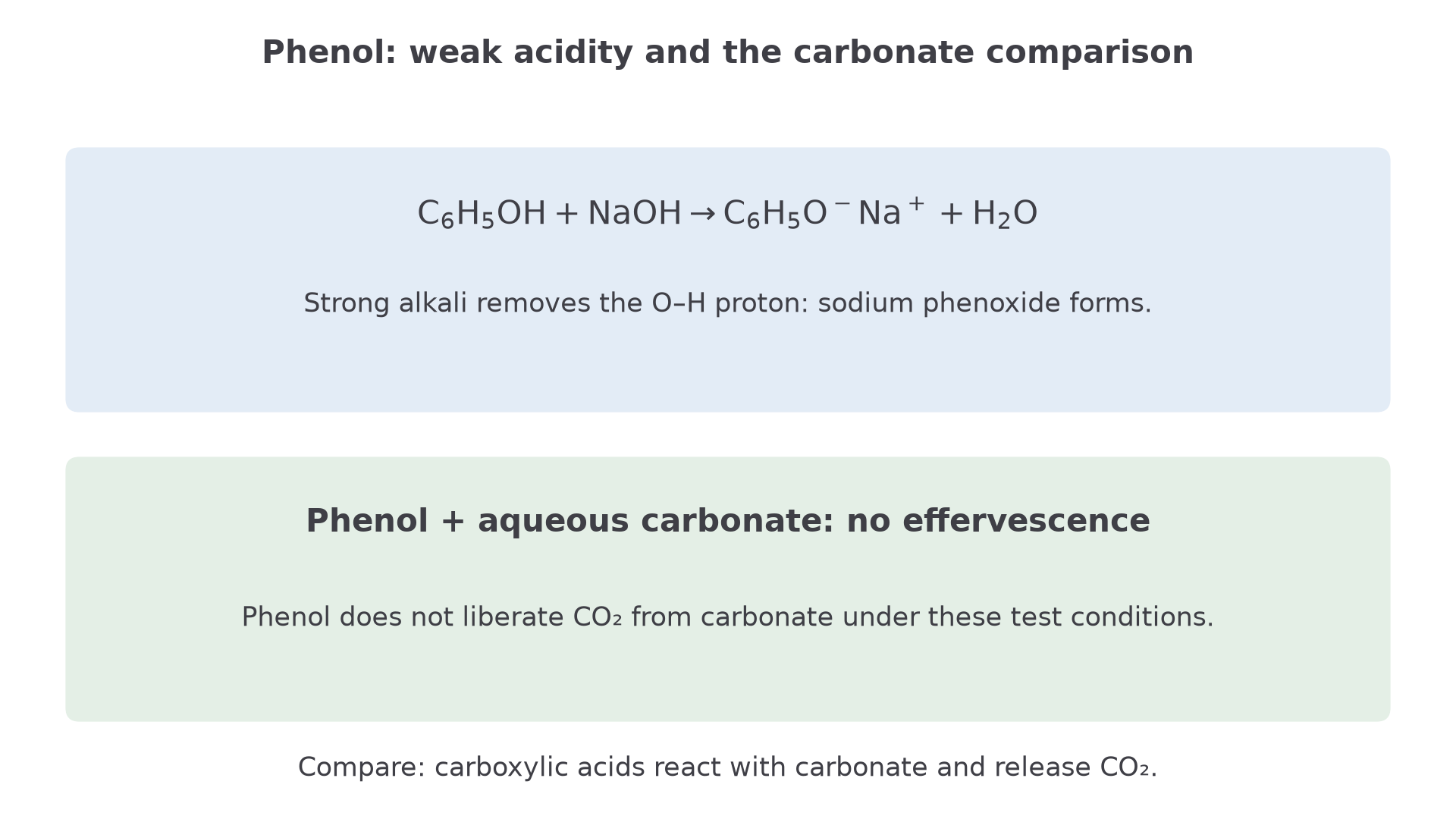
The carbonate result is just as important. Carboxylic acids react with carbonates to produce carbon dioxide, seen as effervescence. Phenol is not acidic enough to do this, so with sodium carbonate solution there is no reaction and no bubbles of .
PAG7 qualitative tests use small quantities, eye protection, safe handling of organic samples and clear observation records.
Do not say that reaction with sodium hydroxide alone identifies a phenol. Many acidic substances react with . The useful phenol evidence in this lesson is the combination of weak acidity and no carbonate reaction.
Weak means partially ionised in water, not simply dilute:
Sodium phenoxide is ionic and dissolves in aqueous alkali. This explains why phenol can dissolve as it reacts with sodium hydroxide. Ordinary alcohols such as cyclohexanol do not form such salts with aqueous sodium hydroxide under these conditions.
For a qualitative comparison, label separate clean tubes and use fresh small portions for carbonate and bromine-water tests. Add the test reagent dropwise, mix, and record colour, precipitate and effervescence separately. A blank tube with reagent and water helps distinguish the sample's result from contamination.
Bromination of phenol
Phenol undergoes electrophilic substitution with bromine much more readily than benzene. In this reaction, H atoms on the aromatic ring are substituted by atoms, while the aromatic ring remains.
With bromine water, phenol forms 2,4,6-tribromophenol. The equation can be written:
Bromination of phenol
[DIAGRAM: asset_name: Lesson 6.1.1h-j: Phenols, acidity and electrophilic substitution - diagram 02; asset_slug: 06_01_01c_phenols_acidity_and_electrophilic_substitution__diagram_02; recommended_method: drawn_chem; description: structure diagram for phenol reacting with bromine water to form 2,4,6-tribromophenol, with the orange decolourisation and white precipitate observation.]
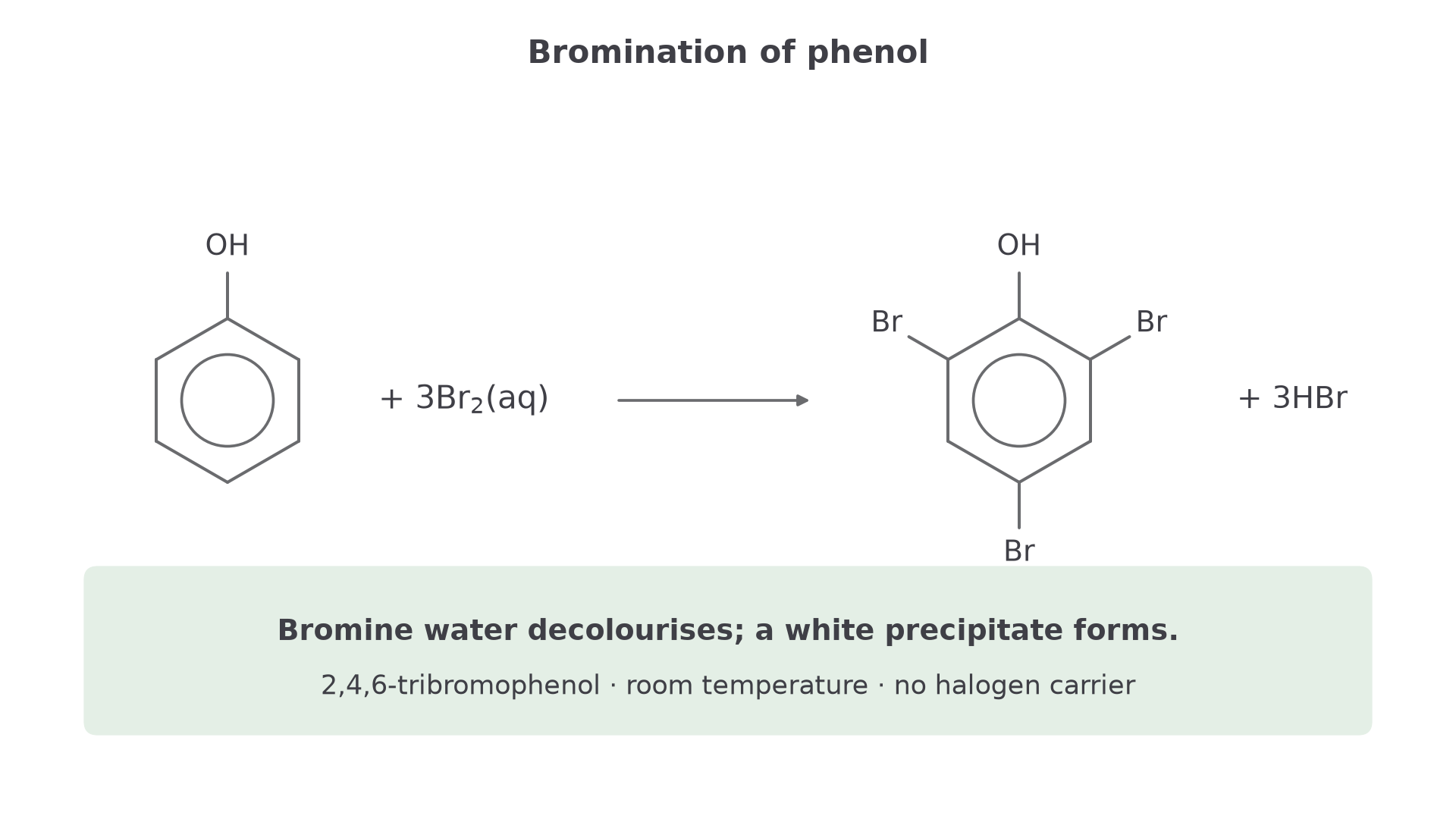
The observations matter. Bromine water is orange and is decolourised as it reacts. The product, 2,4,6-tribromophenol, forms a white precipitate.
OCR exam answers often lose the mark if they stop at "bromine is decolourised". For phenol, include the white precipitate as well.
Worked mass prediction
For phenol and excess bromine, using and :
The phenol:product ratio is 1:1, although three moles of bromine react per mole of phenol. The extra mass comes from replacing three H atoms with three Br atoms.
Continue this lesson.
You’re previewing NovaLearn without an account. Create a free account to read the rest.
Create free account