4.2.3(a) - Organic liquid preparation and purification
Preparing an organic liquid is not just about making a product. The practical skill is to heat the reaction safely, keep volatile substances under control, separate the organic product from water-soluble material, remove traces of water, and finally collect a purer liquid by redistillation. This lesson focuses on that practical sequence and the exact apparatus choices that make it work.
The practical aim
An organic liquid preparation usually has three jobs:
- make the organic product by heating the reaction mixture;
- separate the organic layer from an aqueous layer;
- purify the organic liquid so the final sample contains as little water and other liquid impurities as possible.
For this lesson, the important word is liquid. A liquid product is purified using a separating funnel, an anhydrous drying agent and redistillation. That is different from purifying an organic solid, where recrystallisation and melting point are the central ideas.
Organic layer
The organic layer is the liquid layer that contains the organic product. It may be the upper or lower layer depending on its density compared with the aqueous layer.
The practical sequence is easiest to remember as:
reflux or distil during preparation separate layers dry the organic layer redistil the dry organic liquid.
Risk management sits across the whole method. Many organic liquids are flammable, and some reagents used in these preparations may be corrosive, irritant or toxic. A safe method uses eye protection, careful clamping of glassware, suitable ventilation when vapours may be harmful, and an electric heater or water bath instead of a naked flame when flammable liquids are present.
Quickfit apparatus
Quickfit apparatus uses ground-glass joints so that pieces of glassware fit together securely. In this practical area, the two key arrangements are heating under reflux and distillation. They look similar because both can use a round-bottom or pear-shaped flask, a condenser, clamps, a heat source and anti-bumping granules. Their purposes are different.
[DIAGRAM: asset_name: Lesson 4.2.3a: Organic liquid preparation and purification - diagram 01; asset_slug: 04_02_03a_organic_liquid_preparation_and_purification__diagram_01; recommended_method: drawn_chem; description: Quickfit reflux and distillation apparatus side-by-side, showing condenser orientation, water in/out, open reflux top, thermometer position for distillation, receiving vessel, heat source and anti-bumping granules.]
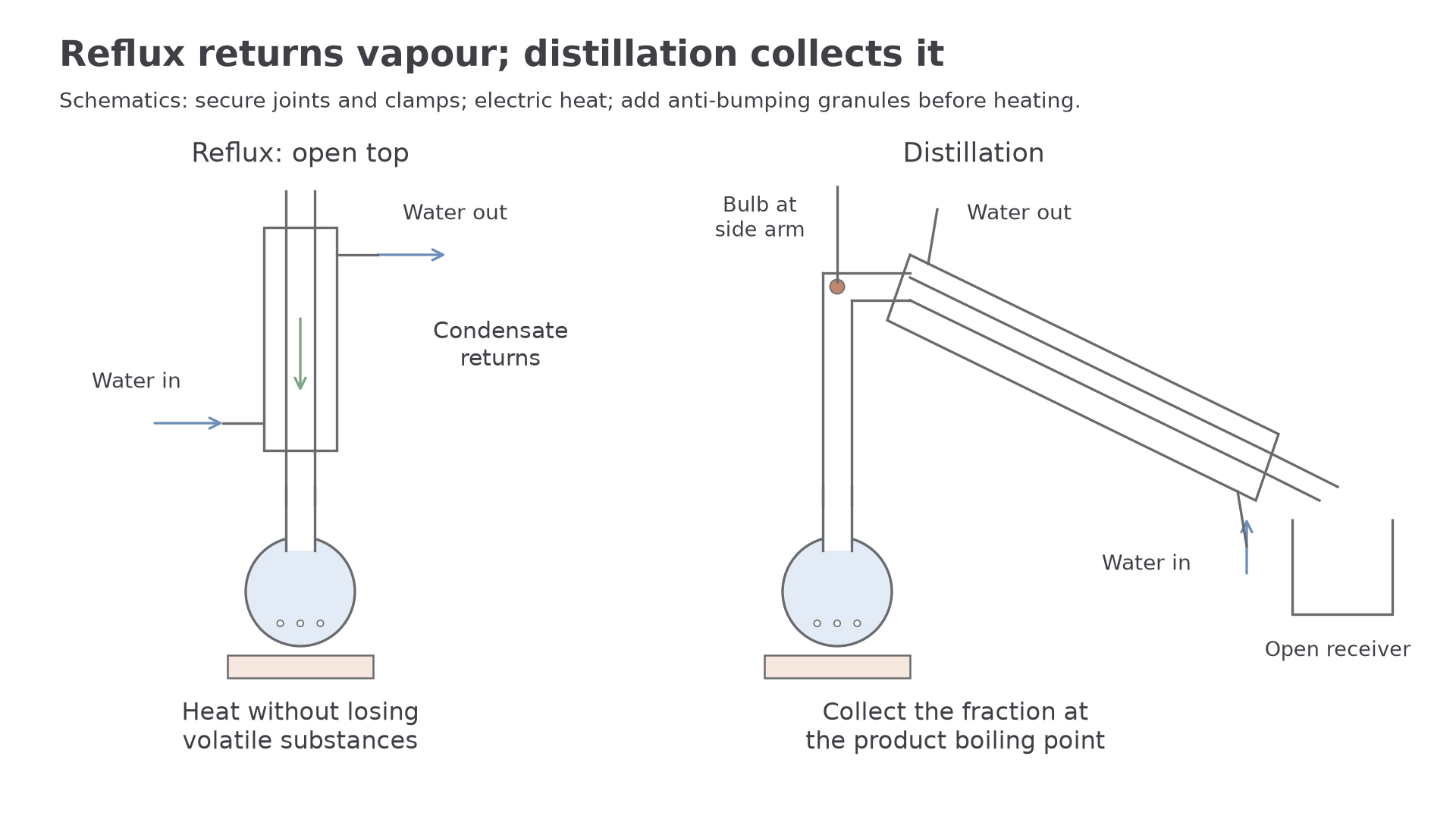
In heating under reflux, the reaction mixture is boiled while the condenser is vertical. Vapour rises, cools, condenses and drips back into the flask. This allows the mixture to be heated for long enough to react without losing volatile reactants, products or solvent.
In distillation, vapour is deliberately led through a side arm into a sloping condenser and then into a receiving vessel. This separates a volatile liquid from a mixture by boiling point.
Two small apparatus details are heavily tested because they reveal whether the setup is safe and functional:
- water enters the condenser at the bottom and leaves at the top, so the water jacket stays full and cools efficiently;
- anti-bumping granules are added before heating, so boiling is smooth rather than sudden and violent.
For reflux, the top of the condenser must not be sealed. A sealed apparatus can allow pressure to build up dangerously. The distillation receiver must also remain open to the atmosphere. A thermometer is not needed at the top of a reflux condenser because the aim is not to collect vapour at a measured boiling point. For distillation, the thermometer bulb should be near the side-arm outlet so it measures the temperature of vapour passing into the condenser.
Using a separating funnel
After an organic reaction, the mixture often contains an organic product and an aqueous layer. The aqueous layer may contain water, acids, alkalis, salts or other water-soluble substances. A separating funnel is used because the two liquids are immiscible and form two layers.
[DIAGRAM: asset_name: Separating funnel and layer identity; asset_slug: 04_02_03a_organic_liquid_preparation_and_purification__diagram_03; recommended_method: drawn_chem; description: Separating funnel with open neck, two layers, stopcock and stem; denser organic lower layer identified using supplied densities.]
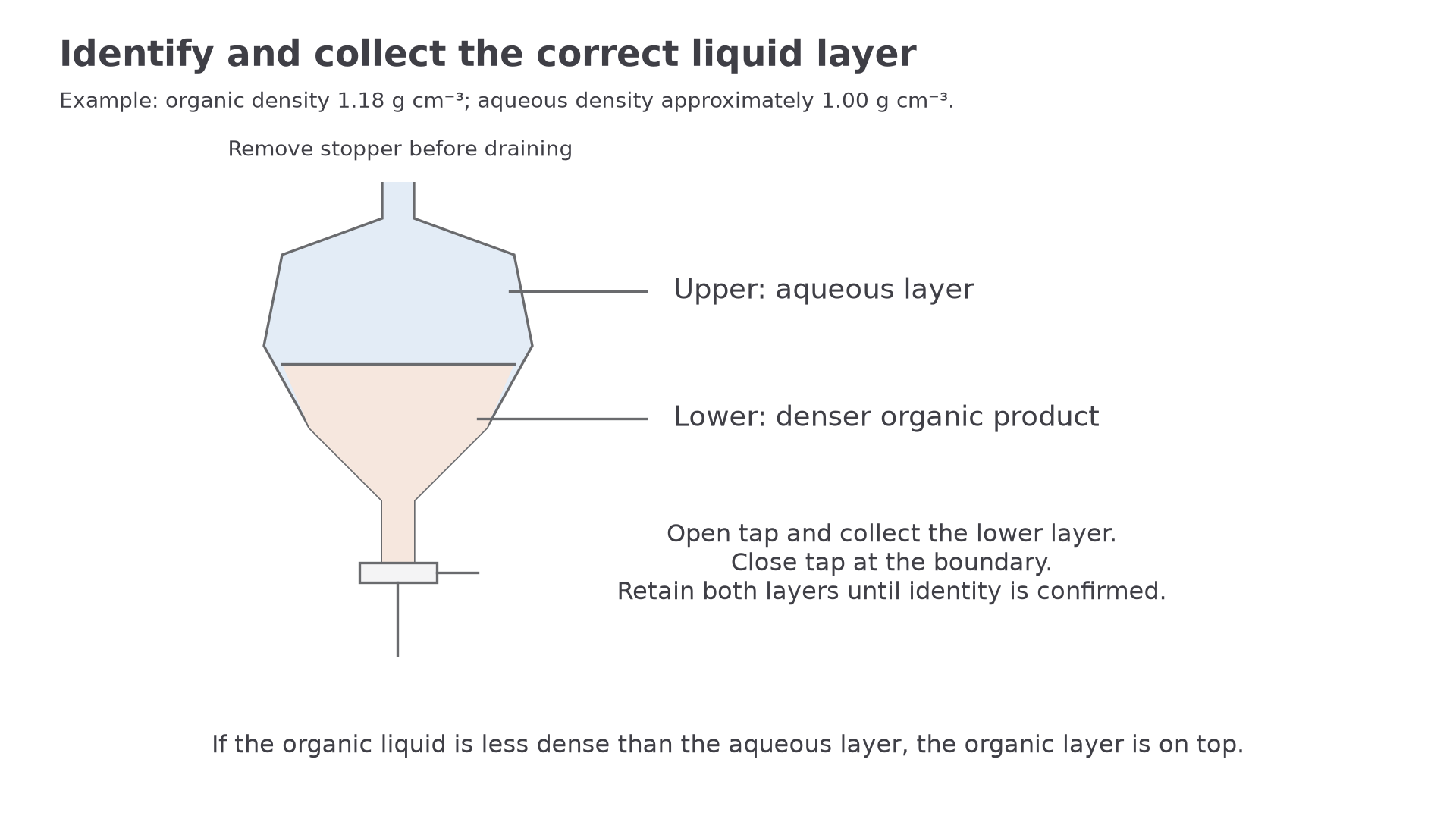
The practical idea is simple:
- cool the mixture, close the tap, and transfer it to the separating funnel;
- allow the layers to settle;
- remove the stopper before running liquid out of the tap;
- drain the lower layer carefully;
- keep the layer that contains the organic product.
If a carbonate or hydrogencarbonate wash is used to neutralise acid, carbon dioxide gas may form. The funnel should be inverted carefully and vented regularly by opening the tap while the stem points away from people. This prevents pressure building up.
The most common mistake is assuming that the organic layer is always on top. It is not. If the organic product has a density greater than water, it will be the lower layer. If the question gives density data, use it. If the layer identity is uncertain in a practical method, adding a little water shows the aqueous layer because that layer increases in volume.
Worked example. A reaction mixture forms two layers. The product is an organic liquid with density 1.17 . The aqueous layer has density close to 1.00 .
Continue this lesson.
You’re previewing NovaLearn without an account. Create a free account to read the rest.
Create free account