6.2.2(c)-(d) - Chirality and optical isomerism
Some organic molecules can have the same atoms joined in the same order but still exist as different 3-D arrangements. In this lesson, you will learn optical isomerism as non-superimposable mirror images about a chiral centre, then practise finding chiral centres in condensed and displayed organic formulae. The key skill is spatial: you must decide whether one carbon really has four different groups around it.
Mirror-Image Isomers
Optical isomerism is a form of stereoisomerism. That means the isomers have the same structural formula, but their atoms or groups are arranged differently in space.
Optical Isomerism
Optical isomerism is stereoisomerism in which two molecules are non-superimposable mirror images about a chiral centre.
Non-superimposable means that no rotation of the whole molecule makes the mirror image match the original. The usual everyday comparison is left and right hands: they are mirror images, but they do not become identical just because you turn one hand around.
Chiral Centre
For OCR organic chemistry, a chiral centre is a tetrahedral carbon atom bonded to four different atoms or groups.
If a carbon is bonded to four different groups, a mirror-image arrangement can exist. The two mirror images have the same connectivity, so they are not structural isomers. They differ only in the 3-D arrangement around the chiral centre.
The word "optical" comes from the behaviour of pure optical isomers with plane-polarised light, but this specification point defines the isomerism through 3-D structure. You do not need to predict rotation direction, use R/S notation, or do polarimeter calculations in this lesson.
Worked reasoning: why can butan-2-ol show optical isomerism?
Butan-2-ol is CH₃CH(OH)CH₂CH₃. The second carbon is bonded to:
- CH₃
- CH₂CH₃
Those four groups are all different. That carbon is a chiral centre, so butan-2-ol can exist as two non-superimposable mirror-image optical isomers.
Drawing 3-D Mirror Images
OCR expects you to understand 3-D diagrams for optical isomerism. The central carbon is tetrahedral, so a flat cross is not enough to show the full spatial arrangement. A wedge usually shows a bond coming out of the page, and a dashed or hashed wedge shows a bond going into the page.
[DIAGRAM: asset_name: Lesson 6.2.2c-d: Chirality and optical isomerism - diagram 01; asset_slug: 06_02_02b_chirality_and_optical_isomerism__diagram_01; recommended_method: drawn_chem; description: 16:9 deterministic wedge/dash diagram showing an alanine-style chiral centre and its non-superimposable mirror image, with four different groups labelled and a mirror plane between the structures.]
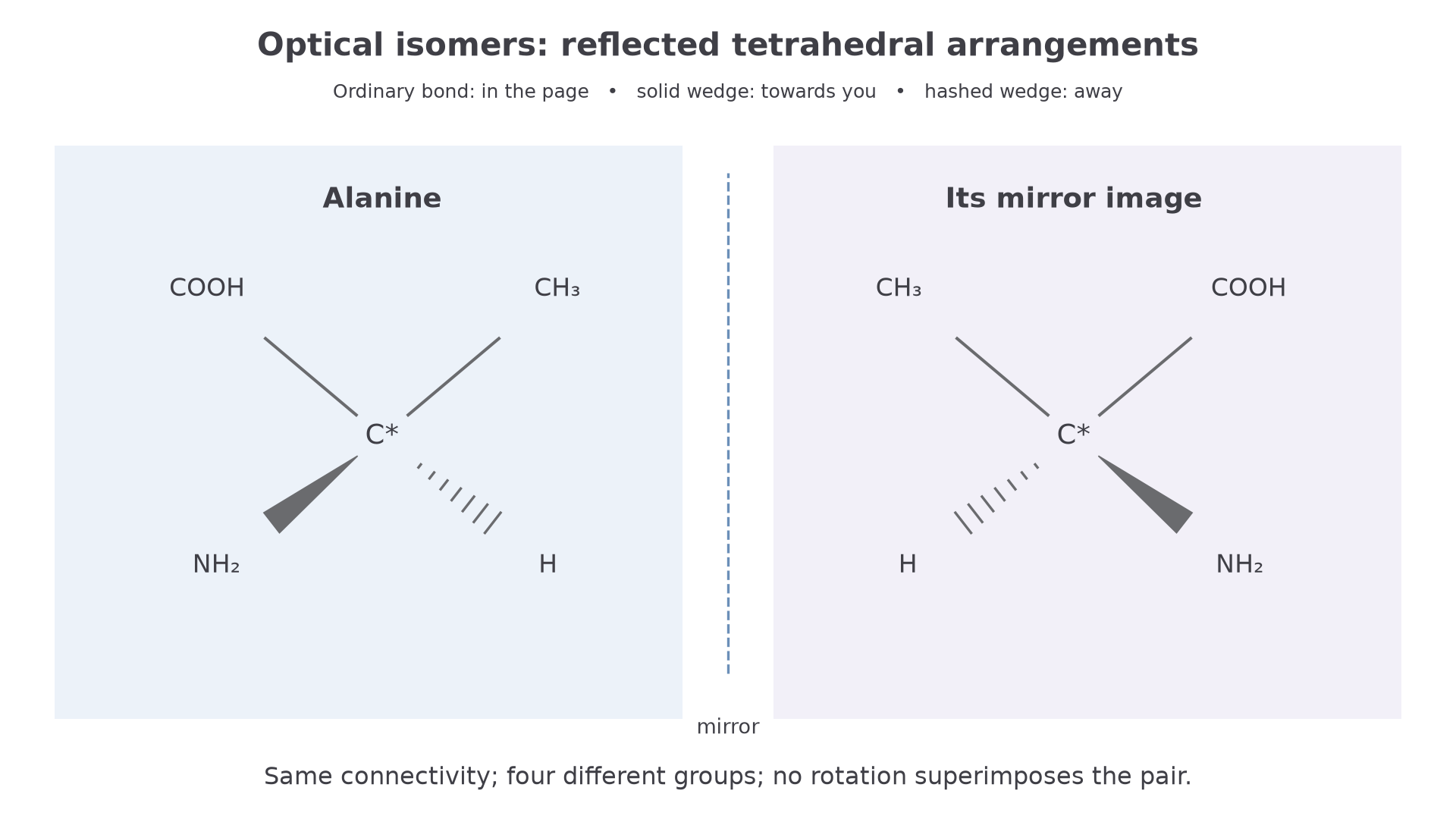
When you draw a pair of optical isomers, keep the same four groups attached to the same central carbon. The difference is their 3-D arrangement. To draw the reflected pair, place a vertical mirror between the structures: left and right positions exchange, while bonds pointing towards you still point towards you. A second method, for a single chiral centre, is to swap exactly two groups while keeping the other two fixed; that reverses the configuration. Rotating the entire diagram does not create a new isomer.
Worked example: an amino-acid centre
Alanine can be written as NH₂CH(CH₃)COOH. The central carbon is bonded to NH₂, CH₃, and . These four groups are different, so that carbon is chiral. A correct pair of 3-D structures must show the same four groups around the carbon, but arranged as mirror images.
Do not change the formula while drawing the mirror image. If NH₂ becomes bonded to the wrong carbon, or if turns into , the answer has become a different molecule rather than the optical isomer.
Finding Chiral Centres
Use a repeatable scan method whenever you are given an organic molecule.
- Look for carbon atoms with four single bonds.
- Ignore carbon atoms in or bonds, because they are not tetrahedral carbons with four single bonds.
- Ignore CH₃ and CH₂ carbons as chiral centres, because they have repeated hydrogen atoms.
- For each remaining candidate carbon, list the four attached atoms or groups.
- If all four groups are different, that carbon is a chiral centre.
- If two attached groups look like carbon chains, trace outward along each chain until you can tell whether the paths are identical or different.
Continue this lesson.
You’re previewing NovaLearn without an account. Create a free account to read the rest.
Create free account