2.2.1 - Electron structure
Electrons are not arranged around a nucleus as neat circular tracks. In this lesson you will build the model used in A-level chemistry: shells contain sub-shells, sub-shells contain orbitals, and electron configurations record which orbitals are occupied. The aim is practical: by the end, you should be able to write full sub-shell configurations for atoms up to krypton and for s- and p-block ions in the OCR boundary.
Shells, sub-shells and orbitals
Electron structure uses a hierarchy of ideas.
A shell is a main energy level around the nucleus. Shells are labelled by a principal number, n = 1, 2, 3, 4.... The first four shells can hold these maximum numbers of electrons:
| shell | maximum electrons |
|---|---|
| 1st shell, n = 1 | 2 |
| 2nd shell, n = 2 | 8 |
| 3rd shell, n = 3 | 18 |
| 4th shell, n = 4 | 32 |
The formula behind these values is 2n², but the values themselves matter most here. The 4th shell maximum of 32 is the full shell capacity; in this lesson's configurations up to Z = 36, you only need the order as far as 4p.
A sub-shell is a group of orbitals within a shell. The sub-shell letters you need here are s, p and d.
| sub-shell | number of orbitals | maximum electrons |
|---|---|---|
| s | 1 | 2 |
| p | 3 | 6 |
| d | 5 | 10 |
Atomic orbital
An atomic orbital is a region around the nucleus that can hold up to two electrons with opposite spins.
That definition does a lot of work. It says an orbital is a region, not a fixed path. It also says a single orbital can be empty, hold one electron, or hold two electrons, but if it holds two electrons they must have opposite spins.
Worked example: capacity of the 3p sub-shell
A p sub-shell contains 3 orbitals. Each orbital can hold 2 electrons:
So a full 3p sub-shell is written as 3p⁶.
Orbital shapes and boxes
For this lesson, the only orbital shapes you need to know are s and p.
An s orbital is spherical. A p orbital is dumb-bell shaped, with two lobes on opposite sides of the nucleus. In a p sub-shell there are three p orbitals, usually described as being at right angles to each other, but the shape of one p orbital is still just one dumb-bell.
If asked for the shape of a p orbital, give one dumb-bell shape. Do not turn it into three separate p orbitals unless the question asks for the whole p sub-shell.
[DIAGRAM: asset_name: h432 electron orbitals; asset_slug: h432_electron_orbitals; recommended_method: drawn_chem; description: Spherical s orbital and single dumbbell p orbital, nucleus dot; equal-energy N2p3 and O2p4 boxes with parallel singles and opposite pair.]
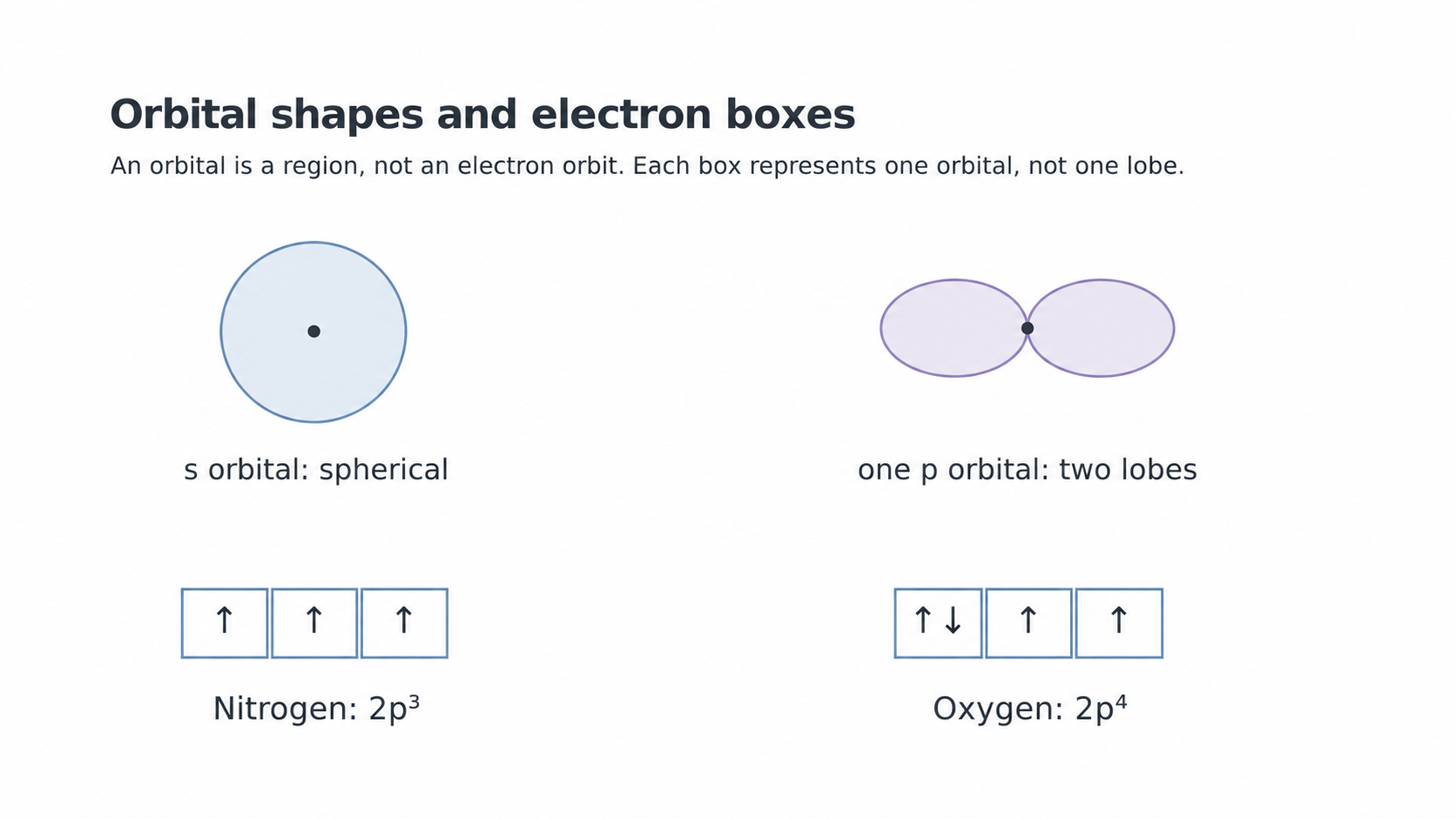
Orbitals can also be shown as boxes. Each box represents one orbital. Each arrow represents one electron. Two arrows in the same box show two electrons with opposite spins:
one orbital with two electrons: [↑↓]
The opposite arrows represent opposite spins. For oxygen’s 2p⁴ sub-shell, the three boxes can be shown as [↑↓] [↑] [↑]: one opposite-spin pair and two parallel-spin single electrons. Any equivalent choice of which box contains the pair is valid.
Worked example: reading a box
If an orbital box contains one electron, the orbital is half-filled. If it contains two opposite-spin electrons, the orbital is full. An s sub-shell has one box, so 2s² means the single 2s orbital is full.
Filling orbitals in order
Electrons fill orbitals in order of increasing energy. For the first three shells, plus the 4s and 4p orbitals, use this filling order:
1s, 2s, 2p, 3s, 3p, 4s, 3d, 4p
The unusual-looking part is that 4s fills before 3d. That is the order you use when building configurations up to Z = 36.
There is one more filling rule. Orbitals with the same energy are occupied singly before any pairing happens. The three p orbitals in one p sub-shell have the same energy, so one electron goes into each p orbital before a second electron pairs with any of them. The single electrons have parallel spins in the ground-state arrangement.
Worked example 1: nitrogen
Nitrogen has atomic number 7, so a nitrogen atom has 7 electrons.
Fill in order:
1s² 2s² 2p³
The 2p³ part means three electrons are in the three 2p orbitals. Because equal-energy orbitals fill singly before pairing, the three 2p electrons occupy separate p orbitals. Nitrogen therefore has three unpaired electrons in the 2p sub-shell.
Worked example 2: oxygen
Oxygen has atomic number 8, so an oxygen atom has 8 electrons:
1s² 2s² 2p⁴
The first three 2p electrons occupy the three p orbitals singly. The fourth 2p electron has to pair in one of those orbitals, with opposite spin.
Writing atom configurations
An electron configuration in sub-shell notation tells you the shell number, the sub-shell letter and the number of electrons in that sub-shell.
For example:
1s²
means "two electrons in the 1s sub-shell". The superscript is an electron count, not a charge: 2p⁴ means four electrons distributed among the three 2p orbitals.
To write a configuration for an atom:
- Use the atomic number as the number of electrons.
- Fill sub-shells in the order 1s, 2s, 2p, 3s, 3p, 4s, 3d, 4p.
- Stop when all electrons have been placed.
- Check that no sub-shell exceeds its capacity: s², p⁶, d¹⁰.
Worked example 1: sulfur, Z = 16
Sulfur has 16 electrons.
1s² 2s² 2p⁶ 3s² 3p⁴
Check the total:
2 + 2 + 6 + 2 + 4 = 16
The 3p sub-shell is not full because it contains 4 electrons, not 6.
Worked example 2: calcium, Z = 20
Calcium has 20 electrons.
1s² 2s² 2p⁶ 3s² 3p⁶ 4s²
The 4s sub-shell is used before 3d, so calcium ends in 4s².
Worked example 3: iron atom, Z = 26
Iron has 26 electrons.
1s² 2s² 2p⁶ 3s² 3p⁶ 4s² 3d⁶
Some mark schemes also allow the filled third-shell terms to be grouped as:
1s² 2s² 2p⁶ 3s² 3p⁶ 3d⁶ 4s²
For learning the filling process, keep the order 4s before 3d.
Special neutral atoms: chromium and copper
Most configurations up to Z = 36 follow the simple filling pattern. The two common neutral-atom exceptions are chromium and copper:
Cr: 1s² 2s² 2p⁶ 3s² 3p⁶ 4s¹ 3d⁵
Cu: 1s² 2s² 2p⁶ 3s² 3p⁶ 4s¹ 3d¹⁰
These are ground-state configurations, so the simple filling sequence needs two exceptions. You do not need a detailed quantum explanation here; just recognise that chromium has a half-filled 3d⁵ sub-shell and copper has a full 3d¹⁰ sub-shell.
Writing s- and p-block ion configurations
A positive s- or p-block ion forms by losing the outermost electrons; a negative ion gains electrons. Here the atoms have atomic numbers up to 36.
The method is:
- Start with the atomic number.
- Adjust for the charge.
- Start from the atom’s configuration: remove electrons from the highest occupied shell for a positive ion, or add electrons to the next available orbital for a negative ion.
For a positive ion, subtract electrons. For a negative ion, add electrons.
Electron count for an ion
Worked example 1: magnesium ion, Mg²⁺
Magnesium has Z = 12, so a magnesium atom has 12 electrons. A 2+ ion has lost 2 electrons:
12 - 2 = 10 electrons
The configuration for 10 electrons is:
Mg²⁺: 1s² 2s² 2p⁶
Worked example 2: chloride ion, Cl⁻
Chlorine has Z = 17. A 1- ion has gained 1 electron:
17 + 1 = 18 electrons
The configuration for 18 electrons is:
Cl⁻: 1s² 2s² 2p⁶ 3s² 3p⁶
Worked example 3: bromide ion, Br⁻
Bromine is a p-block element with Z = 35, so Br⁻ is inside this lesson's ion boundary:
35 + 1 = 36 electrons
Fill to 36 electrons:
Br⁻: 1s² 2s² 2p⁶ 3s² 3p⁶ 4s² 3d¹⁰ 4p⁶
Worked example 4: an ion with a filled d sub-shell
Gallium is a p-block element with Z = 31. Its atom is [Ar] 3d¹⁰ 4s² 4p¹. For Ga³⁺:
- The ion has 31 − 3 = 28 electrons.
- Remove the three electrons in the highest occupied shell, n = 4: the 4p electron and both 4s electrons.
- The full configuration is 1s² 2s² 2p⁶ 3s² 3p⁶ 3d¹⁰. Its occupancies total 28.
Do not fill 28 electrons from scratch as though the ion were a neutral nickel atom: [Ar] 4s² 3d⁸ would remove the wrong electrons. The count checks the result, but the parent atom and outermost shell determine the removal. Transition-metal ions are revisited later.
Quick Recap
- The first four shells hold at most 2, 8, 18 and 32 electrons; s, p, d sub-shells contain 1, 3, 5 orbitals and hold 2, 6, 10 electrons.
- An orbital holds up to two opposite-spin electrons. An s orbital is spherical; one p orbital is a dumb-bell with two lobes.
- Equal-energy orbitals fill singly before pairing. Use the filling order through 4p, remembering neutral Cr/Cu exceptions.
- For s-/p-block ions, adjust the count for charge and remove from the highest occupied shell for a cation. Check the parent configuration as well as the electron total.