5.2.1(c)-(e) - Solution, hydration enthalpy and ionic models
When an ionic solid dissolves in water, two energy ideas compete. Energy is needed to separate ions from the solid lattice, but energy is released when water molecules attract and surround the ions. In this lesson, you will define solution and hydration enthalpies, build the enthalpy cycle that connects them to lattice enthalpy, and explain why ionic charge and ionic radius control the sizes of the energy changes.
Solution and hydration enthalpies
The enthalpy change of solution is the overall enthalpy change for dissolving an ionic solid in water. It covers the complete change from the solid solute to aqueous ions.
Enthalpy change of solution
The enthalpy change of solution, , is the enthalpy change when 1 of solute dissolves in water.
For sodium chloride, the equation for the change is:
Solution enthalpy equation
may be positive or negative. A positive value means the dissolving process is endothermic overall. A negative value means it is exothermic overall.
The enthalpy change of hydration is not the same thing. It focuses on one type of gaseous ion becoming an aqueous ion. The word "gaseous" matters because the lattice has already been separated before hydration is considered.
Enthalpy change of hydration
The enthalpy change of hydration, , is the enthalpy change when 1 of gaseous ions dissolves in water to form aqueous ions.
Examples are:
Hydration enthalpy equations
Hydration enthalpies are exothermic because attractions form between ions and polar water molecules. The oxygen end of water is attracted to cations, and the hydrogen end is attracted to anions. OCR requires the definitions, but not the detailed thermodynamic idea of infinite dilution.
The solution enthalpy cycle
A solution enthalpy cycle is a Hess cycle. It uses conservation of energy: the enthalpy change between the same start and finish is the same whichever route is taken.
The direct route is dissolving the solid:
Direct route
The indirect route breaks the process into two imagined steps:
- Reverse the lattice formation enthalpy to separate the solid into gaseous ions.
- Hydrate the gaseous ions to form aqueous ions.
[DIAGRAM: asset_name: Lesson 5.2.1c-e: Solution, hydration enthalpy and ionic models - diagram 01; asset_slug: 05_02_01b_solution_hydration_enthalpy_and_ionic_models__diagram_01; recommended_method: drawn_chem; description: Deterministic Hess cycle for one mole of NaCl dissolving, with NaCl(s), Na+(g) + Cl-(g), Na+(aq) + Cl-(aq), Delta_solH, -Delta_leH and summed Delta_hydH labels; includes note to multiply hydration terms for salts such as MgCl2.]
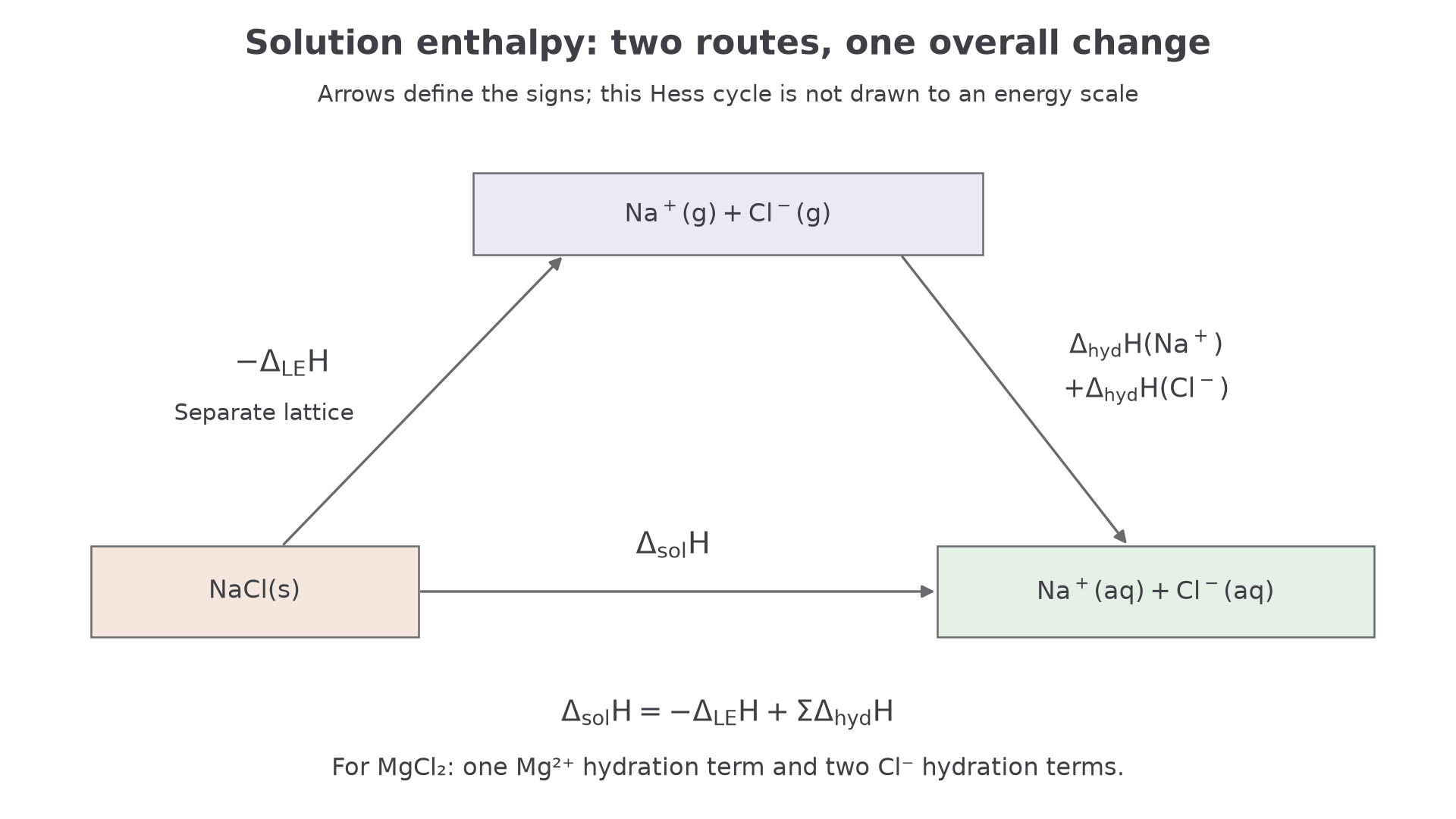
OCR lattice enthalpy, , is the enthalpy change when 1 of an ionic lattice forms from its gaseous ions. That formation value is exothermic. In a solution cycle, the arrow from solid lattice to gaseous ions goes in the opposite direction, so its enthalpy change is -.
For :
Cycle relationship for \(\ce{NaCl}\)
For a salt with more than one of an ion, multiply the hydration enthalpy by the number of that ion in the formula. For , one mole of produces 1 of ions and 2 of ions, so the chloride hydration term is doubled.
Using the cycle in calculations
The calculation is easiest if you write the cycle equation first and then substitute with signs. Do not remove negative signs just because a value is "energy released"; the sign is part of the data.
For magnesium chloride, suppose the data are:
| Enthalpy change | Value / |
|---|---|
| Lattice enthalpy of | -2526 |
| Hydration enthalpy of | -1920 |
| Hydration enthalpy of | -364 |
The cycle equation is:
\(\ce{MgCl2}\) cycle equation
Substitute:
Worked calculation
The negative answer means dissolving is exothermic using these data. The common errors are using the lattice enthalpy with the wrong sign, forgetting to double the chloride hydration enthalpy, or giving the final unit as just rather than .
Worked example: finding a missing hydration term
An illustrative has lattice formation enthalpy , solution enthalpy , and chloride hydration enthalpy , all in . Let the hydration enthalpy of be .
The two chloride ions must both be hydrated. Substituting the answer back gives , checking the sign and multiplier. The negative also agrees with attractive ion–dipole interactions forming during hydration.
Continue this lesson.
You’re previewing NovaLearn without an account. Create a free account to read the rest.
Create free account