6.1.1(d)-(g) - Electrophilic substitution of aromatic compounds
Aromatic rings react differently from alkenes because their pi electrons are delocalised over the ring. In this lesson you will learn the OCR electrophilic substitution reactions of arenes, the nitration and halogenation mechanisms, and how to use the same pattern when an unfamiliar aromatic substitution is supplied in a question.
The aromatic substitution pattern
Benzene contains a delocalised pi-system above and below the six-carbon ring. An electrophile can be attracted to this electron density, but the ring normally reacts by substitution rather than addition. One hydrogen atom on the aromatic ring is replaced by the electrophile, and the delocalised ring is restored.
Electrophile
An electrophile is an electron-pair acceptor.
The OCR reactions in this lesson all fit the same overall idea:
| Reaction family | Reagents and conditions | Organic product from benzene | Other product |
|---|---|---|---|
| Nitration | concentrated in the presence of concentrated | nitrobenzene, | |
| Halogenation | or with a halogen carrier such as , or | chlorobenzene or bromobenzene | or |
| Friedel-Crafts alkylation | a haloalkane with a halogen carrier, commonly | an alkylbenzene | a hydrogen halide |
| Friedel-Crafts acylation | an acyl chloride with a halogen carrier, commonly | an acylbenzene, which is an aromatic ketone |
is often used for a halogen atom, so means or , and means a halogen carrier such as or .
Worked example: predict the main product when benzene reacts with bromine in the presence of iron.
- The reagent is a halogen, so this is halogenation.
- Iron forms an iron halide halogen carrier in the reaction mixture.
- One on benzene is substituted by .
- The product is bromobenzene, ; the other product is .
The balanced equation is:
Electrophilic substitution preserves the aromatic ring overall: one ring hydrogen is replaced, and aromaticity is restored.
Nitration of benzene
Nitration introduces the group into an aromatic ring. For benzene, the overall equation is:
The conditions are concentrated nitric acid and concentrated sulfuric acid. Concentrated sulfuric acid helps generate the electrophile and is regenerated, so it acts as a catalyst in the mechanism.
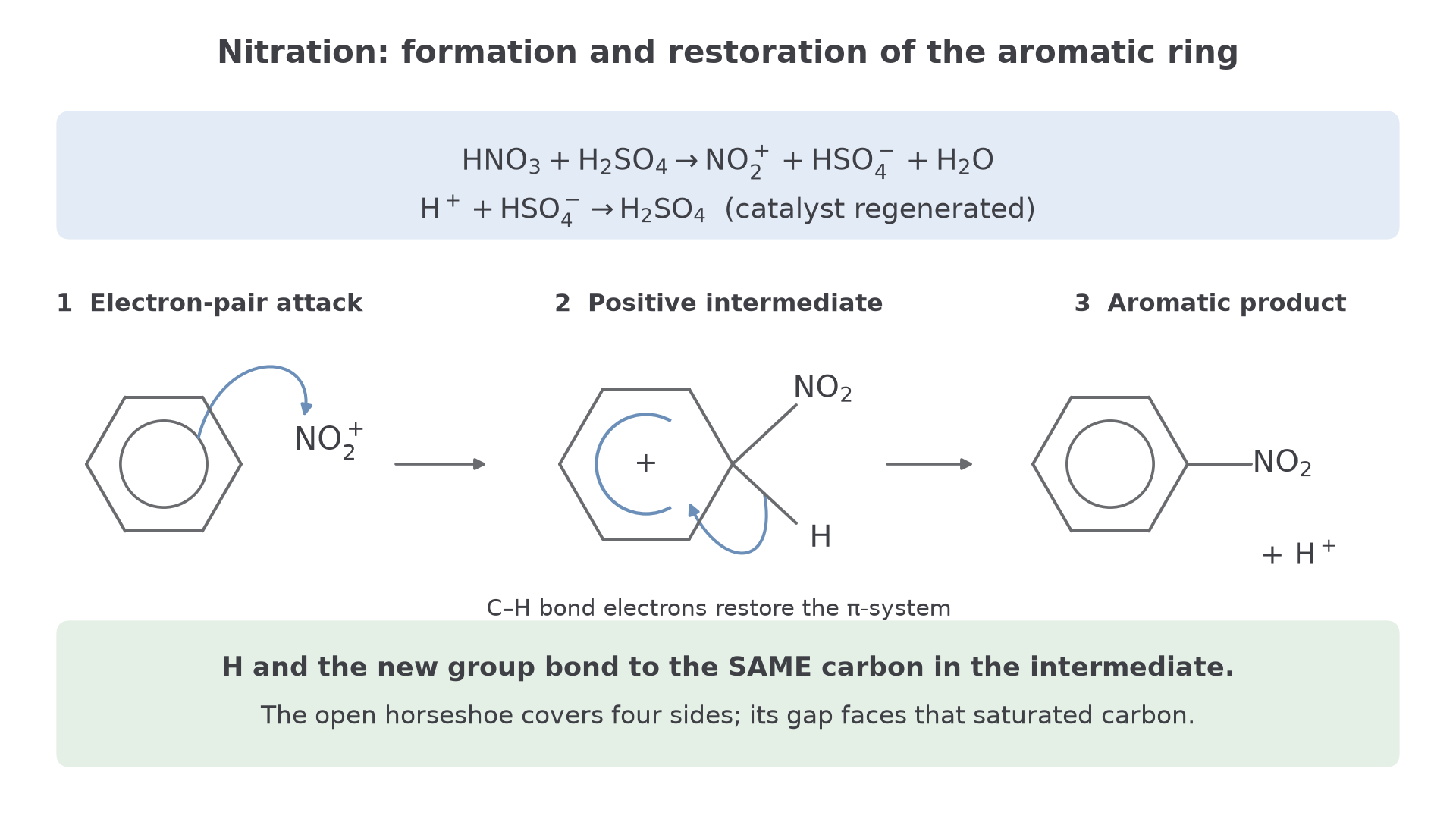
The electrophile is the nitronium ion, . OCR expects equations for its formation. A compact equation is:
The catalyst is regenerated when the proton lost from the ring reacts with hydrogensulfate:
For an exam drawing, use full-headed curly arrows to show movement of an electron pair. Start the attack arrow on the pi-circle, or on a C=C pi bond in a Kekulé drawing, and point it to the nitrogen of . In the positive intermediate, put and the retained H on the same attacked carbon; show the remaining delocalisation as a horseshoe with a + charge (or an equivalent valid Kekulé/Wheland structure). The restoration arrow starts on that carbon's C-H bond and ends inside the ring, not on H itself. Show leaving and the complete aromatic product. The text questions here practise this reasoning; an exam drawing must also display these bonds, charges and arrows.
The mechanism has two important organic steps:
- The delocalised pi-system in benzene donates an electron pair to . A new C-N bond forms and the ring becomes a positively charged sigma complex. The full delocalised ring has been temporarily disrupted.
- A proton is removed from the carbon that has gained . The C-H bond electrons return to the ring, restoring the delocalised pi-system and forming nitrobenzene.
Worked example: outline the nitration mechanism in words for benzene.
First, concentrated sulfuric acid and concentrated nitric acid generate . The benzene pi-system donates an electron pair to the electrophile, forming a C-N bond to , giving a positively charged sigma complex. Loss of then restores the delocalised ring. The lost reacts with to reform .
Notice what is not happening: benzene is not adding and across a double bond. The ring finishes aromatic, so the reaction is substitution.
For mononitration of benzene, warm the concentrated-acid mixture with temperature control, commonly around . Stronger heating can favour further nitration. In the sigma intermediate the attacked carbon has four sigma bonds (two ring bonds, H and the incoming group), so its p orbital no longer participates. Only the other five ring carbons share the remaining delocalisation: draw an open horseshoe spanning approximately four sides, with its gap towards the attacked carbon. A complete circle here would incorrectly claim that aromaticity had already been restored.
[DIAGRAM: asset_name: 6.1.1d-g - Electrophilic substitution of aromatic compounds - diagram 01; asset_slug: 06_01_01b_electrophilic_substitution_of_aromatic_compounds__diagram_01; recommended_method: drawn_chem; description: Nitration with same-carbon H and NO2, four-side horseshoe and correct arrows.]
Halogenation of benzene
Benzene does not react readily with chlorine or bromine alone under ordinary conditions. A halogen carrier is needed. OCR includes iron, iron halides and aluminium halides as halogen carriers.
For chlorination:
For bromination:
The halogen carrier helps generate a strong enough electrophile. For OCR halogenation mechanisms, you may assume the electrophile is , where is or .
Use the same drawing convention as nitration: the first full-headed arrow starts on the ring pi-system and points to . Put X and H on the same carbon in the positively charged intermediate; start the restoring arrow on this C-H bond and point into the ring as is lost.
The organic mechanism is the same pattern as nitration:
- The benzene pi-system forms a bond to .
- A positively charged sigma complex forms.
- Loss of restores the delocalised ring, giving a halobenzene.
If the carrier is represented as for chlorination, the final inorganic step can be written as:
Worked example: outline the bromination of benzene in the presence of .
acts as the halogen carrier and helps generate the electrophile, which can be treated as . The benzene pi-system forms a C- bond to , giving a positively charged sigma complex. Loss of restores the aromatic ring and forms bromobenzene. The hydrogen ion combines with the carrier-derived anion to form and regenerate the carrier.
For the bromine/iron(III) bromide example, the two inorganic equations are:
This is the OCR simplified electrophile model. The carrier is regenerated; it does not supply the bromine atom permanently or become part of the aromatic product.
Continue this lesson.
You’re previewing NovaLearn without an account. Create a free account to read the rest.
Create free account