3.1.3(g) - Halide ion tests
Halide ions are the negative ions made from Group 7 elements: chloride, bromide and iodide. In this lesson you will learn the test-tube reactions used to distinguish aqueous Cl⁻, Br⁻ and I⁻: first with aqueous silver ions, then with aqueous ammonia. The skill is not just remembering colours; it is linking an observation to an ionic equation and then using the ammonia step to confirm the ion.
Silver halide precipitates
The test begins with a solution that may contain a halide ion. Aqueous silver nitrate is commonly used because it supplies aqueous silver ions, Ag⁺(aq). When Ag⁺(aq) meets chloride, bromide or iodide ions, an insoluble silver halide forms as a precipitate.
Precipitate
A precipitate is an insoluble solid formed when two aqueous solutions react.
The general ionic equation is:
where X⁻ is Cl⁻, Br⁻ or I⁻.
For this lesson, you need all three specific ionic equations:
The observations are:
| Halide ion in solution | Silver halide precipitate | Observation after adding Ag⁺(aq) |
|---|---|---|
| Cl⁻ | AgCl(s) | white precipitate |
| Br⁻ | AgBr(s) | cream precipitate |
| I⁻ | AgI(s) | yellow precipitate |
Worked example: writing the ionic equation
A solution contains aqueous sodium bromide. When aqueous silver nitrate is added, a cream precipitate forms.
The reacting ions are Ag⁺(aq) from silver nitrate and Br⁻(aq) from sodium bromide. Sodium ions and nitrate ions are spectator ions, so they are not in the ionic equation.
The state symbols matter if the question asks for them: both ions are aqueous and the precipitate is solid.
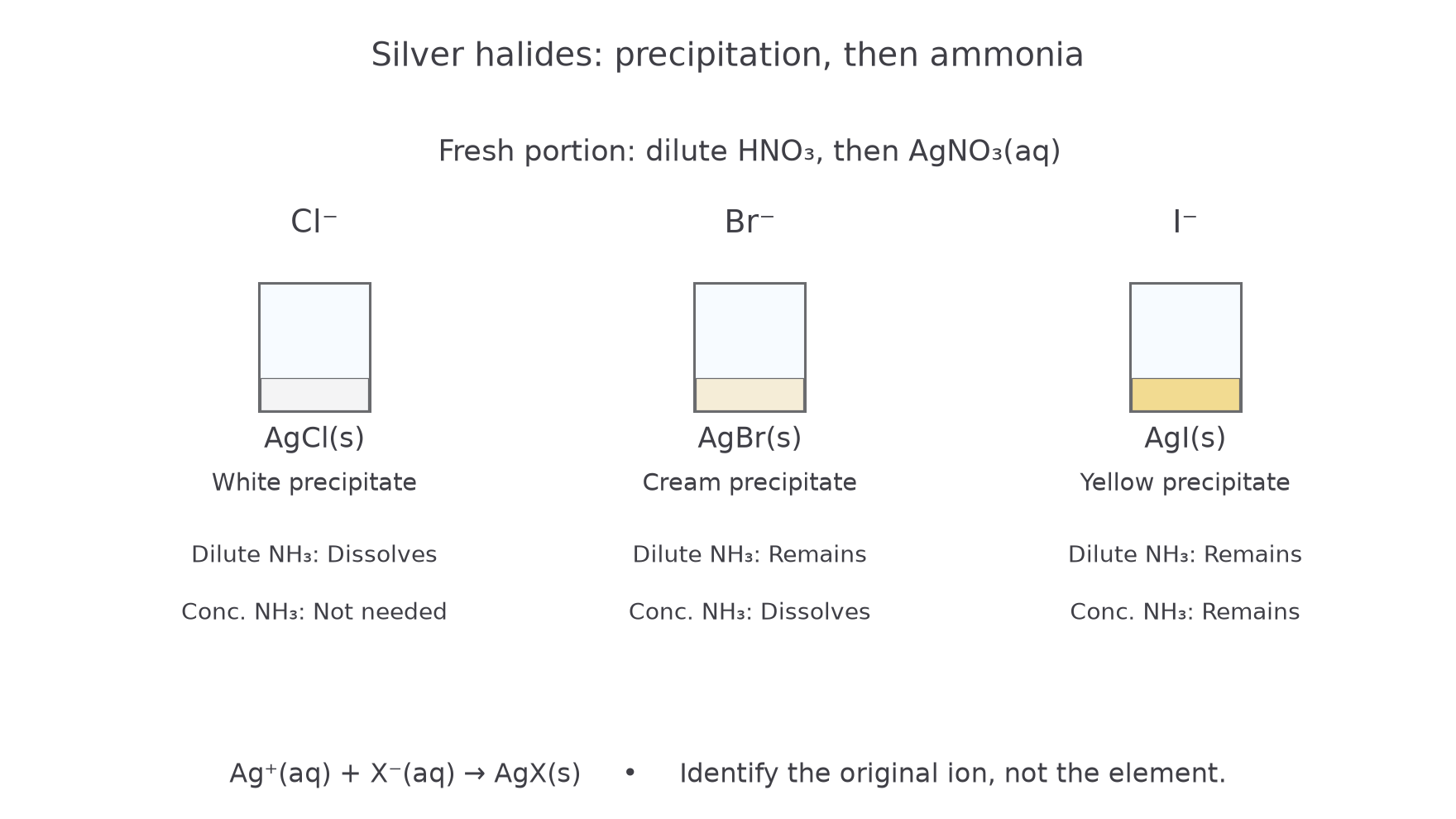
Silver ions identify halide ions by forming insoluble silver halides: white AgCl, cream AgBr and yellow AgI.
Ammonia confirmation
The first precipitate colour can be enough in a simple question, but in real test-tube work the cream and yellow shades can be hard to distinguish. Aqueous ammonia is therefore added after the silver halide precipitate has formed. You only need the observations; the ammonia complex chemistry is outside this OCR boundary.
| Silver halide precipitate | Observation with aqueous ammonia |
|---|---|
| AgCl(s) | dissolves in dilute aqueous ammonia to give a colourless solution |
| AgBr(s) | does not dissolve, or only partly dissolves, in dilute aqueous ammonia; dissolves in concentrated aqueous ammonia |
| AgI(s) | insoluble in aqueous ammonia, even when concentrated |
This gives a practical decision route:
- White precipitate, dissolves in dilute ammonia: chloride ion.
- Cream precipitate, dissolves only in concentrated ammonia: bromide ion.
- Yellow precipitate, insoluble in ammonia: iodide ion.
Worked example: deducing the ion
An unknown solution gives a cream precipitate when aqueous silver nitrate is added. The precipitate does not dissolve in dilute aqueous ammonia but dissolves when concentrated aqueous ammonia is added.
The cream precipitate suggests AgBr(s). The ammonia behaviour confirms bromide because AgBr(s) dissolves only in concentrated ammonia.
Conclusion: the original solution contained Br⁻.
Do not write an equation for the ammonia step unless a question explicitly gives extra information. For this lesson, "dissolves" or "does not dissolve" is the required observation.
[DIAGRAM: asset_slug: 03_01_03c_halide_ion_tests__diagram_01; description: Three labelled test tubes with white/cream/yellow precipitates and dilute/concentrated ammonia outcomes.]
Practical method
For an unknown that may also contain carbonate or sulfate, investigate carbonate first, sulfate second and halide last. Use fresh clean portions for the separate tests; never carry barium chloride or hydrochloric acid from another test into the silver nitrate sample, since they add chloride. Acidify the fresh halide-test portion with dilute nitric acid before adding aqueous silver nitrate, removing carbonate interference without introducing chloride.
This test belongs to qualitative analysis: the aim is to identify a substance from observations rather than measure an exact amount. A good method keeps the observations trustworthy.
A suitable halide test on a solution is:
Continue this lesson.
You’re previewing NovaLearn without an account. Create a free account to read the rest.
Create free account