5.2.2(d)-(f) - Free energy, feasibility and kinetic limits
Some chemical changes are favoured by energy being released, some by entropy increasing, and many by a balance between the two. This lesson teaches how OCR links those ideas using Gibbs free energy, , so that you can calculate whether a process is thermodynamically feasible at a stated temperature. You will also learn the key limitation: a feasible reaction may still be too slow to observe.
The Gibbs balance
Feasibility is about whether a process is thermodynamically allowed under the stated conditions. OCR uses the sign of the free energy change, , to make that judgement.
Free energy change
The free energy change, , combines the enthalpy change of the system, , with the temperature-weighted entropy change of the system, .
Gibbs equation
A process is feasible when has a negative value. If is positive, the process is not thermodynamically feasible under those stated conditions. If , the process is at the boundary where feasibility changes.
The terms in the equation have to be in compatible units:
| quantity | usual unit in OCR calculations | note |
|---|---|---|
| enthalpy change of the system | ||
| temperature must be in kelvin | ||
| or | convert if needed | |
| if is in |
The most common method is to convert from to by dividing by 1000. Then has units of , matching .
Do not read "feasible" as "fast". Negative means the energy balance favours the process; it does not yet say whether particles can get over the activation-energy barrier.
Calculating free energy change
A free energy calculation is usually a careful substitution exercise. The chemistry is in the signs and units.
Worked example:
A reaction has:
Calculate and state whether the reaction is feasible at 298 .
First convert entropy into :
Now substitute into the Gibbs equation:
Estimate before pressing on: , so the entropy term will add about because subtracting a negative gives a positive contribution.
The value is negative, so the reaction is feasible at 298 .
If a question gives entropies of individual substances instead of , use the previous entropy method first:
Then use the resulting in the Gibbs equation. Coefficients in the balanced equation still matter when calculating .
Temperature and sign reasoning
The term explains why temperature can change feasibility. As temperature increases, the entropy term has a bigger effect on .
[DIAGRAM: asset_name: Lesson 5.2.2d-f: Free energy, feasibility and kinetic limits - diagram 01; asset_slug: 05_02_02b_free_energy_feasibility_and_kinetic_limits__diagram_01; recommended_method: drawn_chem; description: Deterministic sign map for Delta H and Delta S combinations, showing always feasible, never feasible, high-temperature feasible and low-temperature feasible cases under the Gibbs equation.]
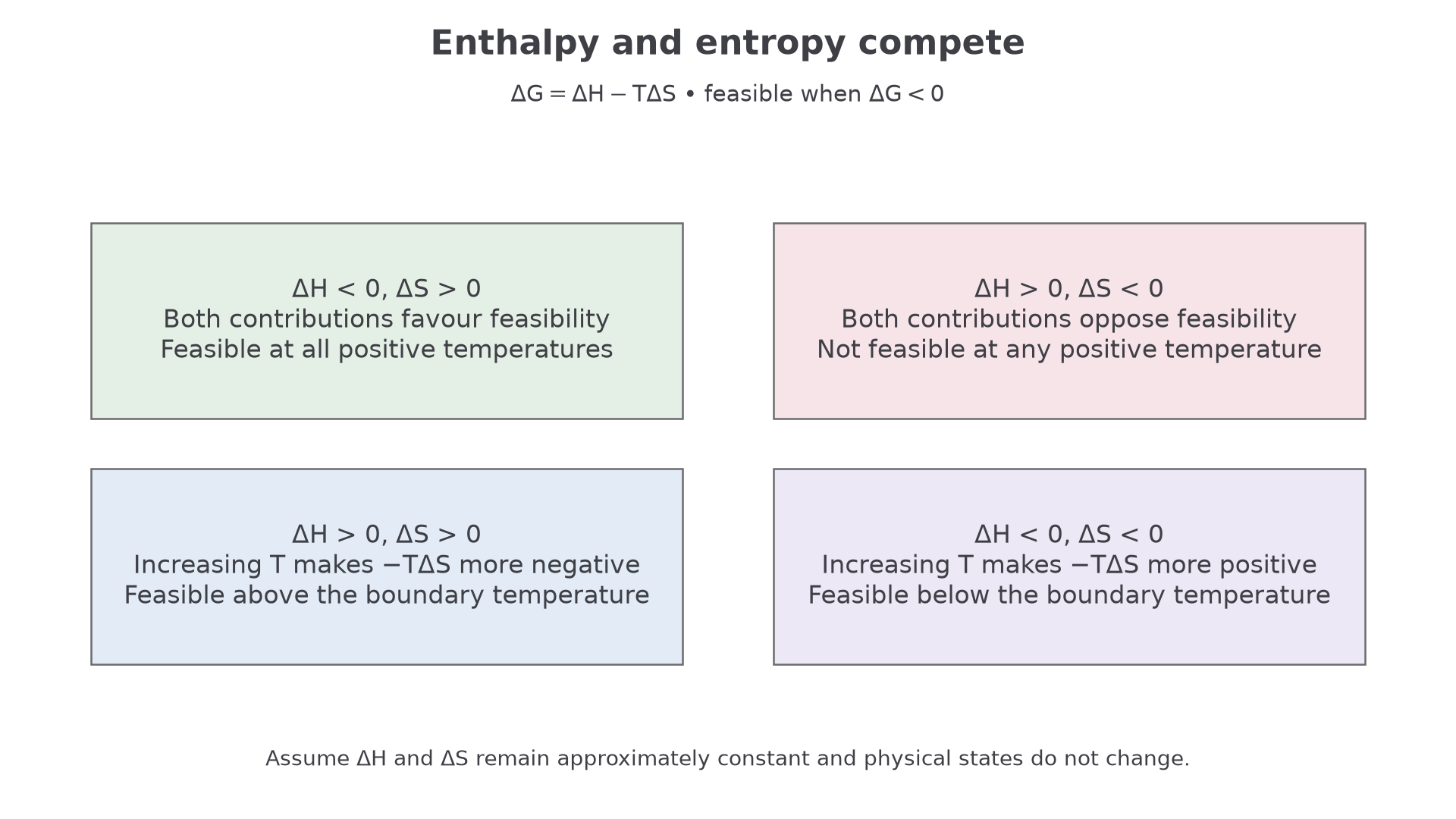
The sign of tells you whether the enthalpy term helps or opposes feasibility. A negative helps make negative; a positive makes more positive.
The sign of has to be read through the term :
- if is positive, is negative, so increasing temperature helps feasibility
- if is negative, is positive, so increasing temperature works against feasibility
This gives four useful cases:
| effect on feasibility | ||
|---|---|---|
| negative | positive | feasible at all temperatures |
| positive | negative | not feasible at any temperature |
| positive | positive | feasible only at high enough temperature |
| negative | negative | feasible only at low enough temperature |
These patterns assume and are approximately constant over the temperature range considered. They are not a replacement for calculation. If numbers are given, calculate .
Worked example:
A reaction has and . Both signs are positive, so the reaction is only feasible at high enough temperature.
Convert entropy:
At the feasibility boundary, :
Rearrange:
Substitute:
Because and are both positive, higher temperature makes more negative. The reaction becomes feasible above 500 .
Continue this lesson.
You’re previewing NovaLearn without an account. Create a free account to read the rest.
Create free account