2.2.2(g)-(h) - Shapes of simple molecules and ions
Molecules and ions are not flat lists of atoms. Their bonds point in three dimensions because electron pairs around a central atom repel each other and settle as far apart as possible. In this lesson you will use that electron-pair-repulsion model to predict the named OCR shapes, bond angles and 3-D diagrams for simple molecules and ions.
The electron-pair-repulsion model
Start with the central atom: the atom joined to the other atoms in the molecule or ion. Around that central atom there are regions of negative charge, usually bonding pairs of electrons and sometimes lone pairs of electrons. These regions repel each other, so the most stable arrangement is the one that keeps them as far apart as possible.
Bonding pair
A bonding pair is a pair of electrons shared in a covalent bond between two atoms.
Lone pair
A lone pair is a pair of outer-shell electrons on an atom that is not used in bonding.
A double or triple bond contains more than one shared pair, but counts as one bonding region for predicting the directions of bonds. CO₂ therefore has two bonding regions around carbon, not four.
The important model is not "bonds repel". It is that electron pairs, or electron-density regions, repel. This wording matters because OCR mark schemes often credit "electron regions" but reject loose answers that talk only about bonds pushing each other.
The relative repulsive strengths are:
Lone pairs repel more strongly because their electron density is concentrated closer to one atom. Bonding pairs are attracted by two nuclei, so they are held between atoms and repel a little less strongly.
A repeatable prediction route
- Identify the central atom.
- Count the electron pairs or electron-density regions around it.
- Separate them into bonding regions and lone pairs.
- Arrange the regions as far apart as possible.
- Name the shape using the positions of atoms only, not invisible lone pairs.
- Give the bond angle.
For simple single-bonded species with H or halogen atoms attached to the centre, you can count electrons around the centre: central atom outer electrons + one bonding electron from each attached atom, then adjust for charge. For other species, first construct the electron structure and count bonding regions/lone pairs; do not apply this shortcut indiscriminately. Add one electron for a 1- ion and subtract one electron for a 1+ ion. Divide by 2 to get the number of electron pairs around the central atom.
Electron pairs determine the arrangement, but atoms determine the shape name.
Shapes with bonding pairs only
When all the electron regions around the central atom are bonding regions, the shape is symmetrical and the bond angles are the largest possible for that number of regions.
[DIAGRAM: asset_name: 02 02 02c shapes of simple molecules and ions diagram 01; asset_slug: 02_02_02c_shapes_of_simple_molecules_and_ions__diagram_01; recommended_method: drawn_chem; description: Six complete examples with correct planar angles, tetrahedral/pyramidal and octahedral wedges, NH3 one and H2O two lone pairs, accurate named angle labels.]
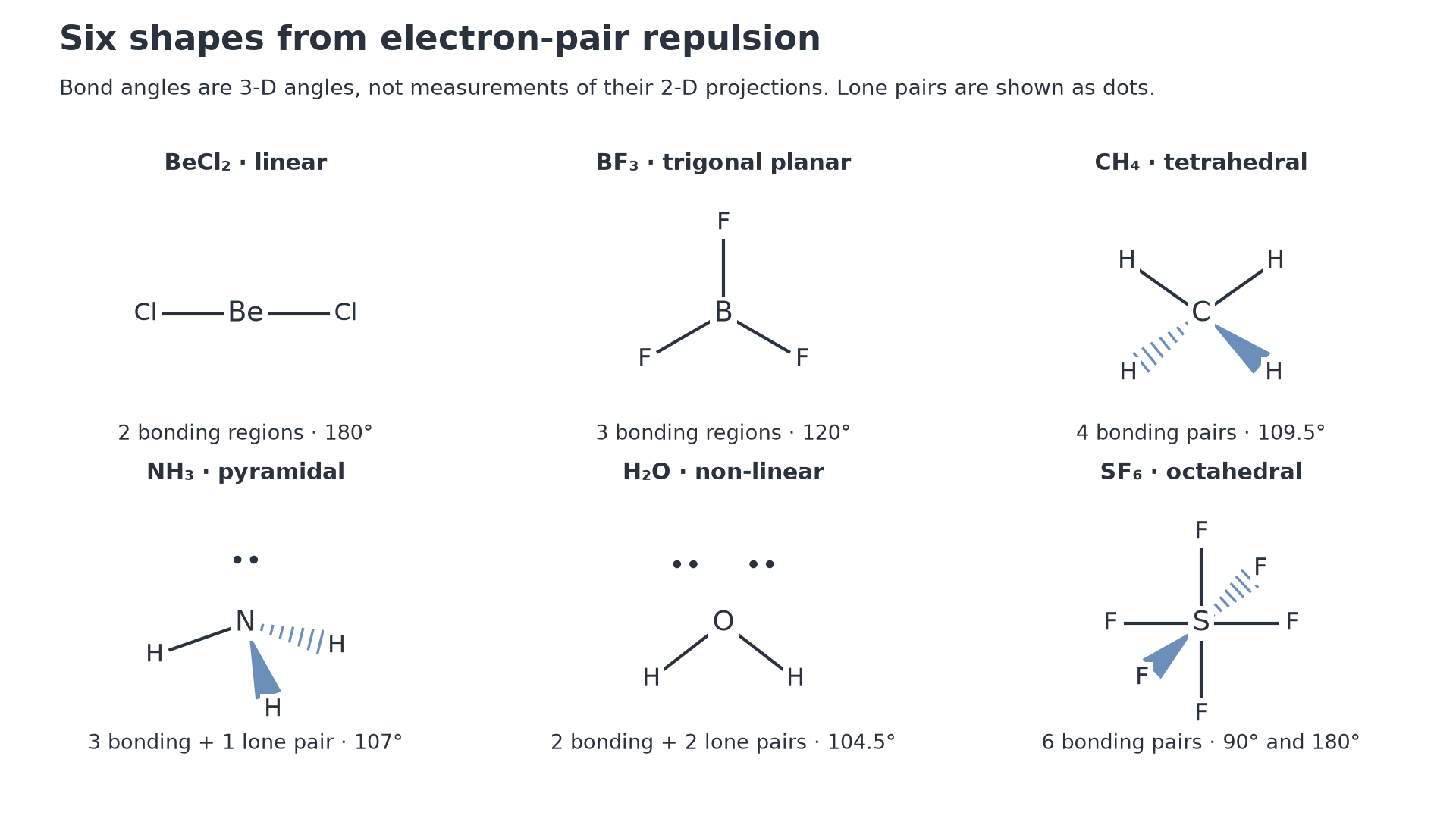
Linear: two electron regions
With two bonding regions and no lone pairs on the central atom, the regions are opposite each other.
Example: BeCl₂ is linear.
Trigonal planar: three electron regions
With three bonding regions and no lone pairs, all three regions lie in one plane, separated equally.
Example: BF₃ is trigonal planar.
OCR can also use a molecule such as SO₃, where each S=O double bond counts as one electron-density region for the shape. There are three bonding regions around sulfur, so the shape is trigonal planar and the O-S-O bond angles are about 120°.
Tetrahedral: four electron regions
With four bonding regions and no lone pairs, a flat square would not put the electron pairs as far apart as possible. The regions point to the corners of a tetrahedron.
Example: CH₄ is tetrahedral.
The ammonium ion, NH₄⁺, is also tetrahedral. Around nitrogen there are four bonding pairs and no lone pairs.
Octahedral: six electron regions
With six bonding regions and no lone pairs, the regions point to the corners of an octahedron: four in a square plane, one above and one below.
Example: SF₆ is octahedral.
There are also straight-line angles of 180° between opposite bonds in an octahedral molecule, but the key angle normally used to identify the shape is 90°.
How lone pairs change shapes and angles
Lone pairs still repel, so they help decide the arrangement of electron pairs. But when naming the shape, you describe only the positions of the atoms.
Pyramidal: four electron pairs, one lone pair
Ammonia, NH₃, has nitrogen as the central atom.
That gives four electron pairs around nitrogen. Three are bonding pairs to hydrogen atoms, and one is a lone pair.
The four electron pairs have an approximately tetrahedral arrangement, but the molecular shape is pyramidal because only the atoms are used to name the shape. The lone pair repels the bonding pairs more strongly than bonding pairs repel each other, so the H-N-H angle is compressed from 109.5° to about 107°.
Non-linear: four electron pairs, two lone pairs
Water, H₂O, has oxygen as the central atom.
That gives four electron pairs around oxygen. Two are bonding pairs to hydrogen atoms, and two are lone pairs.
The electron-pair arrangement is again based on four pairs, but the molecular shape is non-linear because only two atoms are bonded to oxygen. Two lone pairs cause stronger repulsion than one lone pair, so the H-O-H angle is compressed further to 104.5°.
Accepted wording for non-linear includes bent, V-shaped or angular. In this lesson, use non-linear first because that is the OCR list term.
CH₄, NH₃ and H₂O all start from four electron pairs around the central atom. The shape and angle change because the number of lone pairs changes.
Predicting shapes of ions and multi-centre molecules
Ions need the same model, with one extra step: include the charge when counting electrons. A negative charge means there is one extra electron for each minus charge. A positive charge means one fewer electron for each plus charge.
[DIAGRAM: asset_name: h432 shapes ions; asset_slug: h432_shapes_ions; recommended_method: drawn_chem; description: Bracketed NH4+ tetrahedral and PF6− octahedral with electron counts and correct charges; molecular-shape representation not complete outer-electron diagrams.]
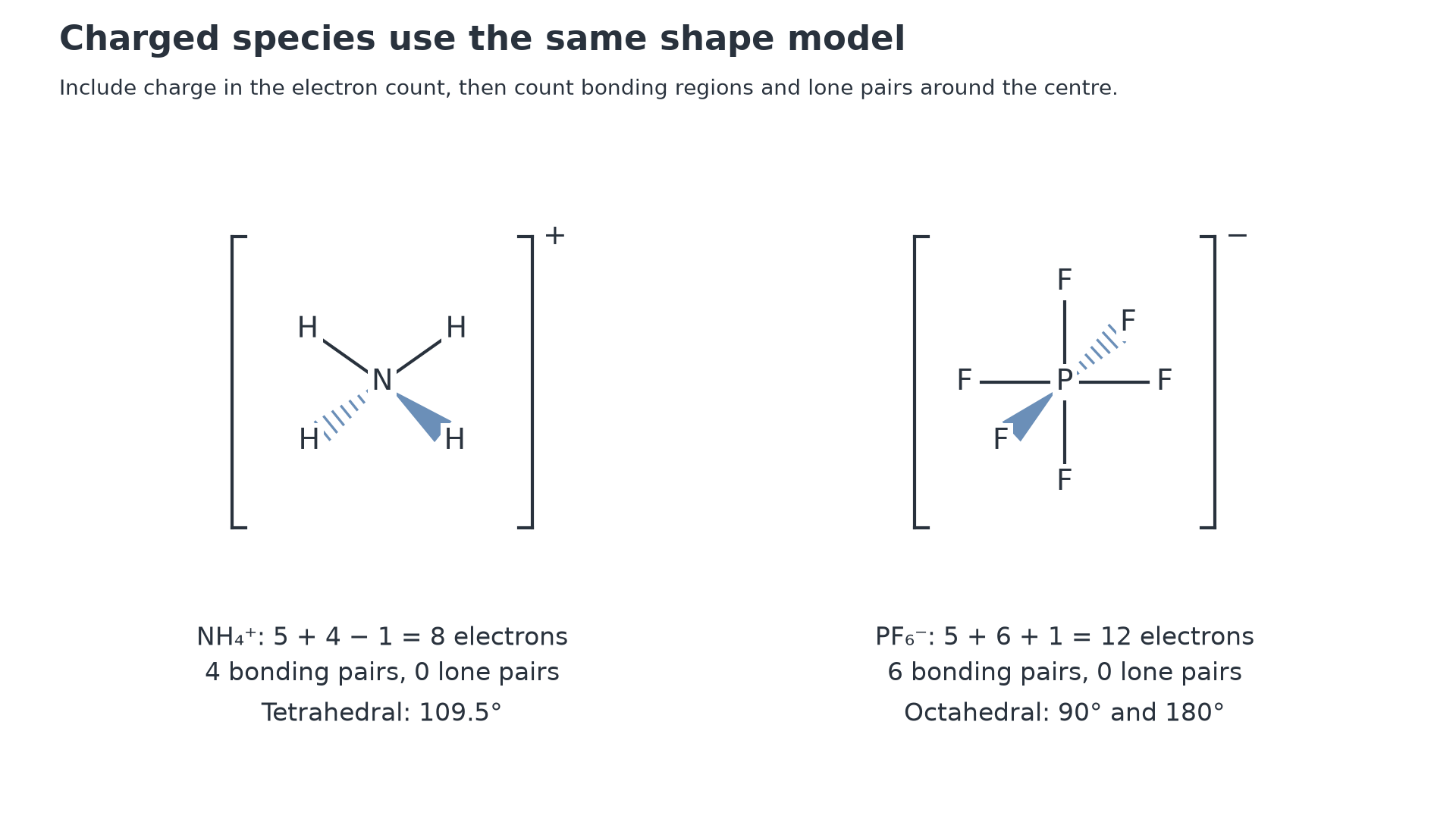
Worked example 1: ammonium, NH₄⁺
Central atom: N
Outer electrons around N before pairing:
So there are four electron pairs around nitrogen. All four are bonding pairs because nitrogen is bonded to four hydrogen atoms. There are no lone pairs on nitrogen.
Therefore NH₄⁺ is tetrahedral with H-N-H bond angles of 109.5°.
Worked example 2: hydronium, H₃O⁺
Central atom: O
Outer electrons around O before pairing:
So there are four electron pairs around oxygen. Oxygen is bonded to three hydrogen atoms, so three pairs are bonding pairs and one pair is a lone pair.
Therefore H₃O⁺ is pyramidal. The pair count predicts the pyramidal shape. It does not fix the exact measured angle: do not assume every pyramidal ion has ammonia’s 107° angle.
Worked example 3: hydrazine, N₂H₄
Hydrazine has the structure H₂N–NH₂. Predict the shape around each nitrogen atom separately.
For one nitrogen atom:
- it forms three single bonds: two N-H bonds and one N-N bond
- nitrogen has one lone pair
- there are four electron pairs around that nitrogen
So each nitrogen centre is pyramidal. The simple model predicts compression relative to the ideal tetrahedral angle. It does not determine an exact angle for every molecule: attached atoms and electron distributions also matter.
This is a useful exam habit: if a molecule has more than one possible central atom, analyse one central atom at a time.
Worked check: tetrahedral or pyramidal?
For PH₃, phosphorus supplies 5 outer electrons and the three H atoms supply 3: 8 electrons give four pairs. Three pairs form P-H bonds, leaving one lone pair. The electron-pair arrangement is based on four regions, but the molecular shape is pyramidal, not tetrahedral. This deduction does not require assuming the measured H-P-H angle is the same as ammonia’s.
Drawing 3-D shapes and using exam language
The mathematical skill here is spatial: you need to represent 3-D forms on a 2-D page. Use three bond styles consistently.
- A normal line shows a bond in the plane of the page.
- A solid wedge shows a bond coming out of the page towards you.
- A dashed wedge shows a bond going back behind the page.
For tetrahedral and pyramidal molecules, wedge and dashed bonds help show the three-dimensional arrangement. The three atoms of a bent molecule such as H₂O lie in one plane and can be drawn with ordinary lines at the appropriate angle; lone pairs can be added when illustrating the electron-pair arrangement. For linear and trigonal planar molecules, all atoms can be drawn in one plane. For octahedral molecules, one useful projection has four ordinary lines making a cross in the page, a solid wedge towards you and a hashed wedge behind. The front and back bonds are opposite in 3-D even when their projections are drawn diagonally.
Going beyond the common examples
The same method works up to six regions, but use a supplied arrangement when the shape is unfamiliar. Five regions have a trigonal-bipyramidal arrangement: three equatorial regions 120° apart and two opposite axial regions, 90° to the equatorial plane. For six regions the arrangement is octahedral. In XeF₄, four bonding pairs and two lone pairs make six regions. The lone pairs occupy opposite positions, leaving four F atoms in a square plane: a square-planar molecule, with 90° and 180° F–Xe–F angles. This is a deduction from the model; the six named common shapes above remain the core recall examples.
Quick recap
- Count bonding regions and lone pairs around each central atom; a multiple bond is one region for shape.
- Electron-pair repulsion gives linear, trigonal-planar, tetrahedral and octahedral arrangements when there are no lone pairs.
- Lone pairs repel more strongly, giving pyramidal NH₃ (107°) and non-linear H₂O (104.5°).
- Adjust the electron count for an ion and analyse each centre separately in a larger molecule.
- A 3-D drawing uses a normal line for a bond in the page, a solid wedge towards you and a hashed wedge away. The model does not give an exact measured angle for every unfamiliar species.