4.1.2(f)-(g) - Radical substitution of alkanes
Alkanes are usually unreactive because their C-C and C-H bonds are strong and non-polar. One important exception is their reaction with chlorine or bromine in ultraviolet radiation, where a hydrogen atom is replaced by a halogen atom through a radical chain reaction. In this lesson, the key is not just remembering the equations: it is seeing how initiation, propagation and termination explain both the reaction and the messy mixture of products.
What Is Substituted
In radical substitution, one atom in an organic molecule is replaced by another atom or group. For alkanes reacting with chlorine or bromine, a hydrogen atom is replaced by a halogen atom.
For methane and chlorine:
For methane and bromine:
The reaction needs ultraviolet radiation, often written as UV. The UV radiation starts the radical chain by breaking the halogen-halogen bond. Without that initiation step, the alkane and halogen do not react readily under normal conditions.
Radical
A radical is a species with an unpaired electron. In this mechanism, OCR equations should show radicals using a single dot, •, such as Cl•, Br• or CH₃•.
The overall reaction is a substitution reaction because the carbon skeleton stays saturated and one H atom has been replaced by Cl or Br. It is not addition, because there is no C=C bond being opened up.
Worked example: naming the reaction from an equation
A reaction is shown:
The organic product is bromoethane. One H atom from ethane has been replaced by Br, so this is a substitution reaction. Because the reaction is started by radicals formed from bromine under UV radiation, the mechanism is radical substitution.
Initiation
The first stage is initiation. Initiation creates radicals from a molecule that is not already a radical.
In alkane chlorination, UV radiation supplies enough energy to break the covalent bond in a chlorine molecule:
In alkane bromination:
The type of bond breaking is homolytic fission. In homolytic fission, each atom takes one electron from the shared pair in the covalent bond. That is why two radicals are formed.
Homolytic fission
Homolytic fission is the breaking of a covalent bond so that each bonded atom receives one electron from the shared pair. It forms radicals.
OCR does not require you to use half-headed curly arrows for this mechanism. What matters in equations is that radical species are shown with the single dot, •, in the correct place.
Worked example: initiation for bromine
For bromination of an alkane, the halogen molecule is Br₂. UV radiation breaks the Br-Br bond homolytically:
The species Br• is a bromine radical because it has an unpaired electron.
Propagation
Propagation is the part of the chain reaction that keeps the reaction going. A radical reacts, but another radical is produced, so the chain can continue.
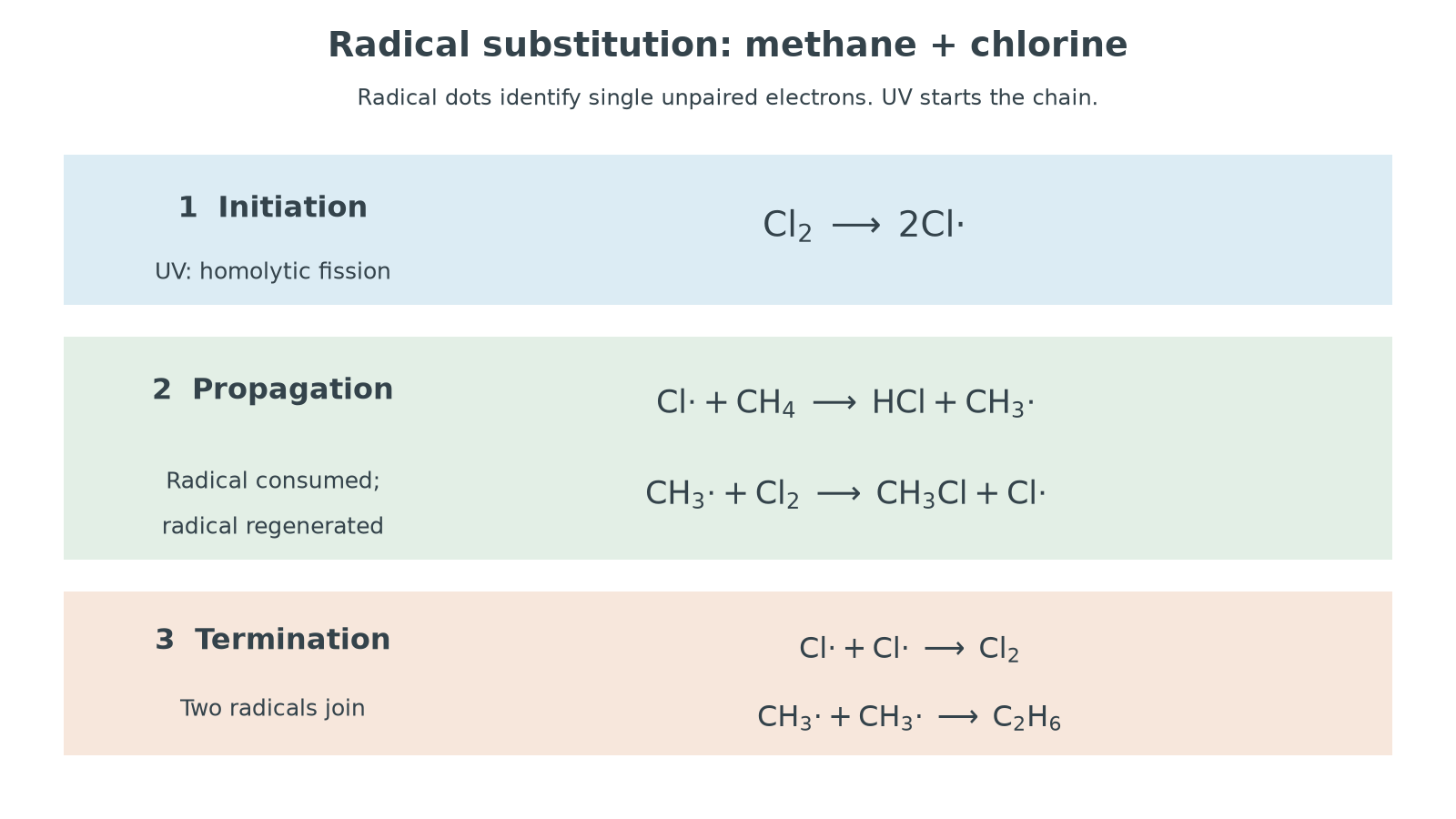
For methane and chlorine, the two propagation steps are:
The first propagation step removes a hydrogen atom from methane. This forms hydrogen chloride and a methyl radical, CH₃•.
The second propagation step uses the methyl radical to form chloromethane. It also regenerates a chlorine radical, Cl•, which can attack another methane molecule. That regeneration is why a small number of radicals can lead to many substitution reactions.
[DIAGRAM: asset_name: Lesson 4.1.2f-g: Radical substitution of alkanes - diagram 01; asset_slug: 04_01_02c_radical_substitution_of_alkanes__diagram_01; recommended_method: drawn_chem; description: OCR-style radical substitution chain mechanism for methane and chlorine, showing UV initiation by homolytic fission, two propagation equations with radical dots, and two termination examples.]
For bromination, the pattern is the same. Replace Cl₂ and Cl• with Br₂ and Br•:
Worked example: identifying propagation
Consider this equation:
It is a propagation step because a radical reactant is used and a radical product is formed. The organic radical becomes a bromoalkane, and Br• is regenerated.
Continue this lesson.
You’re previewing NovaLearn without an account. Create a free account to read the rest.
Create free account