4.1.1(c)-(d) - Homologous series and functional groups
Organic chemistry becomes much easier when molecules are sorted into families. In this lesson you will learn the OCR vocabulary for those families, how to classify carbon skeletons, and how to use a general formula to predict the formula of a member of a homologous series.
Homologous Series
A homologous series is a family of organic compounds that share a repeating pattern. The members are not random compounds with a similar name; they are linked by the same key reactive part of the molecule and by a regular difference in formula.
Homologous Series
A homologous series is a series of organic compounds having the same functional group but with each successive member differing by CH₂.
The "same functional group" part explains why members of a homologous series often react in similar ways. The "successive member differing by CH₂" part explains why their formulae follow a pattern.
For example, these alcohols are successive members of the same homologous series:
| Member | Formula |
|---|---|
| methanol | CH₃OH |
| ethanol | C₂H₅OH |
| propanol | C₃H₇OH |
Going from methanol to ethanol adds CH₂. Going from ethanol to propanol also adds CH₂. The functional group, -OH, stays present.
Include both ideas when explaining a homologous series: the same functional group and the CH₂ step. Equivalent wording is valid; memorising a sentence without applying it is not enough.
Functional Groups and R Groups
A functional group is the atom or group of atoms responsible for the characteristic reactions of a compound. It is the part of the molecule that usually decides the family of organic compound.
For example:
| Homologous series | Functional group or key feature | Example |
|---|---|---|
| alkenes | C=C | ethene, C₂H₄ |
| alcohols | -OH | ethanol, C₂H₅OH |
| carboxylic acids | -COOH | ethanoic acid, CH₃COOH |
This lesson is not about learning all the reactions of these groups yet. The important idea is that the functional group is the part that gives the compound its characteristic reaction pattern.
An alkyl group is a hydrocarbon group with the formula:
Alkyl Group
So a methyl group is CH₃, an ethyl group is C₂H₅, and a propyl group is C₃H₇. These groups often appear as side chains or unchanged fragments attached to a more reactive group.
Chemists often use R as a shortcut. In a formula such as R-OH, the R represents the organic fragment attached to the -OH group. OCR's guidance is careful here: R may be an alkyl group, but it can also represent another fragment of an organic compound that is not involved in the reaction being discussed. So do not automatically translate every R into "methyl" or "one alkyl group".
Worked example: an alkyl group formula
For an alkyl group with 4 carbon atoms:
The alkyl group formula is C₄H₉.
Carbon Skeleton Classes
Organic compounds can also be classified by the shape and type of their carbon skeleton. These words are easy to muddle, so it helps to treat them as a map.
[DIAGRAM: asset_name: Lesson 4.1.1c-d: Functional groups, homologous series and general formulae - diagram 01; asset_slug: 04_01_01b_functional_groups_homologous_series_and_general_formulae__diagram_01; recommended_method: drawn_chem; description: A clean classification map connecting homologous series, functional groups, alkyl/R groups, aliphatic, alicyclic, aromatic, saturated, unsaturated and general formula substitution.]
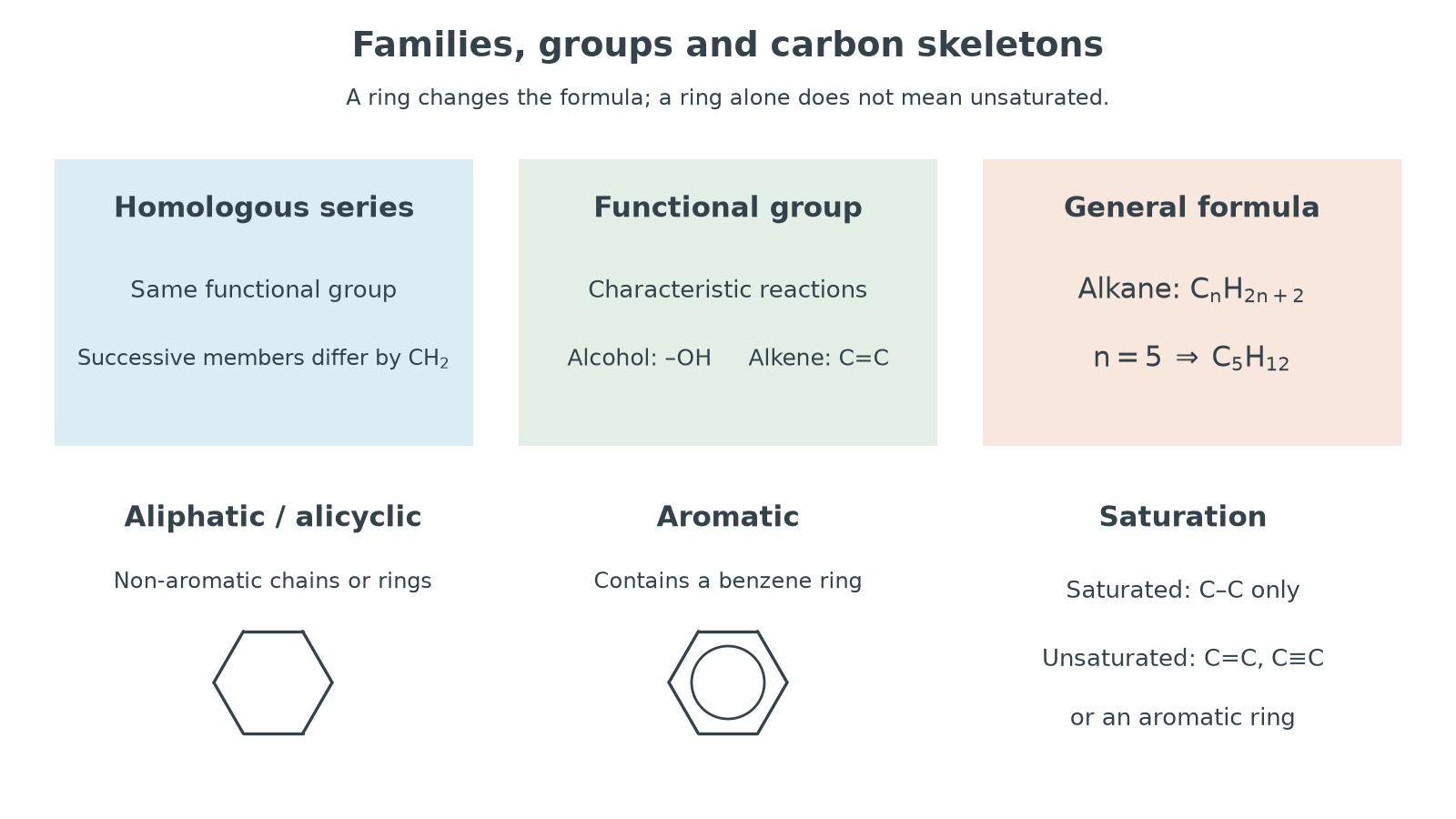
An aliphatic compound contains carbon and hydrogen joined together in straight chains, branched chains or non-aromatic rings. This means "aliphatic" is wider than "straight chain". A branched hydrocarbon can be aliphatic, and a non-aromatic ring can also be aliphatic.
An alicyclic compound is an aliphatic compound arranged in a non-aromatic ring, with or without side chains. The word contains the clue: "ali-" from aliphatic and "-cyclic" from ring.
An aromatic compound contains a benzene ring. For this lesson, that is the boundary. You do not need the rules for aromaticity, electrophilic substitution, or the evidence for the benzene model here.
Worked reasoning: classifying cyclohexane and benzene
Cyclohexane is a ring, but it is not a benzene ring. It is aliphatic because it is a non-aromatic carbon-and-hydrogen structure, and it is alicyclic because it is a non-aromatic ring.
Benzene contains a benzene ring. It is aromatic. Do not call it alicyclic, because alicyclic rings are non-aromatic.
Continue this lesson.
You’re previewing NovaLearn without an account. Create a free account to read the rest.
Create free account