6.3.2(c)-(d) - Predicting NMR spectra and running NMR
NMR is not only a way to identify an unknown molecule. If you already know the structure, you should be able to predict what its carbon-13 and proton NMR spectra would look like. In this lesson, you will turn a molecule into expected NMR signals, then learn why TMS, deuterated solvents and D₂O are used when spectra are run.
From structure to signals
Prediction is the forward version of interpretation. Instead of asking "what structure fits this spectrum?", you ask "what spectrum should this structure give?"
The first step is always to find chemically equivalent atoms or protons. Equivalent atoms are in the same environment, so they give the same NMR signal. Non-equivalent atoms or protons are in different environments, so they give different signals.
For carbon-13 NMR, count carbon environments. In the proton-decoupled spectra used at this level, each carbon environment gives one peak.
For proton NMR, count proton environments, then add three more pieces of information:
- the chemical shift, , in ppm, using the data-sheet ranges;
- the integration ratio, which gives the relative number of protons in each environment;
- the splitting pattern, using the rule for adjacent non-equivalent protons.
[DIAGRAM: asset_name: Lesson 6.3.2c-d: Predicting NMR spectra and running NMR - diagram 01; asset_slug: 06_03_02c_predicting_nmr_spectra_and_running_nmr__diagram_01; recommended_method: drawn_chem; description: Schematic predicted carbon-13 and proton NMR spectra for ethanol, showing two carbon environments and three proton environments with approximate chemical shifts, integration and splitting labels.]
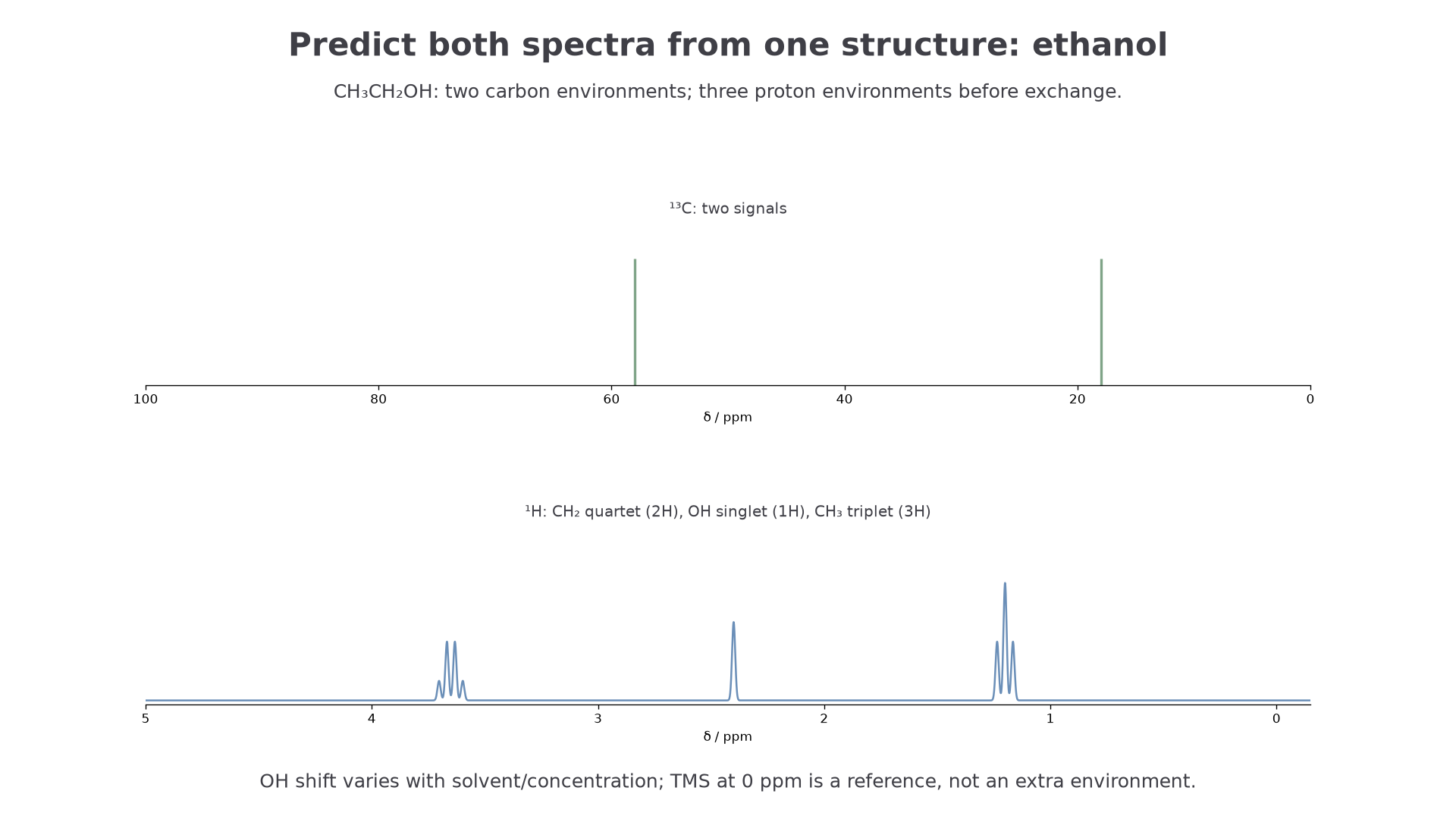
Worked example: predict the number of NMR signals for ethanol, CH₃CH₂OH.
The two carbon atoms are in different environments: one is in CH₃, and the other is bonded to oxygen in CH₂OH. A proton-decoupled carbon-13 NMR spectrum should therefore have two peaks.
The protons are in three environments: CH₃, CH₂ and . A proton NMR spectrum should therefore have three signals. The CH₃ signal integrates to 3H, the CH₂ signal integrates to 2H, and the signal integrates to 1H.
Predicting carbon-13 spectra
A predicted carbon-13 spectrum needs two decisions: how many carbon environments there are, and roughly where their peaks should appear.
Chemical shift
Chemical shift is the position of an NMR signal relative to the TMS standard. It is measured in ppm and written as .
Use the data sheet for approximate carbon-13 chemical shift regions. You do not need to memorise the whole chart. What matters is the reasoning: a carbon attached to oxygen, nitrogen, a halogen, a double bond or a carbonyl group usually appears in a different region from a simple alkyl carbon.
Because OCR carbon-13 spectra are proton decoupled, do not predict splitting in a carbon-13 spectrum. At this level, one carbon environment means one carbon-13 peak.
Worked example: predict the carbon-13 NMR pattern for propan-2-ol, CH₃CH(OH)CH₃.
The two CH₃ carbons are equivalent because the molecule is symmetrical around the central carbon. They give one carbon-13 peak in the alkyl region. The central carbon is bonded to , so it is a second carbon environment and should appear further downfield than a simple alkyl carbon. The predicted carbon-13 spectrum has two peaks.
Predicting proton spectra
A predicted proton NMR spectrum carries more information than a carbon-13 spectrum. For each proton environment, write a short prediction table:
| Proton environment | Approximate shift | Integration | Splitting |
|---|---|---|---|
| What kind of H? | data-sheet region | relative number of H | from adjacent non-equivalent H |
For the simple first-order patterns here, counts neighbouring protons equivalent to each other but in a different environment from the observed protons. Neighbouring sets in different environments can give more complex splitting; do not simply add their counts. For example, a CH₃ group next to CH₂ has two adjacent non-equivalent protons, so its signal is a triplet. The neighbouring CH₂ is next to three CH₃ protons, so its signal is a quartet.
O-H and N-H protons need caution. Their chemical shifts are very variable, they are often broad, and their signals are not usually seen as split peaks. Treat them as exchangeable protons rather than forcing them into the normal splitting pattern.
Worked example: predict the proton NMR pattern for ethanol, CH₃CH₂OH.
| Environment | Expected evidence |
|---|---|
| CH₃-CH₂ | CH₃ signal at about 1 ppm, integration 3H, triplet because it is next to CH₂ |
| CH₃-CH₂-O | CH₂ signal further downfield, around 3-4 ppm, integration 2H, quartet because it is next to CH₃ |
| variable broad signal, integration 1H, usually not split |
Continue this lesson.
You’re previewing NovaLearn without an account. Create a free account to read the rest.
Create free account