4.2.4(a)-(b), 4.2.4(e) - IR absorption, greenhouse gases and uses
Infrared spectroscopy begins with a simple idea: covalent bonds can absorb infrared radiation and vibrate more. That idea explains why some atmospheric gases are linked with global warming, and why IR instruments can monitor pollutant gases and measure ethanol in breath. This lesson keeps to the principles and applications of IR; the detailed skill of interpreting organic IR spectra comes next.
IR and vibrating bonds
Covalent bonds are not rigid sticks. The bonded atoms are held by shared electrons, but the atoms can still move slightly towards and away from each other, or bend around the bond angle. These movements are called vibrations.
When a covalent bond absorbs infrared, or IR, radiation of a suitable frequency, energy is transferred to the molecule. The bond vibrates more: it is in a higher vibrational energy state. Different bonds absorb different IR frequencies because their atoms, bond strengths and vibration patterns are different.
Infrared Absorption
Infrared absorption is the transfer of energy from infrared radiation to a covalent molecule, causing bonds in the molecule to vibrate more.
Absorption increases vibration; it does not mean that the covalent bond disappears or must break.
The important OCR principle is the energy transfer, not a full quantum-mechanical model. You should be able to say that IR radiation is absorbed by covalent bonds and causes increased vibration. You do not need to calculate the energy of an IR photon or explain detailed selection rules.
Worked reasoning: what has happened when a bond absorbs IR?
- IR radiation reaches a molecule.
- A covalent bond in the molecule absorbs radiation of a suitable frequency.
- The absorbed energy increases the vibration of that bond.
- An instrument can detect that less IR radiation of that frequency passes through the sample.
Atmospheric gases and warming
The Earth's surface emits infrared radiation. Some atmospheric gases absorb part of this outgoing IR radiation because their covalent bonds can vibrate more when they absorb IR energy. OCR specifically names atmospheric gases containing these bonds:
| Gas | Bond highlighted by OCR | Why it matters here |
|---|---|---|
| carbon dioxide, | C=O | absorbs some outgoing IR radiation |
| water vapour, | O-H | absorbs some outgoing IR radiation |
| methane, | C-H | absorbs some outgoing IR radiation |
[DIAGRAM: asset_name: Atmospheric infrared absorption; asset_slug: 04_02_04a_ir_principles_atmospheric_gases_and_applications__diagram_01; recommended_method: drawn_chem; description: Correct linear carbon dioxide double bonds, bent water and tetrahedral methane, with Earth-emitted IR absorbed and energy redistributed.]
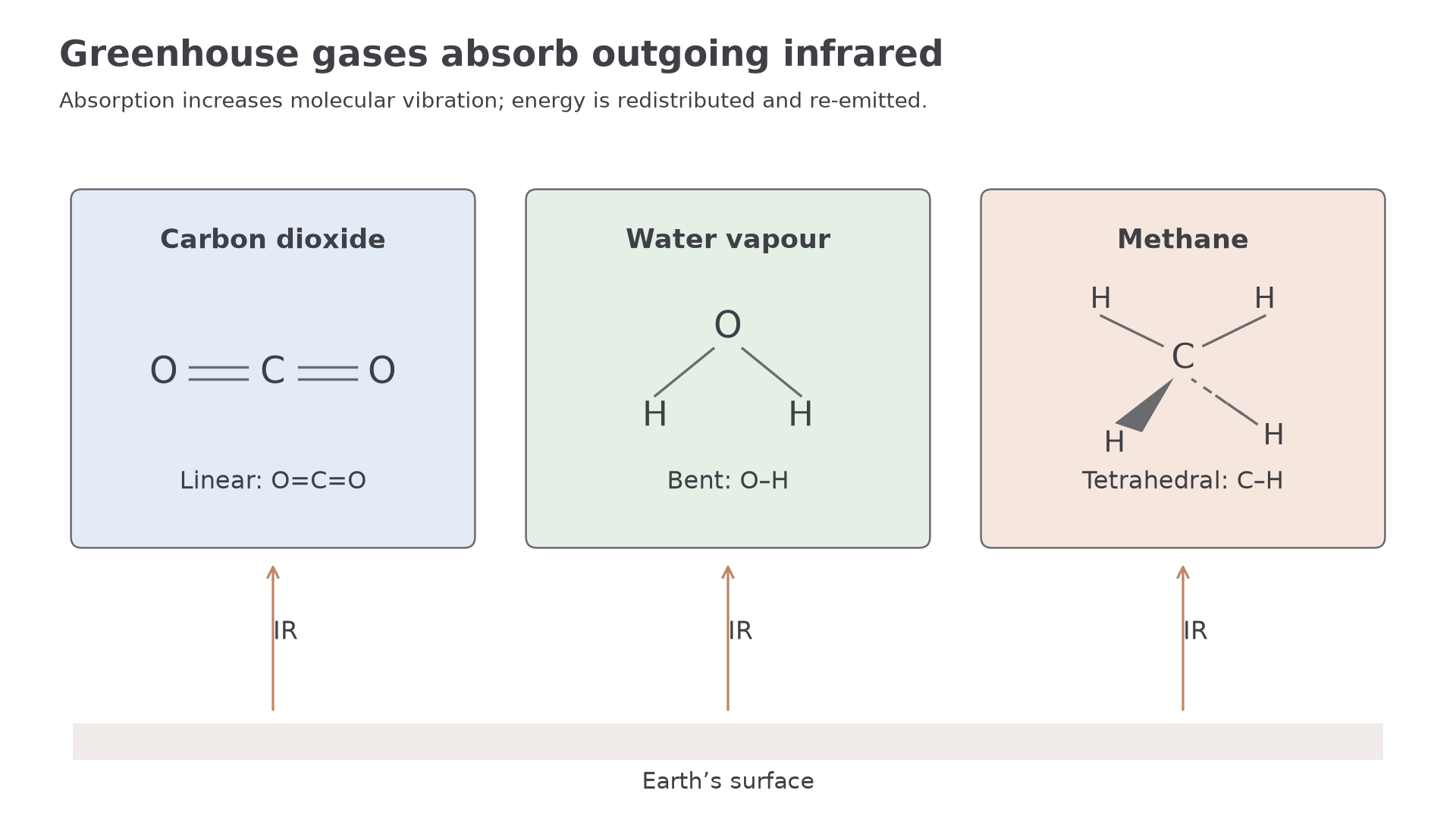
After a molecule has absorbed IR energy, that energy can be transferred through collisions with other particles in the atmosphere and can also be re-emitted as IR radiation. The result is that less energy escapes directly to space than would otherwise be the case. This is the chemical link between IR absorption by greenhouse gases and the contribution of these gases to global warming.
A key misconception is to confuse this with ozone depletion. Global warming in this topic is about infrared radiation and increased bond vibration in gases such as , and . Ozone depletion by CFCs involves ultraviolet radiation and radical reactions; that is a different atmospheric topic.
Worked reasoning: why methane can be linked to global warming.
Methane, , contains C-H bonds. These covalent bonds can absorb suitable IR radiation and vibrate more. If methane in the atmosphere absorbs some of the IR emitted by the Earth, energy is retained and redistributed in the atmosphere rather than escaping directly to space. That is why is a greenhouse gas in this lesson boundary.
Evidence and energy decisions
The IR absorption model is part of the scientific evidence used to explain global warming. It shows a plausible chemical mechanism: particular atmospheric gases absorb IR radiation because of their covalent bonds. Measurements of atmospheric gases, temperature records and climate models then provide wider evidence for decision-making.
OCR links this point to How Science Works. The chemistry does not by itself write government policy, but it helps explain why societies may change energy usage. Burning fossil fuels releases , and methane can be released from sources such as gas systems and agriculture. Acceptance of the scientific evidence has pushed many governments towards policies that increase renewable energy use and reduce reliance on fossil fuels.
A balanced answer should separate the chemistry from the decision. The chemistry is that IR-active atmospheric gases absorb outgoing IR radiation. The decision is whether and how society changes energy sources, considering benefits, risks, cost, reliability and environmental impact.
Continue this lesson.
You’re previewing NovaLearn without an account. Create a free account to read the rest.
Create free account