2.1.3(b)-(d) - Empirical, molecular and hydrated formulae
A chemical formula is a ratio statement. In this lesson you will learn how composition data turns into an empirical formula, how relative molecular mass can scale that into a molecular formula, and how water of crystallisation is handled in hydrated salts. The common thread is simple but powerful: convert masses to amounts in moles, then compare mole ratios.
Formulae as ratios
The formula of a compound tells you which atoms or ions are present, and in what ratio. For simple molecular substances, the molecular formula gives the number and type of atoms in one molecule. For example, glucose has molecular formula C₆H₁₂O₆, so one glucose molecule contains 6 carbon atoms, 12 hydrogen atoms and 6 oxygen atoms.
The empirical formula gives the simplest whole-number ratio of atoms of each element present. The empirical formula of glucose is CH₂O, because the ratio 6:12:6 simplifies to 1:2:1.
You do not need to memorise formal definitions of these two terms for this specification point. You do need to use the terms accurately when interpreting formulae and calculation data.
Empirical formula is the simplest ratio. Molecular formula is the actual atom count in one molecule.
The two formulae may be the same. Water is H₂O as both its empirical formula and its molecular formula because 2:1 is already the simplest ratio. Hydrogen peroxide has molecular formula H₂O₂ but empirical formula HO, because 2:2 simplifies to 1:1.
For ionic compounds, a formula such as MgCl₂ is normally a ratio of ions in the giant lattice rather than the contents of one separate molecule. In this lesson, the same mole-ratio calculation method still works.
Empirical formula from composition data
Composition data tells you how much of each element is present in a compound. The masses are not the atom ratio yet, because atoms of different elements have different masses. A mass of 12.0 g of carbon is 1.00 mol of carbon atoms, but a mass of 16.0 g of oxygen is 1.00 mol of oxygen atoms.
To find the empirical formula:
- Convert each mass to an amount in moles using amount = mass / .
- Divide every amount by the smallest amount.
- Convert the ratio to the simplest whole-number ratio.
- Write the empirical formula using that ratio.
Worked example 1: mass composition
A compound contains 2.40 g of carbon and 0.400 g of hydrogen. Use values C = 12.0 and H = 1.0.
| element | mass / g | divide by | amount / mol | ratio |
|---|---|---|---|---|
| C | 2.40 | 2.40 / 12.0 | 0.200 | 1 |
| H | 0.400 | 0.400 / 1.0 | 0.400 | 2 |
The mole ratio is C:H = 1:2, so the empirical formula is CH₂.
Worked example 2: percentage composition
A compound has percentage composition by mass C = 40.0%, H = 6.7% and O = 53.3%. Treat this as a 100 g sample. The masses are then 40.0 g C, 6.7 g H and 53.3 g O.
Using values C = 12.0, H = 1.0 and O = 16.0:
| element | mass in 100 g / g | amount / mol | divide by smallest | ratio |
|---|---|---|---|---|
| C | 40.0 | 40.0 / 12.0 = 3.33 | 3.33 / 3.33 | 1 |
| H | 6.7 | 6.7 / 1.0 = 6.7 | 6.7 / 3.33 | 2.01 |
| O | 53.3 | 53.3 / 16.0 = 3.33 | 3.33 / 3.33 | 1 |
The ratio is close to 1:2:1, so the empirical formula is CH₂O.
Elemental analysis from combustion products
A compound containing only carbon, hydrogen and oxygen can be analysed by complete combustion. Each mole of CO₂ contains one mole of C atoms; each mole of H₂O contains two moles of H atoms. Find their masses and subtract from the original sample mass to obtain oxygen by difference. Do not count oxygen in the combustion products as all coming from the sample: some came from the oxygen used to burn it.
For example, 0.600 g of a C/H/O compound produces 0.880 g CO₂ and 0.360 g H₂O. Then mol and mol. Their masses are 0.240 g and 0.0400 g. Oxygen in the original compound has mass g, or 0.0200 mol. The atom ratio is 1:2:1, giving CH₂O.
Worked example: a ratio that must not be rounded immediately
An oxide contains 5.58 g of iron and 2.40 g of oxygen. Use (Fe) = 55.8 and (O) = 16.0.
The amounts are mol Fe and mol O. Dividing both by 0.100 gives Fe:O = 1:1.5. Rounding 1.5 to 2 would change the measured ratio. Instead multiply both numbers by 2: 2:3, giving . Check: 2:3 is the same ratio as 0.100:0.150.
If a ratio gives values such as 1:1.5, multiply all parts by 2 to give 2:3. If it gives 1:1.33, multiply all parts by 3 to give 3:4. Do this only after you have divided by the smallest amount.
Molecular formula from empirical formula
An empirical formula may be only a simplified version of the real molecular formula. To find the molecular formula, you need the empirical formula and the relative molecular mass, .
Molecular formula multiplier
The multiplier tells you how many empirical formula units are in one molecule. Multiply every subscript in the empirical formula by this number.
Worked example: from CH₂O to a molecular formula
A compound has empirical formula CH₂O and relative molecular mass 180. Use values C = 12.0, H = 1.0 and O = 16.0.
First find the empirical formula mass:
Then find the multiplier:
Multiply every atom count in CH₂O by 6:
The multiplier should be a whole number. If it is not close to a whole number, check your empirical formula mass, your use of values, and any rounding in earlier working.
Worked example: same empirical and molecular formula
A compound has empirical formula C₂H₆O and = 46.0.
Empirical formula mass:
Multiplier:
So the molecular formula is also C₂H₆O.
Hydrated salt language
Some ionic solids form crystals that include a fixed ratio of water molecules in the crystal structure. This water is called water of crystallisation. The formula shows it after a dot.
For example:
This means there are 5 moles of water of crystallisation for every 1 mole of CuSO₄ formula units in the solid crystal.
Hydrated
A hydrated salt contains water of crystallisation in its crystal structure.
Anhydrous
An anhydrous salt contains no water of crystallisation.
The dot is not a multiplication sign for one molecule joined to another molecule in solution. It is a formula convention showing the ratio of salt formula units to water molecules in the crystalline solid.
When a hydrated salt is heated, water of crystallisation can be driven off:
For copper(II) sulfate:
At this point, the important calculation idea is the mole ratio between the anhydrous salt and water:
So a hydrated salt formula can be written as:
Hydrated formula calculations
Hydrated-salt formula calculations use the same method as empirical formula calculations: turn masses into moles and compare ratios.
Worked example 1: from mass composition
A hydrated salt has formula MgSO₄·xH₂O. A sample contains 2.40 g of anhydrous MgSO₄ and 2.52 g of water of crystallisation.
Use values Mg = 24.3, S = 32.1, O = 16.0 and H = 1.0.
First calculate the formula mass of anhydrous MgSO₄:
Now calculate amounts:
Find the ratio by dividing by the smaller amount:
The experimental ratio is close to 1:7, so:
Worked example 2: from percentage composition
A hydrated salt has formula CoCl₂·xH₂O. It contains 45.4% water by mass. Find x.
Use values Co = 58.9, Cl = 35.5, H = 1.0 and O = 16.0.
Treat the percentages as a 100 g sample:
- mass of water = 45.4 g
- mass of anhydrous CoCl₂ = 54.6 g
Formula mass of CoCl₂:
Amounts:
Ratio:
So the formula is:
Formulae from experimental results
In practical work, the data may not be handed to you already split into anhydrous salt and water. You often need to work out the useful masses from balance readings.
For a hydrated salt heated to remove water of crystallisation:
Then use the normal mole-ratio method.
Worked example: experimental mass results
A student heats a hydrated sample of copper(II) sulfate, CuSO₄·xH₂O, until the mass is constant.
| measurement | mass / g |
|---|---|
| crucible | 32.18 |
| crucible + hydrated salt | 35.00 |
| crucible + anhydrous salt | 33.98 |
Use values Cu = 63.5, S = 32.1, O = 16.0 and H = 1.0.
Find the masses:
Find the amounts:
Find the ratio:
So:
In real experiments, the ratio may be 5.02 rather than exactly 5. Keep enough figures during the calculation, then round to the nearest sensible whole-number value for x. If heating is incomplete, too much water remains in the solid and x may be underestimated. If the salt decomposes or solid is lost by spitting, the apparent mass of anhydrous salt becomes too low and x may be overestimated.
Heating safely to a reliable final mass
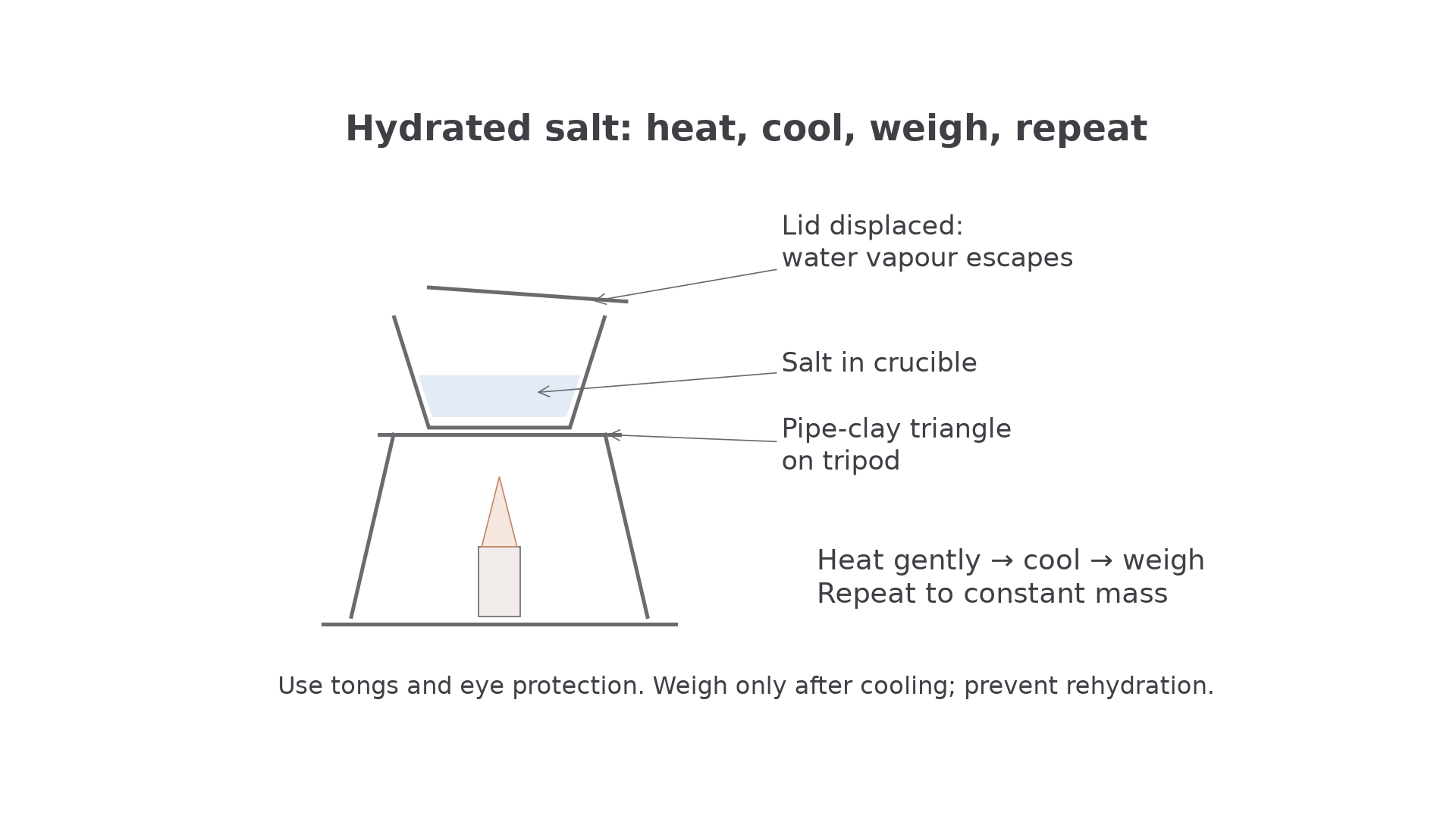
Weigh a clean, dry crucible, then the crucible plus hydrated salt. Heat gently at first to avoid spitting, with a lid slightly displaced so water vapour can escape while limiting loss of solid. Use eye protection, tongs and a heatproof surface. Allow the crucible to cool before weighing: a hot object gives unstable balance readings and may damage the balance. Repeat the heat–cool–weigh cycle until successive masses agree within the balance resolution. Keep the cooled sample dry to limit rehydration. The interpretation assumes that only water is removed and the anhydrous salt does not decompose; constant mass alone cannot prove that assumption.
[DIAGRAM: asset_name: Hydrated salt heating; asset_slug: 02_01_03b_hydrated_salt_heating; recommended_method: drawn_chem; description: Crucible with lid slightly displaced on a pipe-clay triangle and tripod above a burner; heat, cool, weigh and repeat to constant mass.]
PAG1 links this topic to moles determination using measured masses and, in some activities, measured gas volumes. The practical skill is not a separate trick: the measured result must be converted into an amount in mol before it can be used in a ratio.
Quick Recap
Convert composition masses to amounts before forming ratios. Multiply every part of a fractional ratio to obtain whole numbers, and use Mᵣ to scale an empirical formula to a molecular formula. For hydrated salts, compare moles of anhydrous salt with moles of water lost. Check heating assumptions and repeat heat–cool–weigh cycles to constant mass.