5.2.1(a)-(b) - Lattice enthalpy and Born-Haber cycles
Lattice enthalpy connects the giant ionic lattice from bonding with the energy calculations from Hess' law. In this lesson, you will define lattice enthalpy using OCR's formation convention, build Born-Haber cycles for simple ionic solids, and calculate a missing lattice enthalpy from given data without losing signs, state symbols or mole ratios.
What lattice enthalpy means
An ionic solid such as sodium chloride is not made of separate molecules. It is a giant ionic lattice: a repeating three-dimensional arrangement of positive and negative ions held together by electrostatic attraction.
Lattice enthalpy
Lattice enthalpy, , is the enthalpy change when 1 of an ionic lattice is formed from its gaseous ions.
For sodium chloride, OCR's formation definition is represented by:
Lattice enthalpy of sodium chloride
The value is normally negative because energy is released when oppositely charged gaseous ions come together to form the solid lattice. A more exothermic lattice enthalpy, meaning a larger negative value, indicates stronger ionic bonding in the giant ionic lattice.
Be careful with the wording. The definition is not "formation of 1 of gaseous ions". The gaseous ions are the starting point. The product is 1 of ionic lattice.
As a strength measure, lattice enthalpy is about attractions between ions in the lattice. For two similar ionic solids, stronger attraction between oppositely charged ions gives a more exothermic lattice enthalpy. In OCR questions, say "ionic bonding in a giant ionic lattice" rather than "intermolecular forces" or "bonds between molecules".
A calorimeter cannot directly combine separately prepared samples of gaseous positive and negative ions to form the lattice. Instead, a Born–Haber cycle uses measurable energy changes and Hess' law to find the lattice enthalpy indirectly.
Energy terms in the cycle
A Born-Haber cycle uses conservation of energy. The direct route from elements to the ionic solid has the same overall enthalpy change as an indirect route that turns the elements into gaseous ions and then forms the lattice.
Enthalpy change of formation
The enthalpy change of formation, , is the enthalpy change when 1 of a compound is formed from its elements in their standard states under standard conditions.
For :
Formation of sodium chloride
First ionisation energy
First ionisation energy is the enthalpy change when one electron is removed from each atom in 1 of gaseous atoms to form 1 of gaseous 1+ ions.
For sodium:
First ionisation energy of sodium
The other two energy terms in Born-Haber cycles are used through their equations:
- Enthalpy change of atomisation forms gaseous atoms from the element in its standard state, for example or .
- Electron affinity forms gaseous negative ions from gaseous atoms and electrons, for example .
Atomisation is usually endothermic because bonds or metallic attractions must be broken. First electron affinity for a halogen is usually exothermic because a gaseous atom gains an electron to form a 1- ion. Use the signs and values given in the question; do not try to remember a data table.
Successive electron affinities
An oxide ion requires two different electron-affinity steps:
The first electron affinity adds an electron to a neutral atom. The second adds an electron to an already negative ion and is endothermic because the incoming electron is repelled. Do not replace these by twice the first electron affinity. For , use two sodium atomisation and first-ionisation terms but one of each oxygen electron affinity. For , use first and second ionisation energies of magnesium and first and second electron affinities of oxygen.
Atomisation starts from the element's standard state: bromine is liquid, so its per-mole equation is . A supplied bond-dissociation enthalpy for must be halved for one mole of oxide; a supplied oxygen atomisation enthalpy already represents and is not halved again.
The state symbols are not decoration. Born-Haber cycles depend on gaseous atoms and gaseous ions, because ionisation energy and electron affinity are defined for gaseous species.
Building a Born-Haber cycle
A Born-Haber cycle is a Hess' law cycle for forming an ionic solid. Start with the elements in their standard states, end with the solid ionic lattice, and choose an indirect route that makes gaseous atoms, then gaseous ions, then the lattice.
[DIAGRAM: asset_name: Lesson 5.2.1a-b: Lattice enthalpy and Born-Haber cycles - diagram 01; asset_slug: 05_02_01a_lattice_enthalpy_and_born_haber_cycles__diagram_01; recommended_method: drawn_chem; description: Deterministic Born-Haber energy-level cycle for NaCl showing Na(s) + 1/2Cl2(g), gaseous atom and ion stages, Delta_f H, atomisation, first ionisation energy, electron affinity and Delta_LE H.]
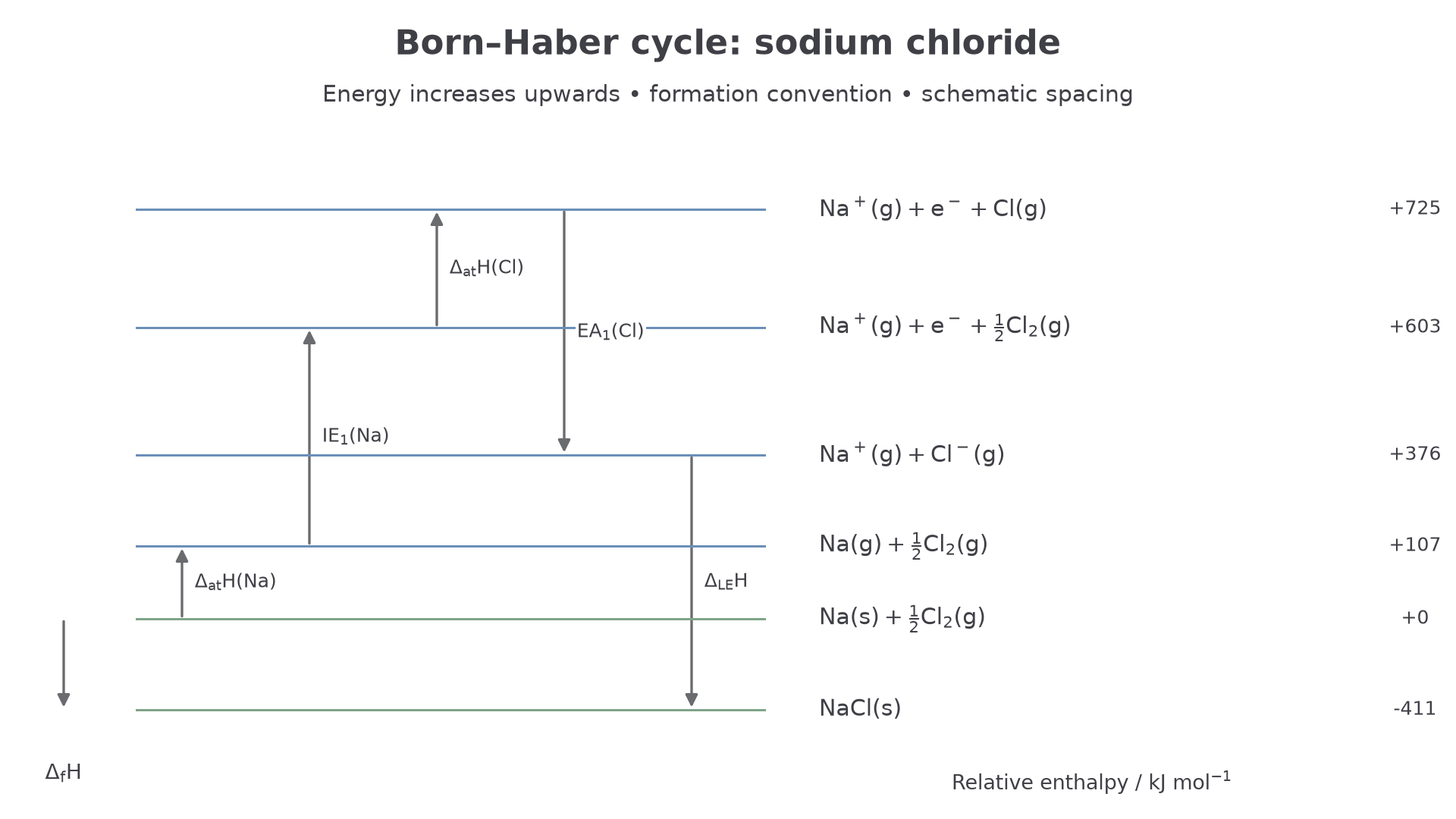
The cycle has a simple sequence:
- Formation route: .
- Atomise sodium: .
- Ionise sodium: .
- Atomise chlorine: .
- Add the electron to chlorine: .
- Form the lattice: .
This gives the conservation-of-energy equation:
\(\ce{NaCl}\) Born-Haber relationship
Every term is per mole of formed. That is why the formation equation uses half a mole of chlorine molecules: 1 of contains 1 of chloride ions, so the cycle needs 1 of chlorine atoms.
Continue this lesson.
You’re previewing NovaLearn without an account. Create a free account to read the rest.
Create free account